
DVD Review: Whiplash – A Conversation With My Father

My wife and I recently watched the award winning Whiplash.Whiplash It is a phenomenal movie and stirred something in me. I found at times that I was holding my breath and my heart was racing. I watched a few scenes over again and had the same effect (you can watch one of my favorite scenes at the end of this review). If you’re going to watch it, though, know that the language is raw and graphic – clearly a reason the movie is rated-R. After making a comment about the movie on social media, my dad, Paul Linzey, mentioned that he and my mom had also recently watched it. Then I had a great idea: Why don’t I co-write a review with my dad, looking at some of the themes of the movie from a biblical perspective? So today’s review is actually from an ongoing email conversation he and I have been having over the past couple days. I’ve enjoyed it immensely and hope you find some value in it. 🙂
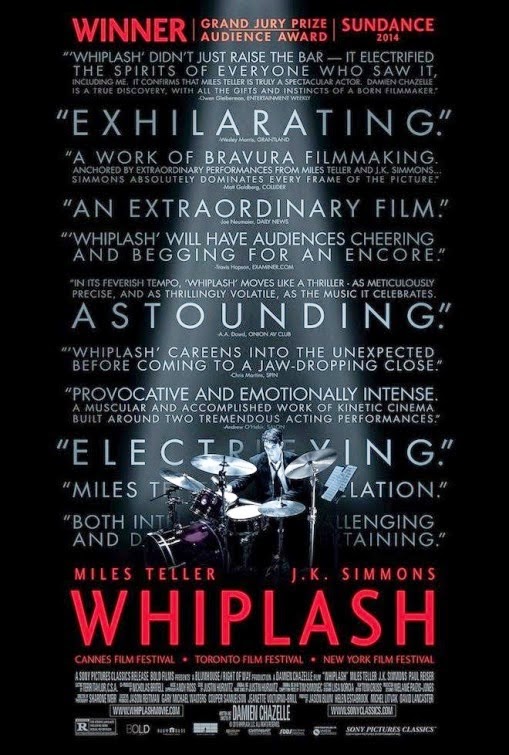
Chris: I’d like to kick off with the theme of relationships since I’m doing this with my you. There are three primary relationships I can identify in the movie:

– Andrew and his dad
– Andrew and his girlfriend
– Andrew and Fletcher

I think it’s pretty clear that Andrew’s relationship with Fletcher overrides the others. Here’s what I find interesting, though. While the girlfriend moves on and finds someone else, the dad is constant throughout Andrew’s ups and downs. They go to movies together. Dad stocks Andrew’s apartment with snacks. When the lawyer is trying to convince Andrew to testify against Fletcher, Andrew asks his dad, “Why are you here?” Dad’s response? “Don’t you know there’s nothing in the world I love more than you?” Even when Andrew returns to play with Fletcher for JVC after both had been kicked out of the conservatory, his dad was at the performance and ran backstage to hug the son in his most embarrassing moment. I’m very much reminded of the father in the Prodigal Son story. No matter what the son did, the dad is still there to throw his arms around his son and proclaim his love.

Paul: Yeah, the relationships are a powerful part of the story. And at times they’re pretty painful. Like in the scene at the family dinner table. It’s obvious the whole family is so proud of the football star and totally unimpressed with Andrew’s musical ambitions. You can feel his pain and anger when he points out that the football player is merely at a Division III college. In other words, it’s not worth bragging about. But nobody gets it, and Andrew is still considered the oddball whose goals and values are meaningless. But you’re right about the dad’s loyalty. Even though he didn’t understand his son, he was always there, like you pointed out. There’s a verse in the Bible that says

“Train a child in the way he should go, and when he grows up he will not stray from it.”

Some commentators point out that the terminology in the text is farm language, agricultural terms, specifically having to do with shaping and growing trees. If this is so, they believe the point of the verse is that good parents will find out their child’s interests, callings, and personality and adjust their parenting methods to bring out the best in the child – to help the child discover his or her direction in life. It’s not telling parents to make sure they raise the child the way they want the child to turn out. There’s more to parenting than that. It’s an art. It requires diligence, attention, getting to know the child intimately. It calls for relationship patterns that allow the child to explore and experiment. And the wise parent guides the child in the process of becoming. I didn’t see Andrew’s family fostering this kind of emotional-psychological freedom to be. We typically use that verse to tell parents how to raise their kids, and to tell our kids what we want them to do. Very controlling, very heavy-handed, very condescending. But maybe it was actually designed to liberate parents and liberate children, freeing all of us to discern what the Lord might want us to do, and to become. And then support each other in that process.

Chris: Let’s talk for a second about Andrew’s intense desire to be the best. In one scene, he tells his girlfriend, “I want to be great.” She responds, “You’re not great?” He comes back, “I want to be one of THE greats.”

Paul: Why are people who excel in almost any field edgy, quirky, OK — weird? Do we have to be so intensely focused and driven in order to be the best? Is it even possible to be “normal” and still be the best in the world at something? It’s true that in order to succeed, we have to make sacrifices. We have to prioritize. But is there a limit to how far we should go?

Chris: I was really pondering this one. I had a friend some years back who thought that all competition was contrary to Christ-like behavior. I’m not inclined to go that far, but I see his point. When you hear Jesus using expressions like “servant of all,” “the last shall be first,” and “the least of these,” it’s easy to see that Jesus has a heart for the underdog. The question is, “How far do Jesus’s teachings call us to care for the underdog vs. how far do Jesus’s teachings call us to BE the underdog?” I’m don’t think Jesus is calling us to eschew success, but there needs to be a healthy balance between success and humility, and my personal opinion is that such humility prevents us from ever achieving the status as “best in the world.”

Paul: It seems clear biblically that the Church will be the underdog societally, especially as we move towards the Eschaton. It’s also true, if I understand James 1:27 correctly, that we are called to care for the underdog. And it is true that we are called to be servants of all. However, that doesn’t necessarily mean we are called to be underdogs, impoverished, or less than the best in our chosen vocation. To follow that logic, each of us would need to be orphaned and widowed to truly be Christian. But that is clearly not the case. Jesus told at least one person that he would need to sell all his possessions and give to the poor, but there were quite a few other rich people he did not tell that to. In fact, there were some wealthy folks who supported him and his disciples so they could do the work of the Kingdom. Same with Paul and his ministry team. I don’t think humility per se is contrary to being the best. Many would agree that Moses would be considered one of the greatest leaders of all time. Yet Numbers 12:3 specifically says he was the most humble man in all the earth. I think you and I would agree that Jesus was the greatest person of all time. Yet, he was humble, according to Philippians chapter 2. And St. Paul was a pretty impressive apostle. Perhaps the best? Yet he displayed some impressive humility. Perhaps understanding of the word “meek” can be helpful here: “Power or greatness under control.” So I don’t believe that humility ought to prevent a Christian from being the best at what he or she hopes to achieve in life, whether as a musician, an athlete, a teacher, a pastor, a plumber, or anything else. In fact, the Bible says,

“Whatever your hand finds to do, do it with all your might.”

Don’t we usually understand that to mean “do your best”?

Chris: I don’t think humility NECESSARILY prevents us from greatness, only when pursuing greatness requires trampling on others.

Paul: Absolutely. I agree. And this is what we see happening in Whiplash. People trampling all over each other. Dog eat dog. Get mine. do what it takes to self-promote. I guess you could say Osteen’s teaching applied to the music industry. It’s all about you.

Chris: BWAHAHAHA! Joel Osteen applied to the music industry – now that.is.funny. Making sure that “I get mine” regardless of how it affects others flies right in the face of biblical principles:

Whatever you want men to do to you, do also to them (The Golden Rule) Matthew 7:12

and

Let nothing be done through selfish ambition or conceit, but in lowliness of mind let each esteem others better than himself. Let each of you look out not only for his own interests, but also for the interests of others. (Philippians 2:3-4)

Switching gears again, how did you guys respond to the language? It was incredibly harsh.

Paul: The profanity was indeed overwhelming. But we knew going in that the main reason for it’s R rating was raw language. More importantly, however, being in the world means we rub elbows with real people, real heathens, real scoundrels. We’re called to be in the world, though not “of” the world. Jesus didn’t avoid sinners. That included prostitutes, tax collectors, and cussers. Besides, there’s not a single word or phrase in the movie that I haven’t heard in the Army . . . . . . . or in the church! An aspect of human existence that I thought the movie showed pretty well was that every one of us has our own pain, our own problems, and our disillusionments. This was true of just about every character in the show. Would you comment on that?

Chris: You hit the nail on the head. The director has even said he approaches life from a dark place and I think the characters reflected that. But each gets so caught up in his own trouble he fails to find the relief that can be found in community. It’s the attitude that greatness only comes through suffering and, while there may be some truth to that, authentic relationships can help heal wounds.

Paul: And that’s where art and the gospel begin to intersect.

Chris: Thanks, Dad.

_ _ _ _ _ _ _
As always I welcome your thoughts and opinions. did you see the movie? What did you think?


Paul Linzey is a pastor, writer, and mentor. A retired Army chaplain, he and his wife live in Lakeland, Florida.
Chris Linzey is a husband, dad, pastor, and writer. Currently an Army Reserve Chaplain, he and his family Illinois.
Chris Linzey is a husband, dad, pastor, and writer. Currently an Army Reserve Chaplain, he and his family live in Illinois.

Help Me Buy an Orphanage

Okay, not really “buy” an orphanage, but for only $8 we can do something REALLY cool and make a significant impact in kids’ lives – here, check out the story…

Scorziell 1Jeff and Tammy were missionaries to Africa from 1984 to 1989. Moving back to the U.S., they lived, worked, and raised their family. They planted a church in Orange County, California, which is where my wife and I met them. I joined the pastoral staff in 2004. Jeff and Tammy are some of the best people I know. Their love for Jesus and their heart for people is incredibly authentic – there is nothing false or pretentious about them. In the six years I spent in ministry with them, they and their daughters and sons-in-law became like family to us.

Then, in 2011, they were asked to pastor the Bulawayo Baptist Church in Zimbabwe. The pastor was retiring and some friends of theirs submitted their names and they got the job. They sold everything and immigrated to Zimbabwe. Talk about a leap of faith!

Zimbabwe is in Southern Africa. It is one of the five poorest countries in the world, has one of the highest AIDS problems on the continent.Zimbabwe The average life expectancy is only 37 years and almost 10% of the population is orphaned. It is a country that desperately needs help.

Tammy says:

“One of my cousins said to me shortly before I left for Zimbabwe, ‘Tammy, I can only imagine all the prayers that went up to God by the dying parents asking Him to watch over their children and I think He is sending you there in answer to their prayers.’ That statement is what motivates me to do all that is in my power and ability by God’s AMAZING GRACE to help support these children any way I can.”

Tammy immediately began going to the orphanages in Bulawayo telling Bible Stories and doing Jana Alayra worship with them. As she began making relationships, two orphanages obtained property in September 2012 and they offered it to her, a 50+ California girl who never farmed a day in her life, to help them use the land to become self-sustainable.
Scorziell 3

Thus was born “Fruitful Harvest,” a ministry with the mission of creating “Zimbabwean Products Helping Zimbabwean Children.”Scorziell 4

One of the Properties belongs to the Sandra Jones Centre. This is a home with over 70 sexually abused, abandoned, and orphaned children. Many of the young girls are between 11 and 17 years old. Most of them are victims of rape and incest and are pregnant. Many are also uneducated. Debbie Brennocks, the founder and director of the Centre, and Tammy took another leap of faith and applied for a grant that would help teach these girls a skill to help them support themselves and their baby (if they chose to keep them). It was approved and they now teach the girls gardening skills and how to raise chickens.Scorziell 5

Currently they are raising 1000 chickens every 9 weeks and sell the chickens to the community. They raised three batches last year and because of the generous help from a local chicken farmer they are able to generate a profit of $4,500 a batch – and the girls are learning a trade in the process.

The goal for 2015 is to raise six batches and, if all goes well, they are poised to raise $27,000 for the Centre. This is very exciting but it costs us $18,000 a month to run the centre plus they still owe $250,000  for the remaining payment of the property (they have paid $300,000 to date).

The other property belongs to an orphanage called Harvest Family Village. Jenny Hensman, the founder and director of this orphanage, has taken in AIDS orphans as well as the costly and difficult to care for handicapped children. The handicapped child is often the most poorly cared for of all orphans.

At this orphanage, Tammy began with 500 Rhode Island Red chicks to help them generate income from selling of eggs. The first hen house was built using scraps found around the property. Scorziell 7They raised funds to secure the fencing against wild dogs and other animals that could harm the birds. They are now making plans to expand and raise our next batch of 1000 hens which could add an additional $1250 per month.Scorziell 8

There is no government support for these children. The orphanages feed, clothe, educate, pay medical bills, etc. for the children all by faith and the help from others God leads to them.

I’ll be honest – this is the most ambitious ministry fundraiser I’ve ever tried. But I’m not asking you to buy me a gulfstream jet. I’m asking you to help pay for an orphanage. It would be incredible if we, the worldwide Church, could fund this ministry. The most “viral” blog post I’ve ever written was viewed 35,000 times. And that had no greater significance on people’s lives. Here we have an opportunity to make a HUGE impact in the lives of children. If this post were seen by 35,000 people it would only take those people making a ONE-TIME contribution of $8.00 to fully pay-off the Sandra Jones Centre property.

Please consider how you can help these children and this ministry.Scorziell 2 Whatever you donate through our GoFundMe campaign goes right to Fruitful Harvest Ministries and missionaries Jeff and Tammy Scorziell. The Church Plant does not hold on to any of it.

Click on the button to go to our fundraising campaign:

If you have any questions you can contact us through The Church Plant or see the Fruitful Harvest Ministries website.

God bless you all.

Chris Linzey

_ _ _ _ _ _ _ _ _ _
Please share this post on Facebook, Twitter, and Email. Even if you can’t donate, you can help spread the word and be praying for the ministry to Zimbabwe!

DVD Review: I, Frankenstein

Now available on DVD (or streaming on Netflix) is the 2014 film I, Frankenstein. I, FrankensteinThe IMDB user reviews give this movie 5.2 stars out of 10. I was surprised, because the movie’s premise is the eternal struggle between gargoyles and demons, and who doesn’t love storylines like that?!?

Honestly, I thought 5.2 stars was generous. The movie was everything I expected it to be. For some reason, I enjoy watching cheesy apocalyptic movies showcasing the forces of good vs. the forces of evil. Since I was expecting a terrifically terrible movie, I was not disappointed!

– Affected acting.
– Poor writing.
– Ridiculous plot lines.

It’s everything you’d see in an MST3K movie. MST3K

Here are the basics of the movie:
– Demons exist and are trying to take over the world
– God created the order of the gargoyles to fight off the demons
– Frankenstein’s monster (named Adam in the movie) is a soulless, ageless creature roaming Earth for hundreds of years.
– The demons realize that the soulless Adam is the key to possessing the dead and bringing legions of demons to Earth to finally conquer everyone.
– Adam and the gargoyles fight off the demon horde.

Enough about the film-making elements – let’s talk about the film from a biblical perspective.

I’m always amused by these kinds of films because there is a segment of humanity that is greatly fascinated with the idea of angels and demons (true, the gargoyles aren’t exactly angels, but they’re supposed to fill the role of some kind of angelic protector-figure). The demons are your traditional Hollywood demons Demon Prince – they growl a lot and when they are dispatched go out with a burst of fire.

But there’s nothing quite like that in the Bible. In fact, the biblical accounts of demons never show us a visual image. The horned-headed, spikey-tailed, pitchfork-wielding demon of the screen is not biblical. The biblical image of possessed people is always of the human. While demons cause people to cut themselves and behave like lunatics, we never get to SEE them. When Jesus talks to demons, it is always through the voice of the possessed person.

So why our fascination with demons and angels?

I believe it’s because there is something in us that recognizes the reality of the spiritual realm even though the Western world denies it. In biblical studies and missiology (the study of missions) we talk a lot about worldview and how we perceive reality. The reality of the Western world tends to be one of rational thought. Angels, demons, and spiritual things are relegated to the heaven and hell but have little to do with human reality. It can be represented in this graphic of the “excluded middle.” The Excluded Middle

But there is no exclusion in the Bible. The spiritual world interacts with the human world. And Jesus takes dominion over it – in a powerful and final way. There is no power that counters God. The Bible is not about cosmic dualism, yin and yang. While there are evil forces, they are not equal to God’s good. God is superior and none can compare.

But we love to make movies about spiritual forces fighting tremendous battles for humanity. It can be disturbing to realize that the Bible DOES talk about demonic interaction with humanity. And the Bible never says that demons went away once the New Testament was completed. Yet the truth remains that God has fought the battle for us. Jesus conquered death, and because of his sacrifice we are assured of our final destination – the presence of God.

There is no power that rivals God’s.

So take movies like this for what they are: complete fiction.

And poorly done fiction at that.

_ _ _ _ _ _
If this post resonates with you in any way, please share it on Facebook, Twitter, or email!

DVD Review: Noah

Noah

Last night my wife and I finally caved and watched Noah. I had heard a lot about it from Christian and secular sources, but wanted to see it with my own eyes. So here’s the BLUF (Bottom Line Up Front): This is quite possibly one of the worst movies of all time.

I mean all time.

As in the entire history of the world.

It’s that bad.

Remember how bad Waterworld was?

Noah was worse. At least Waterworld knew it was campy, with the “Smokers,” “jet skis,” and hilarious performance from Dennis Hopper. In fact, the best “end of the world” films always have that campy element.

But Noah seemed to think that it was a serious film, and that was a big blunder.

The biggest problem of the film was that it was confused. The writer/director claimed he wasn’t trying to make a biblical story on film – he simply used the Noah narrative as a foundation for his sci-fi/fantasy movie. This is where the confusion came in.

The story of Noah RELIES on the audience having prior knowledge of the biblical narrative. Without prior knowledge, the movie becomes completely disjointed and bizarre.

What’s with the snake?
What’s with the rainbow shockwaves in the sky?

Viewers familiar with the Old Testament will understand, but a secular audience misses these cues without prior knowledge. Therein lies the problem.

The writer/director needs prior knowledge for his story to work, yet he makes the mistake of deviating from the original story. I’m not just talking about taking artistic license with telling the story. This movie goes WAY beyond artistic license. I’m talking about adding elements that simply never existed.

– the villain who hacks a hole in the side of the ark and escapes the flood
– the strong vegetarian vibe (the animals are the only innocent ones) when the Bible CLEARLY says that God gives animals to humanity to eat
– the exclusion of Ham and Japheth’s wives when the Bible CLEARLY says that they were on the ark
– Noah wrestling with annihilating his family for God (because all humanity is evil) when the Bible says God chose to spare Noah and his family because Noah was righteous

See what I mean? The writer/director needs the biblical narrative to make sense of his story. The writer/director blatantly disregards the biblical narrative. The film is schizophrenic from the get go.

This doesn’t even begin to address the anachronistic elements like medieval knights and Old Navy wardrobe choices, fallen angel rock monsters that can be sent back to heaven with a hot spear, and Noah’s wife creating the first EPT (I wish this were a joke but, alas, it is not). EPT

As my wife said about two-thirds of the way into the movie:

This.is.odd.

Yup, that was an understatement, sweetheart.

If you care about the biblical narrative, you won’t want to see this movie. If you care about decent cinema and the art of filmmaking, you won’t want to see this movie.

Noah is a total dog.

Woof.

_ _ _ _ _ _
If this post resonates with you in any way, please share it on Facebook, Twitter, or email!

Off With Her Head! A Biblical Response to the Death Penalty

Queen of Hearts

The Queen of Hearts is quite a memorable character in literature. She’s prone to rage and has one punishment for any offense: death.

The death penalty is again being hotly debated due to the pending execution of death row inmate Kelly Gissendaner. Gissendaner was found guilty of plotting her husband’s murder. While incarcerated, her supporters state Gissendaner has turned her life around and is a pastoral presence in the prison. They are seeking clemency.

Christians, meanwhile, are back to debating the merit and justification of the death penalty. Let’s note from the outset that there is no monolithic Christian perspective on this issue. Some adamantly believe the death penalty is wrong while others (just as adamantly) proclaim that the death penalty is biblically justified.

One’s position on the death penalty is not an indicator of piety or faithful Christian discipleship.

I looking at the issue from a biblical perspective we run into a big problem: the Bible is not a guide for running a democratic republic. Let’s break it down a bit.

The Old Testament

Death penalty proponents point to passages in the Old Testament that call for death as the penalty for certain offenses. It’s true – we can’t deny that the Law did indeed embrace for the death penalty. Just a couple quick examples:

He who strikes a man so that he dies shall surely be put to death. (Exodus 21:12)

If a man acts with premeditation against his neighbor, to kill him by treachery, you shall take him from my altar, that he may die. (Exodus 21:14)

But here’s the thing – the Old Testament was designed to govern the ancient theocracy that was Israel. It was not a political guide for all time. We cannot say, “The Old Testament endorses the death penalty so we should as well.” It’s not that simple. We don’t live in that society and are not governed by those rules. The Old Testament might demonstrate principles that certain crimes are worthy of death, but we cannot bring in ancient theocratic law to rule a modern democratic republic.

The New Testament

In the New Testament we see a strange reversal – Jesus seems to take the understanding of Old Testament retribution and turn it on its head. One of the most striking examples is John 8, where a woman who, by Old Testament law, deserved death, receives a pardon from Jesus. Grace and forgiveness take the place of judgment and condemnation.

But the New Testament makes no claim to represent political power – in fact, quite the opposite. The New Testament tells believers how to behave on a personal level no matter what the government might do. The New Testament does not address how to run a government. The whole penal system, while necessary to an ordered and civilized society, is never really addressed in the New Testament (although the NT does reference authorities being put in place by God to punish evil-doers).

So where does that leave us? We can see principles for righteous judgment and punishment. We can see principles for forgiveness and leniency. But we have to be honest and say that there is no direct guidance for how to run a penal system in a democratic republic.

That being said, we need to approach the topic with sensitivity to how God leads and directs us without belittling people who disagree. Good Christians might favor the death penalty. Equally good Christians might oppose it. And some Christians might vacillate between the two positions in the course of their lives.

Life is more complicated than simple black and white dichotomies.

_ _ _ _ _ _ _
How about you – do you or don’t you support the death penalty? What is your reasoning for your position?

I welcome all discussion, just keep it civil and polite. If this post resonates with you in any way, please share it on Facebook, Twitter, or email!