If you give money to God, He’ll give money to you. NOT so we can get rich, but so that we can live generous lives & be a blessing to others!
Boy that sure makes us feel good, doesn’t it?
It’s a promise of getting money (which we all love) and it comes our way when we first give money to God.
Here’s the kicker – the part that makes us feel better about the whole exchange is that the money that God gives us needs to be used to bless others.
Everyone got that?
Give money to God. God gives money to you. Go and bless others with what God has given you in return.
Here’s the thing. IT’S GARBAGE! TOTAL BALONEY!
Boy, this really got me steamed up today.
There’s no equation by which we can coerce God into giving us cash. Moolah. Greenbacks.
I know plenty of righteous poor people who give to God and never get money in return. God’s not a bank paying you interest on your investment.
Telling people that if they give then God will give back is ludicrous.
“But Pastor, what about the poor woman who gave her last two coins?”
What about her?
That’s a great story, but the point is not, “Give to God and he’s gonna give you more in return.” There is no Heavenly CashBack Plan. The point of the widow giving is about the heart of the giver.
Jesus says, “So what if you give a little out of your abundance? Look at this poor woman who gave a lot out of her poverty!” Her heart was in the right place – not because she wanted God to return her money ten-fold, but because she prioritized giving to God above everything else. She gave until she had nothing left to give.
What a heart.
I’m not there. I haven’t met a whole lot of people who are. But shouldn’t that be our goal? Can we grow and mature and get to the point that we’re willing to commit to God 100% of everything we have and everything we are?
Jesus said, “The poor you will have with you always.” There’s not divine get-rich plan. Giving to God may get you no earthly reward. Don’t believe anyone who tells you differently.
At the same time, when we cultivate generous hearts then we reap unseen rewards. We may never experience them in this lifetime – but that’s not the point.
So examine your heart and your motivations for giving.
Help me out here – finish this expression: “Those who do not learn from history…”
Those who do not learn from history are doomed to repeat it? It means that the wise person sees what others have done and decides not to go the same route or make the same mistakes. The person who can look back and learn from the past has a better chance of making better decisions tomorrow. And if you don’t learn from the past, you will keep making the same mistakes over and over and over again!
There are times that we have seen our political and military leaders behaving this way ~ not learning from the mistakes of others, trying the same thing other people tried but expecting different outcomes. Back in the 1950’s the French had a little problem with a country in Southeast Asia called Vietnam. They could not get the locals in line and they could not overcome the native guerillas. 10 years later America goes marching in thinking we can do better. We did not really learn from the French mistakes. We made some of the exact same mistakes – mistakes that cost people their lives. It was complete idiocy.
There are also personal moments of idiocy. God gave me a wife to help keep track of all of the moments I act like an idiot. If we don’t learn from what happened in the past then we’re going to be doing the same stupid things people before us did. If we don’t learn from the past then we’re going to making the same bad choices we’ve always made.
In the OT you have the law, you have the prophets, you have wisdom and poetry writing, and then you have books like Joshua, Judges, Ruth, Esther, Kings, and Chronicles. These books are usually referred to as the histories. Part of what the histories are there for is to provide an example of how to and how not to live. This is especially true in the book of Judges. In Judges, everything in Israel turns on its commitment to Yahweh and living life according to Yahweh’s ethics.
Yahweh’s ethics? What the heck are those? That phrase refers to living life the way God wants his people to live. Are you worshiping God only, or are there other things influencing your spirituality? Are you taking care of people who need assistance; the widows, the orphans, showing hospitality to strangers or to the poor? You see, part of being one of God’s people is a directive to look outside ourselves and to take care of others. Finally, participating in a Yahwistic ethic means asking, “Are you maintaining a high standard of personal integrity?”
By the times of the judges, Israel has been failing miserably at right living! The book of Judges is a sad book that highlights the decline of the nation because they have turned their backs on their true king – Yahweh. The end of Judges (17:6) sums up perfectly the state of decline:
In those days there was no king in Israel; every man did that which was right in his own eyes.
Look at Jephthah. He’s an interesting guy, who has had the deck stacked against him from the very start. Have you ever felt that people or life (or even God) has something against you and that you can’t get a leg up no matter what you do? Have you been in a situation that doesn’t go your way and, even though it’s not your fault, there’s nothing you can do?
Jephthah is the firstborn son of a childless man. The only problem is that his mother was a prostitute. So later on, when his father has other sons from his legitimate wife, the legitimate sons give Jephthah the boot, telling him, “No half-breed is going to share in our inheritance. You’re not a full part of this family. Get out of here!” That’s painful stuff, being rejected by family, forced to live as an outsider. But what man rejects, God can use!
So Jephthah bolts; he heads for the hills. God has a funny way of preparing Jephthah for use, though. While he is away, he draws all sorts of worthless scallywags to him and they become land pirates. They raid other towns and form a band of pirates and thieves. It like Sons of Anarchy: Bible Edition.
Meanwhile, back at the ranch…Israel has turned away from God and served everything else under the sun except God. Isn’t that the way we are? We also go through cycles of drawing close to God. Then we slip and go through a period of drifting away. We have our own sin cycles, and we need to recognize when we’re in one so we can call out to God and say, “Hey, I need your help!” This time, though, God looks at the Israelites and says, “Okay, have it your way. I’m done with you.” And the Philistines and Ammonites invade and rule in Israel for almost 2 decades.
The people finally have enough and say, “God, we made a mistake. We should never have left you! We have sinned against you.” And God says, “When other people attacked you, didn’t I rescue you? Haven’t I always come to your aid? Haven’t I always been there for you? But you turn away from me and ignore me. You act as though I haven’t been here for you. So go ask your other gods to rescue you now. Let them get you out of the mess you’re in.” And Israel says again, “We have sinned. Do with us what you think fit, just rescue us today!” And take a look at 10:16
He couldn’t stand their griping any more.
We so often have an image of God as a loving father who is patient and quick to welcome us back with open arms. Well, that is one aspect of God’s character. But it is not the only aspect. God gets frustrated and angry when believers continually do dumb things when they should know better!
Those of you who have kids or spent any time with kids, has their behavior ever aggravated you? Angered you? Frustrated you? Do you love your kids any less when they behave like that? No, but that doesn’t take away the aggravation. This is the image we see of God in this story. The idiotic behavior of believers makes God say, “You know what…? Deal with it. I am not going to do this right now.” This really isn’t something new. People doing stupid things and turning away from God when they KNOW what they should be doing seems to get on God’s nerves.
The same thing happened in Exodus 33:3. This is right after the “Golden Calf Incident of ’76.” Oh, yeah, remember that? God’s people have grown inpatient waiting for God and Moses so they make their own sacred cow. This is right when God is about to send Israel into the Promised Land. God has enough and says this: “Go on to the land where milk and honey flow. I shall not go with you myself—you are a headstrong people—or I might exterminate you on the way.”
Clearly God gets frustrated by human behavior, and every once in a while he has to say, “I’m out. I won’t be part of this.” On the surface God’s behavior can seem harsh, even indecisive. I’m here, I’m not. I’m here, I’m not. But I don’t think God is being too harsh. I think he’s being realistic. Often times we won’t get in gear until we risk losing something dear and important to us. You know what I’m talking about. You know there are areas of your life that you refuse to change and will never change until you’re faced with a big enough consequence. And then see how fast you can change! This was the Israelites. God said, “I don’t want to deal with this – how many times do I need to come to your rescue?” So they toss out all of the idols and vow to serve God only – then comes the hunt for the savior/warrior.
And someone says, “Hey remember our half-brother we told to take a hike? He’s become a pretty successful commander leading raids. He’d probably be a good choice to lead our people into a fight against the Ammonites!” And they go and they ask Jephthah, “Jeph, please come be our military commander!” You’ve seen how nice people are when they want something from you? But don’t go pointing fingers too quickly. We’re all like that sometimes.
We’re always nice to people when we want something from them – we treat God the same way!
When you need something from God, what kind of reacquainting dance do you do? “Hey, God, I know it’s been a while, but if you could see fit to help out….”
Jephthah’s own family treats him this way calls them on it. “Aren’t you the guys who hated me and kicked me out? Why come to me when you are in trouble?” And they say, “But we are in trouble, that’s why we come to you now. Look, come fight for us. Be our military commander and also be the leader of the tribe.” You see, they’re getting desperate. They need help so they keep offering more and more in an attempt to win Jephthah over. And Jephthah says, “Lemme get this straight. I’ll come fight for you, AND you’ll restore my position within the tribe? I’ll be the head honcho?” And they say, “Yup, that’s what we’re asking.” So they shake hands and it’s a done deal.
Every scene of the story so far is an exercise in negotiation. The Israelites try to negotiate with God. The tribe leaders negotiate with Jephthah. Now it’s Jephthah’s turn as he takes the lead as commander of the clan. He tries to negotiate with the king of the Ammonites. He sends a message saying, “Friend! There should be no trouble between us. In fact, there should be peace. How about you go your way with what your god has given you, and we’ll go our way with what Yahweh has given us?” But the king of the Ammonites doesn’t pay any attention to the message. And the spirit of the Lord comes upon Jephthah as he prepares for battle, but the man cannot stop negotiating. He once again tries negotiating with God.
“If you give me victory over the Ammonites, then the first person to meet me from the door of my house when I return from battle will belong to Yahweh, and I will offer him up as a burnt offering.” He’s trying to bribe God! “God, give this to me and in return I’ll give you….” How many times have we seen this in movies or television. It’s become a joke to the secular world. Someone is on hard times and turns to God saying, “If you get me out of this I promise I’ll…” but help arrives in the middle or at the end of the prayer and they quickly turn to heaven and say, “Um…never mind.” Why do we think we can bribe God?
Can God be bought off? There is no price high ENOUGH to buy off my God. That’s good news for us, because when God says, “I’ll never leave you, I’ll never abandon you” it means that no enemy could get between God and us. It means no one can say, “God, if you turn your back on Tom, then I promise that I’ll give you such-and-such.”
God can’t be bought by you or anyone else.
Jephthah should have known that. But he thinks he needs to give God an appropriate offering for a personal victory, and his personal victory ends up as a very personal loss, for when he returns home victorious, the first person out of the door to greet him is his daughter, his only child. And he is torn up because he think that his vow to God requires him to sacrifice his child on the altar. It shows how little he REALLY knows God. His daughter also thinks that he is bound, and she attempts to protect her father’s honor. “Father, let me go mourn for two months, then do to me what you have promised God you would do.” And when she returns from mourning with her friends, he did with her as he had vowed. She had never married.
Think about this for a second. She is his only child. What is the significance of pointing out that she was a virgin and had never married? By making a stupid vow, by thinking he could buy off God, he ended up exterminating his own bloodline. Where is the honor in this? There is no honor here. Human sacrifice is a characteristic of foreign, pagan worship, not Yahweh worship. Israel has gone through cycles of turning away from God and turning towards other gods.
Have you ever noticed that when your start spending time around new friends that your vocabulary changes? You start using words and phrases that you’ve never used before. When we spend time away from God, we pick up habits and practices that are not characteristic of someone who is a true worshipper of God. For the Israelites, human sacrifice is not a characteristic of worshipping Yahweh. It is a pagan act of worship.
The story shows that Jephthah, Israel’s leader, sacrifices like a foreigner, even though the sacrifice of his daughter is offered to Yahweh. Israel’s return to God is incomplete, it isn’t total, because they are still acting like foreigners and attributing their behavior as worship to God.
We keep doing the same things we always do yet expect things to change because we are “worshiping God.” That’s insanity. That’s idiocy. It’s time to break with the old way of doing things and turn whole-heartedly towards God and his ways. This means in the way we sacrifice or worship. This means in the way we treat God and others. This means in our family relationships. This means at our jobs and with our friends.
It’s time to stop doing things the way we’ve always done them or doing things the way outsiders do them and start doing things the way God wants us to do them. Don’t act like outsiders act and think that you are a true worshiper of God! If we don’t do things differently, nothing will change. We will never go deeper. So take a minute. Pause before the Lord. Ask God to show you what you have allowed to remain in your life as a foreigner that does not fit the picture of a true worshipper of God.
Are we willing to focus on God alone and let everything else fall by the wayside?
Will we give up negotiating with God and simply life the life he wants us to live?
Image courtesy of Stuart Miles / FreeDigitalPhotos.net
Have you ever wondered which Bible version was the best version? If so you’re in the same boat with most Christians. When it comes down to it, people usually base their choice on two factors: 1) what they’ve been taught by their pastors and 2) what they’ve grown up with in their own Christian life. There is sometimes a third factor: readability. Sometimes people will choose a version based on how easy it is to read and/or understand.
Let’s talk honestly about the different versions and what they mean. Hopefully you’ll be able to choose wisely and with discernment for your own needs.
The first real difference between versions has to do with the original manuscripts. The Bible was not written in English but in Hebrew, Aramaic, and Greek. So any English translation is a secondary work. Most mainstream Evangelicals believe that the original manuscripts are what are inspired, not the various translations. That means that, while translations are different, no single translation is more anointed than any other.
It is important to note that among all of the differences between translations and the original texts they use (KJV uses some different manuscripts than the NIV, etc.) there are no real significant theological differences between any of them. That means we can have confidence that the Bible translation we are reading today is accurate to the Bible the early church was reading.
So then it comes down to a choice of personal preference. Let me walk you through some of the options and why they are the way they are.
There are three mindsets for translators working on a Bible:
1) Translating word for word as much as possible. This is called a literal or wooden translation. These translations would include the KJV, NASB, RSV, and ESV.
2) Trying to blend the literal wording with the actual meaning. This is called dynamic equivalence. These translations would include the NIV, HCSB, and (to a lesser degree) the NLT.
3) Trying to put the Bible into an easy to read version regardless of the original wording. This is called a paraphrase. An example of a paraphrase would be The Message. It is not actually a translation but rather loose approximation of meaning based off of other translations.
Most serious Bible students stay away from paraphrases. While they create an easy to read story, they place fast and loose with the actual text. Since we believe that the original text was inspired, I would rather not give an approximation. On the other hand, being too wooden becomes very burdensome to read and makes for difficult comprehension.
For this reason I prefer a version that is a dynamic equivalent – one that cares about the original text and seriously attempts to bridge the original text with a contemporary vocabulary and comprehension (like the NIV or HCSB). The problem with dynamic equivalent translations, though, is that the translation involves much more interpretation than a wooden translation. What I mean is this:
A wooden translation focuses more on getting the words translated accurately than on meaning. In order to get to underlying meaning, translators of dynamic equivalent versions have to make some educated guesses as to meaning, context, etc. This means that the translators’ personal theology or ideology has a greater chance of coming through in a dynamic equivalent version than a wooden translation. You may not like the woodenness of the ESV or NASB, but they are less likely to include the personal biases of the translators.
In the end, I always tell people that the best version is the one that they will actually pick up and read! No matter what your decision, I have confidence that you’re reading God’s Word to humanity. So find one that works for you – one that you can dig into and spend time with.
Happy reading!
Let your voice be heard: Which version is your “go to” version? Why?
Image courtesy of Grant Cochrane at FreeDigitalPhotos.net
Do you ever get sick of greedy, money grubbing churches always asking for your money? For some reason many people have the impression that churches are always asking people for money. Churches have reputation for being money hungry; for trying to squeeze every red cent out of the people who attend. Shoot – I would get tired of that kind of behavior!
In all honesty, though, churches probably ask for money a lot less than you think. I’m not talking about the weekly routine of collecting money. Different churches call it different things:
– Taking the collection
– Passing the plate
– Time for tithes and offerings
– What else have you heard?
Though this has become a standard feature in many evangelical churches it’s not quite the same thing as “asking for money.” It’s not like the Christian radio station that has a bi-annual fundraiser telethon. In the Christian worship service, giving becomes an extension of worship – something we do in recognition that what we have is a gift from God and through our giving we say, “I value God and his kingdom and want to express it through my finances.”
So giving becomes an act of worship (assigning worth to something) and a practical way of making sure the needs of the ministry are met.
I had a friend tell me the other day:
The church doesn’t need money. Jesus didn’t need money.
But the truth is that the church does need money. Ministry requires money. And yes, Jesus did need money. Jesus had a group of financial backers that helped make his ministry possible:
And the twelve were with him, and also some women who had been healed of evil spirits and infirmities: Mary, called Magdalene, from whom seven demons had gone out, and Joanna, the wife of Chuza, Herod’s household manager, and Susanna, and many others, who provided for them out of their means. (Luke 8:1-3)
Jesus and his staff were provided for out of the means (income) of these women.
Once the Apostle Paul was trying to raise money to do ministry to Christians in Jerusalem. He was collecting it from the Corinthian church:
On the first day of every week, each of you is to put something aside and store it up, as he may prosper, so that there will be no collecting when I come. And when I arrive, I will send those whom you accredit by letter to carry your gift to Jerusalem. (1 Corinthians 16:2-3)
There are many different financial needs for a church to do ministry. Some are related to physical location: rent/lease/mortgage, utilities, salaries, etc. Some are material needs for people: rent assistance, utilities assistance, food/clothing aid. Some are for spiritual ministries: materials for communion, children’s church, Bible studies, etc.
Ministry requires finances. And how will people in the church ever know about the need unless the church tells them? It’s plain logic, really. It’s not about being money-hungry, it’s about letting people in the church know that, in order to do what God has called the Church to do, it’s going to take some backing.
If you don’t want to give, no one is twisting your arm.
Paul says:
The point is this…each one must give as he has decided in his heart, not reluctantly or under compulsion, for God loves a cheerful giver. And God is able to make all grace abound to you, so that having sufficiency in all things at all times, you may abound in every good work. (2 Corinthians 9:6-9)
To honor God and to participate in what he wants to do through my church my wife and I give. But that’s between us and God. Your giving is between you and God.
Whatever you decide to do, do it with joy for God, not for anyone else.
BE HEARD! How have you seen churches handle money well? How have you seen them handle money poorly?
So there’s a minor kerfuffle going on with Megyn Kelly of Fox News. The other night she was talking about an author who wanted to do away with the idea of a white Santa. Ms. Kelly found the idea to be ludicrous and insisted that there are some people whose ethnicity you cannot touch. Jesus, for example, was a white guy – you can’t change what it is.
Here it is…
Now, here’s the thing. There have been a lot of people making fun of Ms. Kelly. I’ve even cracked a few jokes like:
Of COURSE Jesus was white. Who on earth would want to worship a middle eastern Jew?
Please understand that the previous sentence is a joke – I’m not serious. The simple fact of the matter is that Jesus was a middle eastern Jew. There’s a good chance he looked like a lot of cab drivers in New York.
In the midst of the discussion about Ms. Kelly’s goof there have been some accusations of racism. We need to be careful about the words we use, because I don’t think racism is at play here.
Racism is treating people as inferior because of their race.
What happened on Fox News the other night was not about inferiority. It wasn’t racism. It was racial bias but not racism. And racial bias is normal. It is a normal human trait to imagine stories from our own perspectives. When we read our imaginations usually make the characters look like us. Even when the author is clear about a character’s description we will often overlook that description in our heads.
There were many fans of The Hunger Games who were upset when the character Rue was cast as a little black girl. They failed to recognize the description the author provided and filled in their own gaps from their own perspectives….
The story of Jesus is no different. We don’t have any photos of the man, so we are left to use our imaginations to see him. Left to ourselves, we fill in the blank spots from our own experiences, culture, and background.
Megyn Kelly wasn’t being racist. Ignorant, sure, but not racist (and honestly, it’s hard not to see Jesus as white when the majority of sacred art we’re exposed to is European…).
One of my most prized possessions is a book called “The Life of Jesus” (1978, Buechner and Boltin). I don’t think it’s in print any more, but you can get it used on Amazon.
It’s the story of Jesus combined with sacred art from around the world. Let me show you some famous art of Jesus…
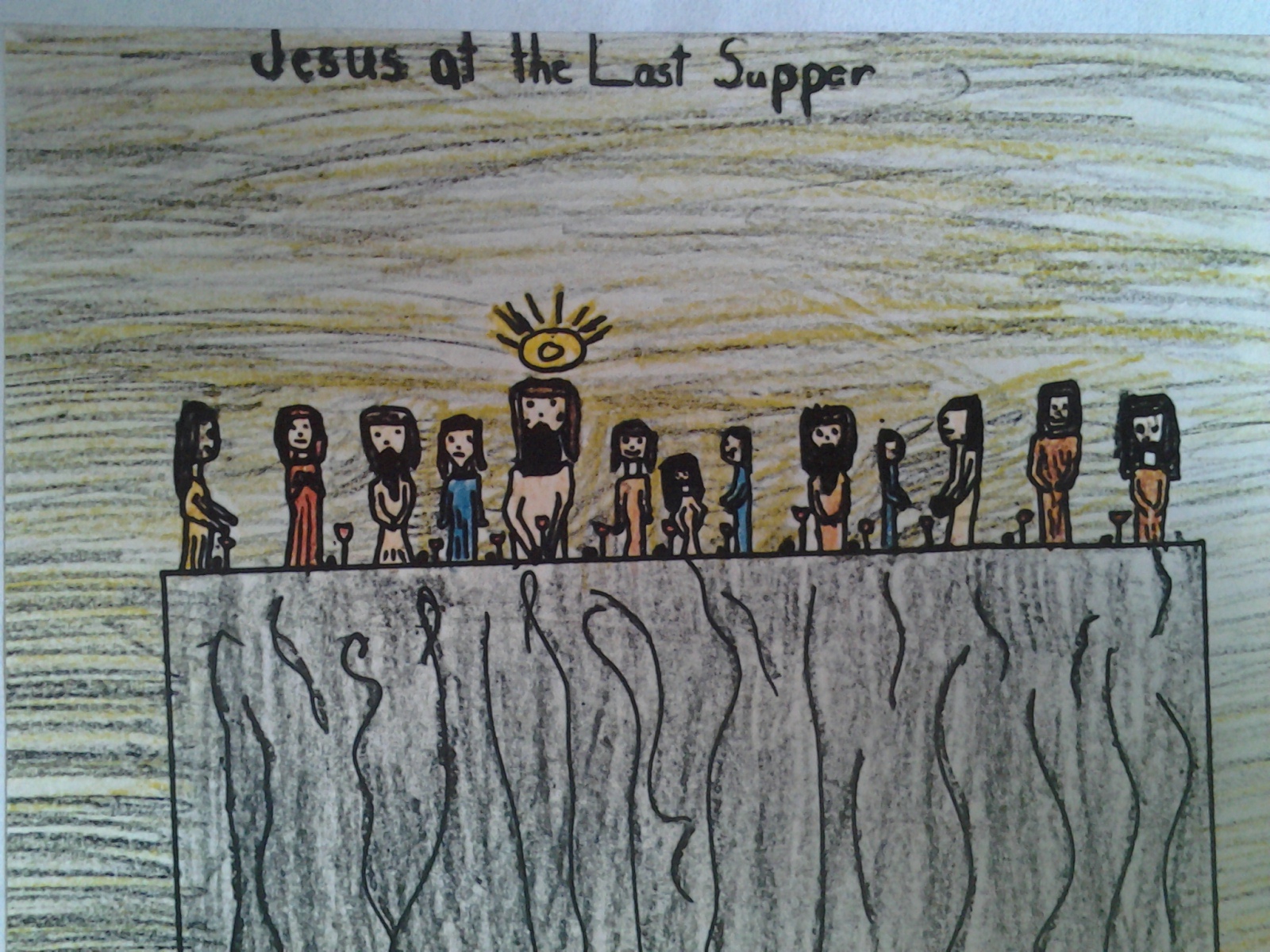
Christ Crowned with Thorns. Wood. Philippines, 20th CenturyVirgin and Child. Oil on Canvas. Uruguay, 20th Century.The Last Supper. Crayon on Paper. U.S.A., Contemporary.Mother of Divine Grace. Textile. Japan, Contemporary.Crucifixion. Bronze. Italy, 1933.Adoration of the Magi. Rome, circa 200.The Holy Family. Painting on Silk. Japan, 20th Century.
We all tend to fashion the Bible from our own background. Is it wrong to see Jesus as a white guy? As Japanese? As African? Historically, sure – he was a middle eastern Jew. But the whole point of the Incarnation is that Christ is WITH us. God is not far away and removed – He is one of us. So the God who left heaven to be like me might look like me. What other god ever bothered to become like us?
The mystery and magnificence of YAHWEH is the Incarnation. His name is Emmanuel, which means: God with us.
Ms. Kelly might want to apologize for her cultural bias and ignorance but I don’t fault her for seeing Jesus from her background and heritage. I don’t really expect my blog will ever cross her path, but if you do know her send her the link, okay? 😉
This Christmas season take some time to reflect on the idea that God cares enough for us to become like us. To feel like us. To suffer like us. To die like us.
Image courtesy of David Castillo Dominici at FreeDigitalPhotos.net
Some people are allergic to success.
That’s really the only thing I can come up with when I look at some people. It’s not that they haven’t been given the opportunity to succeed – it’s simply that they’re allergic. Every time the door to success opens their immune system goes berserk and they shut down. So the door closes, success walks away and they are left standing there wondering why they can’t ever catch a break – why life always seems to be stacked against them.
Samson was a guy like that – allergic to success.
He started out full of promise. It seemed as though he had everything going for him. His mother had been sterile but God miraculously provided a baby. The baby was to be set apart – dedicated to God. His specialness included a vow on his part to abstain from alcohol (not a general prohibition for all believers, but specific to him), not to eat anything unclean, and not to cut his hair.
So Samson, whose name means “Sunny”, was born. This guy is set up for success. God has promised to use Samson to deliver Israel from the hands of its enemies. But Samson’s allergies kick in and he repeatedly does things that show that he cares more about the world than acting like a called-out believer.
He marries a Philistine woman. This is not an indictment on other ethnic groups – it’s an indictment on becoming intimate with people from false religions. In his pursuit of this woman he is forgetting about being set apart for the One True God. Not only is he aligning with a false god, he should have been going to war against the Philistines rather than to a wedding.
On his way to visit his fiancée during the engagement he kills a lion and becomes unclean by handling a dead body.
He becomes embroiled in arson, murder, and revenge. This is not exactly a stand-up guy here. He’s actually more of a thug and bully. Though he had been chosen by God and set up for success, Samson continually does things to slam shut those open doors.
In the end his enemies pluck out his eyes and chain him in the pagan temple for their amusement. The man whose name means “Sunny” is now plunged into darkness, ridiculed by the very people God had chosen him to defeat. His last declaration is: “Let me die with the Philistines.” He dies, not as a God-fearing believer, but with the pagans in their temple. He does more to destroy the enemy in death than he ever accomplished in life.
Samson wasted all of the potential God had for him. The opportunity for success was there but he squandered it.
Even today there are many people who are allergic to success. They fail to move when the door is open. They can’t find the get-up-and-go to take advantage of what has been set before them. The allergy is horrible because it prevents people from seeing the problem. Rather than realizing they shot themselves in the foot they simply ask, “Why can’t I ever catch a break?”
One of my favorite quotations is:
God has a purpose and potential for you. Seek Him – discover his potential for you. Grab onto it and don’t forfeit it by making dumb choices. Don’t shoot yourself in the foot and stand back wondering what happened. Your own choices will play a HUGE part in your failure or success.
Don’t be a Samson. Fight this deadly allergy and you can know success.
Recently I read a post from Rachel Held Evans called “15 Reason I Left the Church.” I don’t know Ms. Evans, but her post seems to be intended to reflect a common experience (and thus motivations?) of all 18-29 year olds who have left the church. To be fair, in much contemporary usage “leaving the church” does not mean abandoning faith but rather walking away from “organized religion” – traditional Christianity as known and practiced by Evangelicals world-wide.
I love the church. I don’t love the church just because I’m a pastor. I love the church for what it is and what it does. I love the church because of WHOSE it is – not mine (though we often refer to a building as “that’s my church”) but God’s.
In the Bible the word “church” is ekklesia which quite literally means “called out”. The church is the group that God has called out of the world to be different; to be HIS. That being said, church is never about us. It’s always about HIM. Too often we get caught up in personal desires and wants when it comes to the local church. I believe this to be one of the primary errors of the generation Ms. Evans claims to represent – their focus is directed in the wrong direction. There is too much focus on the self instead of on the One who established and called out this group.
But I do want to look at the reasons she gives for walking away:
1. I’m better at planning Bible studies than baby showers…but they only wanted me to plan baby showers.
I’m not exactly sure what Ms. Evans means by this reason. Perhaps she’s trying to make a point about gender roles in the church? Without her explaining we’re left to guess, but my guess seems reasonable. I’m not sure why her church didn’t want her to plan Bible studies. I would encourage all Christians with the words of Paul:
Now the body is not made up of one part but of many. If the foot should say, “Because I am not a hand, I do not belong to the body,” it would not for that reason cease to be part of the body. And if the ear should say, “Because I am not an eye, I do not belong to the body,” it would not for that reason cease to be part of the body. If the whole body were an eye, where would the sense of hearing be? If the whole body were an ear, where would the sense of smell be? (1 Corinthians 12:14-17)
Paul’s point is this – there are many parts and roles within the body of believers, the church. One part is not better or worse than the others. Each must fulfill its role to have a healthy and fully functioning body. We can’t always have our ideal role – sometimes we fill roles that don’t fulfill our personal desires. That’s when we have to remember that it’s not about us – it’s about the body. Sometimes we are called to put ourselves on the back burner for the benefit of the group.
2. When we talked about sin, we mostly talked about sex.
Some churches do this, I’m sure, but not all. The Bible talks about all sorts of sin. Here’s the thing, when the Bible does talk about sin lists, i.e. here are things to avoid (as in Ephesians 5:3-5), sexual sins are always on the list. Our sexuality is a big part of who we are, and it keeps coming up in the Bible. So, while churches should talk about all the different ways sin destroys our connection with God, young people shouldn’t be surprised when sexual sin becomes part of the conversation.
My question is this: is the problem that churches are mostly talking about sexual sin or is the problem that sexuality is not an area where young people want to be told that God has an ideal right and wrong?
3. My questions were seen as liabilities.
I can imagine that there are churches that try to quash questions. I know there are some churches and pastors who embrace questions. It means people are thinking! Since I know there are churches and pastors where questions are encouraged I have a hard time accepting this sweeping generalization as a legitimate complaint against The Church. One church’s behavior doesn’t mean The Church worldwide has the same attitude.
4. Sometimes it felt like a cult, or a country club, and I wasn’t sure which was worse.
There’s really nothing to say about this complaint. It’s about a feeling, and you can’t argue with feelings. I would ask why she felt that way, but feelings are subjective. It’s dangerous to judge people or organizations on subjective grounds rather than objective. Feelings change. “I don’t like the music there. I don’t like the pastor here. I don’t like the color of the carpet.” The subjective complaints could go on and on and on. Rather than merely leveling complaints, what is it Ms. Evans is looking for? What feeling would be acceptable?
5. I believe the earth is 4.5 billion years old and that humans share a common ancestor with apes, which I was told was incompatible with my faith.
There are churches where this is not an issue. I agree with the idea of an “old earth”. As for the humans and apes bit, I tend to believe that the commonality reflects a common creator rather than a common ancestor, but I can still worship with people who disagree. The Bible is not a science book – it is a book of faith. Our relationship with God is not based on science but on faith. Christians around the globe can agree on the basics of faith and choose to lovingly disagree on non-essential issues. Again, Ms. Evans is making broad generalizations based on limited (or singular) church experiences.
6. Sometimes I doubt, and church can be the worst place to doubt.
Yes, some churches frown on doubt. But an honest reading of the Bible shows that even some of the “greats” go through times of doubt. Will you turn your back on what God has instituted based on some who cannot allow an expression of doubt? You discredit those churches that would express it with you.
7. I didn’t want to be anyone’s “project.”
Without further explanation from Ms. Evans I really don’t know what she’s talking about other than to say that she seems to have a specific example in mind. There are people in the church who will try to make others into projects. Sometimes those people are well-intentioned. Sometimes they are not. But the church is not a perfect place – it is a group of sinners who are part of a new community – a kingdom community. That means that our humanity is sometimes going to get in the way. It means that church and church relationships can get messy. It’s not a reason to walk away.
8. It was often assumed that everyone in the congregation voted for Republicans.
This excuse amuses me. I think the voting record of a church changes based on geographic location. While some churches are largely Republican, I know of congregations that are largely Democrat. Then there are some churches that hold to neither side but try to preach Jesus and the Gospel regardless of politics. As a pastor I firmly believe that neither party has it all right. Sometimes the Bible will side with one and other times it will side with the other.
9. I felt like I was the only one troubled by stories of violence and misogyny and genocide found in the Bible, and I was tired of people telling me not to worry about it because “God’s ways are higher than our ways.”
Again with the “feeling.” It’s impossible to argue against subjective criticisms. You felt that way but were you really the only one? There’s no one else?
10. My own selfishness and pride.
I think a lot of these 15 reasons could actually be subcategories of #10…
11. I knew I would never see a woman behind the pulpit, at least not in the congregation in which I grew up.
There are Christian traditions that frown on women in ministry. There are other traditions that do not. Why walk away from the Church because you are unhappy with a single tradition? I am the son of an educated (Ph.D) and ordained woman. I grew up in a home and church where mom was a contributor to the theological discussion and service. I am married to a woman who has a graduate degree in Biblical Studies and has preached the gospel on multiple continents. Your sweeping complaints do not represent the whole of American Christianity.
12. I wanted to help people in my community without feeling pressure to convert them to Christianity.
I agree that the church should be involved in helping the community! And we should offer help with no strings attached. At some point, however, we have to come to a realization that physical help has limits if we never tell people about the gospel. It’s saying, “I care about your well-being but I don’t care about your eternity.” While we may not be balanced, the Church (even 18-29 year olds) needs to know that telling people about eternity is important.
13. I had learned more from Oprah about addressing poverty and injustice than I had learned from 25 years of Sunday school.
True, many churches do not really approach the subject of poverty and injustice. But you’re really talking about a political endeavor rather than a spiritual one. I agree that Christians ought to be concerned with poverty and injustice, but many people seem to want these elements to be the sole mission of the Church. They are not. The mission of the Church is Jesus and disciple-making – helping people grow in their own faith and worship of Him. The Bible says that when the early church got together:
They devoted themselves to the apostles’ teaching and to the fellowship, to the breaking of bread and to prayer. Everyone was filled with awe, and many wonders and miraculous signs were done by the apostles. All the believers were together and had everything in common. Selling their possessions and goods, they gave to anyone as he had need. Every day they continued to meet together in the temple courts. (Acts 2:43-46)
While helping to assist other believers was part of what they did it was not their primary raison d’etre. They were there for prayer, worship, spiritual growth, and fellowship. Taking care of each other was a natural expression of the love they developed for each other. Please don’t mistake the Church for a political or social activism group. Oprah is great on the poverty and justice issues – she’s not so hot on promoting worship of the One True God. The Church is not supposed to be Oprah – it’s supposed to be the Church.
14. There are days when I’m not sure I believe in God, and no one told me that “dark nights of the soul” can be part of the faith experience.
Dark nights of the soul can be part of the faith experience. Now you can come back to us.
15. One day, they put out signs in the church lawn that said, “Marriage = 1 Man + 1 Woman: Vote Yes on Prop 1,” and I knew the moment I saw them that I never wanted to come back.
It grieves me to see the church get involved in politics. Ed Stetzer writes, “When you mix politics and religion you get politics.” I believe that churches ought to stick to preaching Jesus and the gospel and not promote any particular political measure. I don’t know if your church put up those signs or if others in the community put them up, but the church shouldn’t promote any political activity. That being said, the Bible DOES address issues that come up in politics. There are good Christians who differ in politics.
Well, there you have it. Probably not the most eloquent response to your 15 reasons, but I wanted to give another perspective to all of the 18-29 year olds who have walked away from the church. The church is not perfect because it is filled with flawed humans. Nevertheless, God has instituted the church – it’s about His kingdom here on earth.
Perfect? No.
Growing in God’s grace? I pray so.
p.s. I don’t really imagine this ever getting around to Ms. Evans, but if you do know her shoot a copy of this over to her, would you? 😉
How about you? Have you had positive experiences with the Church?
_ _ _ _ _ _ _
I welcome all discussion, just keep it civil and polite. If this post resonates with you in any way, please share it on Facebook, Twitter, or email!
This is one of those conversations I wish we didn’t even need to be having. Yet here we are. I can’t believe the amount of hatred I’ve seen directed against President Obama. And yes, I’ve seen many accuse him of being the Antichrist.
But he’s not. In fact, the Bible barely makes mention of any single person being a mega-villain, end of the world, apocalyptic Antichrist. There is one paragraph in 2 Thessalonians that refers to the “man of lawlessness” but it is vague in typical apocalyptic style and is not even close to a description of President Obama.
For the most part, the supervillain antichrist is the stuff of Christian fiction (that means it’s made up out of a writer’s imagination as opposed to non-fiction which is literature that is true, like history, biography, science, etc.). It’s not even good Christian fiction at that. It gives us this image of Nicolae, a super-evil dude who is the epitome of all things evil who ushers in the end of the world and the eventual reign of Christ.
Fiction.
Not real.
The Bible does talk about antichrist, but probably not in the way you think:
Dear children, this is the last hour; and as you have heard that the antichrist is coming, even now many antichrists have come. Who is the liar? It is the man who denies that Jesus is the Christ. Such a man is the antichrist – he denies the Father and the Son. (1 John 2:18, 22)
John did not consider there to be a single cataclysmic figure, but established that many who oppose Christ are already in the world. Rather than a personal villain, John sees the antichrist as anyone who denies that Jesus is the Christ (Anointed One or Messiah). If that’s our criteria for antichrist then John was right – many antichrists have come. And I’m sure many more will come.
John continues:
Every spirit that does not acknowledge Jesus is not from God. This is the spirit of the antichrist, which you have heard is coming and even now is already in the world. (1 John 4:3)
We don’t have to wait for the antichrist to come. It’s not some far-off distant event. John said nearly 2000 years ago that the spirit was already in the world. Stop waiting for that apocalyptic, Hollywood villain.
Now as to Mr. Obama specifically – he has publically declared that he is a Christian, a believer in Jesus. If he is not denying that Jesus is Christ then Mr. Obama cannot be the antichrist. It seems like pretty clear logic to me.
So what is our beef with Mr. Obama? It seems that we’ve taken our political animosity and clothed it in religious terms and ideas. We’re not happy with how he runs the government. We’re not content with his direction and vision for the future. So we take our political unrest and couch it in apocalyptic language. This is detrimental on several levels:
It does not allow for genuine political discourse. Any time someone uses the God-card it immediately shuts down conversation. I knew a guy one time who told me that God told him that he was supposed to leave our college and move to the northwest. What can you say to that? “No, God didn’t tell you that.” The God-card is a conversation ender. It’s used by angry, political Christians. Instead, let’s actually talk about ideas and policies. Let’s use our words to express why we are upset about the vision and direction of the government. Then let’s use our citizenship to affect change through our voting.
It perpetuates bad theology. The Bible never talks about a single antichrist villain. The idea that there is one big baddie who is the binary opposite to Jesus is bad theology. There is no power that is equal to God. The idea of polar opposites is dualism. It’s not Christian faith. Instead of looking for one person to usher in the end of the world, let’s focus on living kingdom lives here and now. Jesus preached, “Change your way of thinking, for the kingdom of heaven is here and now.”
It damages Christian credibility in this world. How can people take us seriously if we’re running off at the mouth putting spiritual villain labels on any politician we don’t like?
We have to take Mr. Obama at his word when he says that he is a Christian. Who are we to disagree? We don’t know his heart or his relationship with God. Stop using faith as a catapult for your political ammo.
Image courtesy of David Castillo Dominici at FreeDigitalPhotos.net
One of my favorite uses of Google is as a dictionary. I simply type: “define __________ ” and fill in the blank with whatever word I want defined. Today I typed: define integrity. This is what I got:
the quality of being honest and having strong moral principles; moral uprightness.
It’s about honesty. I would add that integrity means that quality of character that acts according to principles even when no one else is watching. Integrity is being consistent in our moral behavior. Just because I can get away with something does not mean that I should do it. Integrity says, “I know that I shouldn’t be doing this, so even though I could, I won’t.”
This week a lot of people had the opportunity to display integrity. Many failed. It seems that there was a system glitch that oversaw the EBT debit cards (food stamps) in Louisiana. For a brief time the cards had no limit—none. When people found out many flooded Wal-Mart and other supermarkets. Some people went to check out with multiple shopping carts filled to overflowing with groceries!
Let’s be honest – the people who took advantage of the glitch did nothing legally wrong. They were using the cards that had been given them. The glitch was not their doing (in a funny sidenote, Wal-Mart is blaming Xerox and Xerox turned around and is blaming Wal-Mart!).
While there was nothing illegal going on there was most certainly an issue of honesty and integrity. Just because a glitch allows you to do something doesn’t mean it’s the right thing to do. Every one of those people knew better. But when the restraints were removed there was no personal integrity to say, “Wow, what a funny glitch! I’m not gonna be a free-rider and take advantage of this.”
The Bible talks about integrity:
The Lord judges the peoples; judge me, O Lord, according to my righteousness and according to the integrity that is in me. 9 Oh, let the evil of the wicked come to an end, and may you establish the righteous—you who test the minds and hearts, O righteous God! (Psalm 7:7-9)
Better is a poor man who walks in his integrity than a rich man who is crooked in his ways. (Proverbs 28:6)
This post is not at all about poverty or social justice. I’m not opposed to the “haves” making sure that the “have nots” receive help. But this story does illustrate a human problem – when we think we can get away with something we will often do things we KNOW to be wrong.
Our issues may not be with food stamps. But we have other hidden issues that we wrestle with when we think no one is watching, when we feel like we can do it without consequence or repercussion.
Instead, let’s strive to be people of integrity. Let us live up to a quality of character that acts according to God’s principles even when no one else is watching.
I am delighted to have Kevin Linzey as my first guest blogger. Kevin is husband to Britt, dad to 3 awesome boys, and loves bromance movies. Oh yeah, he is also an Army Finance Officer who did his undergrad studies at West Point (The United States Military Academy) and his graduate work at Syracuse University. Take it away, Kev!
What is the role of government? What SHOULD BE the role of government? These questions are easy enough to ask — difficult to answer. Many people are bothered these days by the government shutdown. Even our national leaders cannot agree on what the role of government should be. Should the government force health insurance on people? Should the government pay for this or subsidize that? What about the debt ceiling?
My education (and personal interest) is in economics. There are many branches of economics from macro-economics (performance, structure, behavior, and decision-making of an economy as a whole) to international economics (market relationships among the nations) to micro economics (the study of individuals’ interactions in markets). The one thing that ties it all together is that economics is the study of choices and incentives. It is the study of behavior and trying to figure out why people, firms, or countries behave the way they do.
The basis for most of economics is that people want stuff. People are creative problem-solvers and generally find a way to provide stuff to each other. Over time people specialize based on skills, talents, and interests. One person might provide labor as a handyman. He sells his skills and time fixing people’s houses. Money is used as a common exchange system so we don’t have to barter and trade. The person needing the washing machine repaired doesn’t give the repairman dinner. The repairman gets money that he can then use to buy whatever he wants. Currency is a great system to enable specialization!
Ok so enough of the basics. Back to the question; What is the role of government?
All types of goods have markets. This is the exchange of goods and services where some people provide the goods and other people consume them. The meeting point between the people selling and the people buying? That is the price. Most people are familiar with the interaction of supply and demand. If something has a lot of supply but low demand, the price will be low. If demand goes up, the price will go up. Since we have currency as a medium of exchange, working in free markets where suppliers and consumers can come to an agreement on price it is a great system. Everyone gets a choice. Some people will line up outside the Apple store 3 days before the new iPhone comes out and pay $400 for a new phone. Others will wait a couple years until the supply has increased and overall demand has gone down and the price has dropped to $100 for the same phone. In cases like this, no government is needed (except maybe police to keep the Apple fanatics from fighting for a place in line!).
However, there are some markets that fail. Some goods or services are not provided in the right quantity for the good of society. These are generally called public goods. Public goods are defined as non-excludable (you can’t stop people from consuming it) and non-rivalrous (my consumption does not stop your consumption). The classic public good is defense/security. An Army provides defense to everyone. Just because I am safe doesn’t mean you are not safe. We all consume security. And if we live in a secure country, there is no way to stop someone from consuming that security.
So the problem with public goods is that there is little incentive for the individual to pay for that good. Everyone else will pay for it, so why should I? That’s how we get the free rider problem. The problem is that if everyone tries to get a free ride, NO ONE will pay and we won’t get the public good! Other examples of public goods are lighthouses, clean streets, flood control, etc.
Another type of market failure is when there are negative externalities. This is just a hoity-toity way to say some choices have bad consequences that affect other people. A company many save money by producing as much as it can and just ignoring pollution. However, the rest of the community has to deal with the pollution whether they want to or not!
A third type of market failure is information asymmetry. This means that not everyone shares information equally. Buyers may not know the bad things about what they are buying because the company doesn’t tell them. Or it could be individuals buying and selling a used car. How does the buyer know whether or not he is buying a lemon? How does he know the guy selling it is being honest? Unless he’s a mechanic and very knowledgeable about cars he may never know! So he offers a lowball price to cover the risk he faces that he might have to spend money to fix up the potential lemon.
Another information related problem is copyright/patent enforcement. In today’s information society, it is pretty easy to find out how something is made. If anyone could reproduce anything, what incentive is there to be creative and come up with new products? If you won’t get to profit off your invention, why bother inventing it?
There are still more market failures but you probably get the point. Individual incentives sometimes don’t lead to the best situations for the whole of society. This is where government comes in. A legitimate government (i.e. all people recognize its authority) can effectively enforce solutions to the market failures. It will tax everyone to pay for public goods so there are no free riders. It will make sure people don’t make bad choices that affect their neighbors (pollution, etc.). It will protect consumers who might not otherwise have the right information to make good choices. It will enforce patents and copyrights so people can benefit from their ideas. Addressing market failure is a commonly agreed to role of government among economists.
The Bible talks about the role of government many times. In the time of Samuel, Israel decided they wanted a king. Prior to Saul, the nation had no king. Judges and priests were the social leaders. They helped resolve disputes and enforce justice. They were recognized as legitimate by the people because the people acknowledged the authority God placed on those judges and priests.
But then God set the precedent for peaceful voting when he allowed the people to (in effect) revolt against his social order. The people thought they knew better and demanded a king. God gave them a king but warned them about all the bad that would come of it. When the people again demanded a king God allowed it.
Unfortunately we focus so much on our earthly incentives, the economic gain from exchanging goods and services. We focus on getting more money and getting more stuff. We think and ponder about the forms of government and even God’s people complain just as we have been doing since the Israelites complained to Samuel. We argue and fight but don’t take heed of the warning God gave about earthly governments.
Jesus took a different approach to teaching priorities. He said multiple times that his Kingdom was not of this world. He was not concerned with politics. The fighting among people for power has nothing to do with God’s kingdom. When he was asked about money he said, “Give to the government what belongs to the government. And give to God what belongs to God.”
We need rules. We need enforceable processes to protect people during disputes. While a free market is the most beneficial system for exchanging goods and services, in a fallen world greed, pride, deception, and all the bad things will surely be present. Even when God’s people had no king, God still gave them judges to help resolve problems.
Letting people make their own choices for their own best interests rather than being told what to do by an oppressive government is usually the best way. But markets do fail. Greed and power spur people to take advantage of one another. But in all the wrangling over political power and crashing markets let’s remember some of the benefits of God’s kingdom not being of this world.




 draws all sorts of worthless scallywags to him and they become land pirates. They raid other towns and form a band of pirates and thieves. It like Sons of Anarchy: Bible Edition.











 churches and pastors who embrace questions. It means people are thinking! Since I know there are churches and pastors where questions are encouraged I have a hard time accepting this sweeping generalization as a legitimate complaint against The Church. One church’s behavior doesn’t mean The Church worldwide has the same attitude.


 Chris Linzey