So there’s a minor kerfuffle going on with Megyn Kelly of Fox News. The other night she was talking about an author who wanted to do away with the idea of a white Santa. Ms. Kelly found the idea to be ludicrous and insisted that there are some people whose ethnicity you cannot touch. Jesus, for example, was a white guy – you can’t change what it is.
Here it is…
Now, here’s the thing. There have been a lot of people making fun of Ms. Kelly. I’ve even cracked a few jokes like:
Of COURSE Jesus was white. Who on earth would want to worship a middle eastern Jew?
Please understand that the previous sentence is a joke – I’m not serious. The simple fact of the matter is that Jesus was a middle eastern Jew. There’s a good chance he looked like a lot of cab drivers in New York.
In the midst of the discussion about Ms. Kelly’s goof there have been some accusations of racism. We need to be careful about the words we use, because I don’t think racism is at play here.
Racism is treating people as inferior because of their race.
What happened on Fox News the other night was not about inferiority. It wasn’t racism. It was racial bias but not racism. And racial bias is normal. It is a normal human trait to imagine stories from our own perspectives. When we read our imaginations usually make the characters look like us. Even when the author is clear about a character’s description we will often overlook that description in our heads.
There were many fans of The Hunger Games who were upset when the character Rue was cast as a little black girl. They failed to recognize the description the author provided and filled in their own gaps from their own perspectives….
The story of Jesus is no different. We don’t have any photos of the man, so we are left to use our imaginations to see him. Left to ourselves, we fill in the blank spots from our own experiences, culture, and background.
Megyn Kelly wasn’t being racist. Ignorant, sure, but not racist (and honestly, it’s hard not to see Jesus as white when the majority of sacred art we’re exposed to is European…).
One of my most prized possessions is a book called “The Life of Jesus” (1978, Buechner and Boltin). I don’t think it’s in print any more, but you can get it used on Amazon.
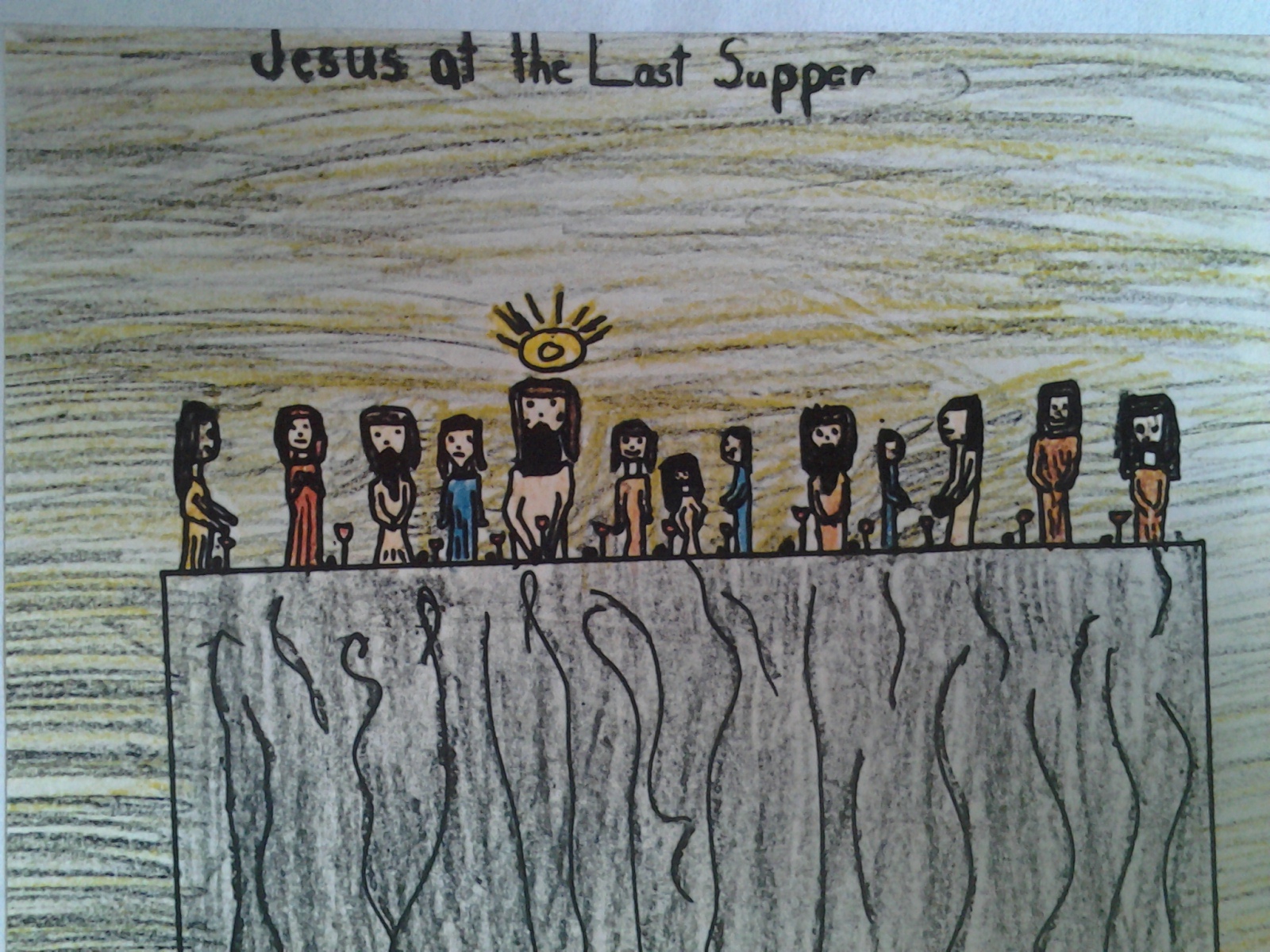
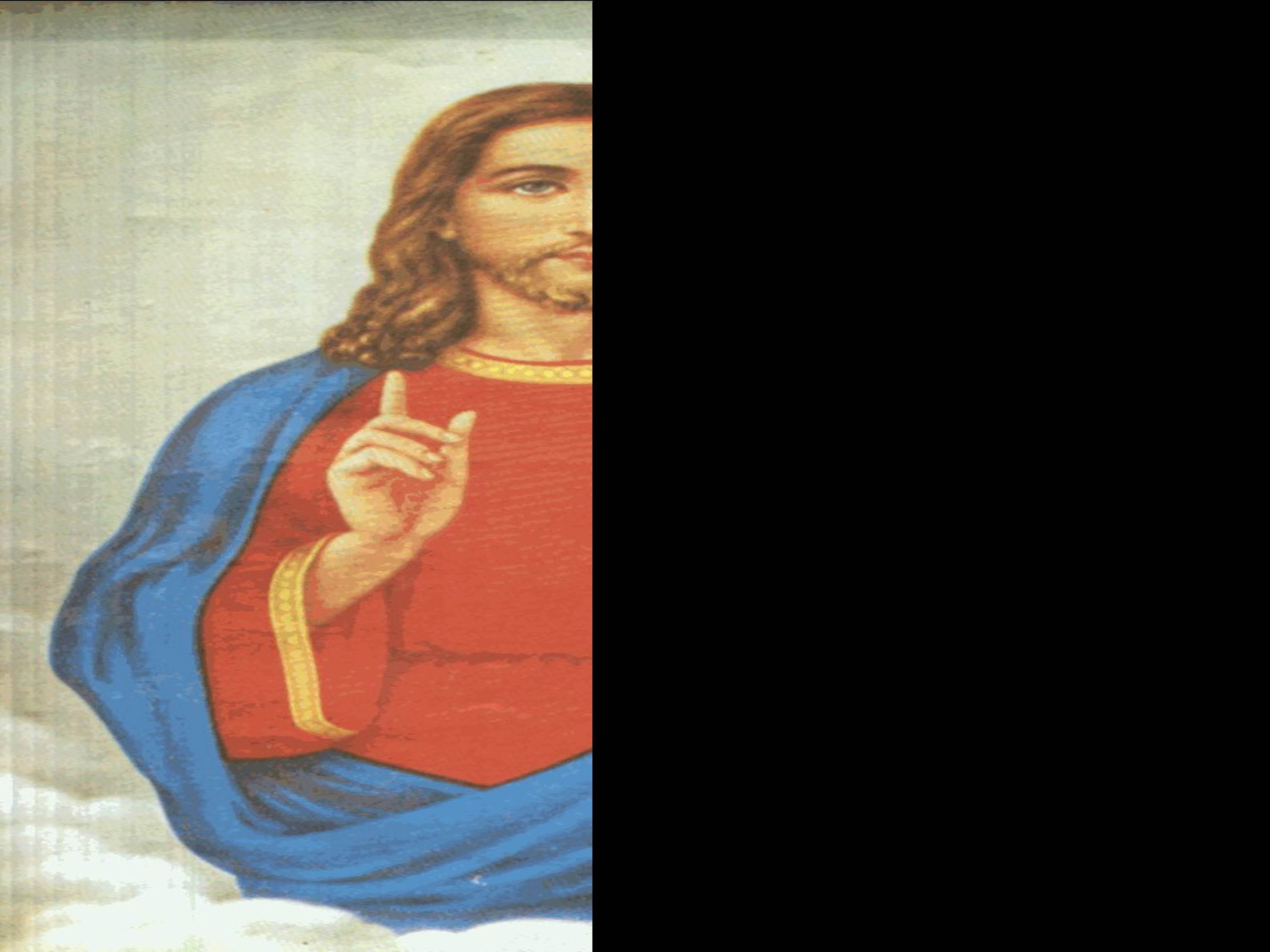
It’s the story of Jesus combined with sacred art from around the world. Let me show you some famous art of Jesus…
Christ Crowned with Thorns. Wood. Philippines, 20th CenturyVirgin and Child. Oil on Canvas. Uruguay, 20th Century.The Last Supper. Crayon on Paper. U.S.A., Contemporary.Mother of Divine Grace. Textile. Japan, Contemporary.Crucifixion. Bronze. Italy, 1933.Adoration of the Magi. Rome, circa 200.The Holy Family. Painting on Silk. Japan, 20th Century.
We all tend to fashion the Bible from our own background. Is it wrong to see Jesus as a white guy? As Japanese? As African? Historically, sure – he was a middle eastern Jew. But the whole point of the Incarnation is that Christ is WITH us. God is not far away and removed – He is one of us. So the God who left heaven to be like me might look like me. What other god ever bothered to become like us?
The mystery and magnificence of YAHWEH is the Incarnation. His name is Emmanuel, which means: God with us.
Ms. Kelly might want to apologize for her cultural bias and ignorance but I don’t fault her for seeing Jesus from her background and heritage. I don’t really expect my blog will ever cross her path, but if you do know her send her the link, okay? 😉
This Christmas season take some time to reflect on the idea that God cares enough for us to become like us. To feel like us. To suffer like us. To die like us.
Image courtesy of arztsamui at FreeDigitalPhotos.net
In Part I we looked at how a person isn’t saved by reciting magic words – it’s a matter of faith. While saying the Sinner’s Prayer is a great way to express one’s faith, it is faith that saves and not the prayer.
We also talked about what Christians mean when we use the word “saved.” It’s an understanding of the condition of your soul in relation to eternity. Life as we know it is merely one part of our journey. Death does not stop the journey but continues it.
Those who are “saved” (i.e. have faith in Jesus) will be spending eternity in the presence of God – this is heaven. To be totally honest the Bible doesn’t give explicit details about the nature of heaven. There is a lot of symbolism and imagery when people describe it (streets of gold, etc.), but no solid, “This is what heaven is like.” The most we can say about heaven is that it is the opposite of hell – it is the presence of God and a place that is wonderful, enjoyable, and the place where we are free from any problem, care, or worry.
Those who are “lost” (i.e. have no faith in Jesus) will be spending eternity outside the presence of God – this is hell. And, again, to be totally honest, the contemporary image of hell is not from the Bible as much as it is from the imaginations of writers, artists, etc. The most we can say about hell is that it is the opposite of heaven – the absence of the presence of God and a place that is generally unpleasant, uncomfortable, and not a place you want to be 😉
But the question I hear most frequently from non-Christians is:
Why would a loving God send people to hell?
People have a hard time hearing the message that God loves them when we simultaneously send the message that God will punish them if they don’t become part of the faith. While some Christians do send that message, the Bible does not. The Bible is clear:
God is patient with you, not wanting any to perish, but all to come to repentance. (2 Peter 3:9)
The verse speaks for itself – God doesn’t CHOOSE to send people out of his presence. He wants everyone to be in His presence (heaven). So then…who goes to hell?
Hell is for those who do not choose God. He doesn’t send – we decide. The Bible says:
The works of the flesh are obvious: sexual immorality, moral impurity, promiscuity, idolatry, sorcery, hatreds, strife, jealousy, outbursts of anger, selfish ambitions, dissensions, factions, envy, drunkenness, carousing, and anything similar, about which I tell you in advance-as I told you before-that those who practice such things will not inherit the kingdom of God. (Galatians 5:19-21)
For know and recognize this: no sexually immoral person or impure or greedy person, who is an idolater, has an inheritance in the kingdom of the Messiah and of God. (Ephesians 5:5).
Hear me out – I’m not God, and the Bible doesn’t get into the nitty-gritty of a lot of these. The point is, though, that certain behaviors and actions are not acceptable to be in the presence of a Holy God (holy means set apart or different).
It comes down to love and punishment. I think about it as a parent. I love my kids. But I have certain standards for their behavior. There are some things that are not acceptable. Because they are human individuals they are going to choose to do things with which I disagree.
Sometimes their behavior warrants being put in time-out. What is time-out? It’s removing the child from the family system – they cannot be part of the family system because of the choices they made to behave the way they did.
My children want to live by their own rules (or lack thereof). Then they’re always surprised when they go to time-out. Adults are no different. We want the freedom to live our own lives the way we want and then complain when we are told that there are eternal consequences for our behavior.
The Bible says:
All have sinned and fall short of the glory of God. (Romans 3:23)
Ultimately, we all deserve the BIG TIMEOUT (hell). But Jesus paid the price for our brokenness. Now we can once again be in the presence of God. But we can only approach him through faith and repentance.
When all is said and done, God is the one to judge our hearts and behavior. Not me. Not you. Not any human. I fully believe there will be people in heaven that will completely surprise us. Similarly, there will NOT be people in heaven that we always expected to be there.
In the meantime, we do our best in this life to live the life He has called us to live.
That means I may not do some things I want to do because it goes against what he wants me to do.
Because his way is supposed to come before my way.
Image courtesy of bandrat at FreeDigitalPhotos.net
The other day I had an interesting conversation with a young youth pastor. For the record, it was not the youth pastor at my church. He made the statement:
“The sinner’s prayer has sent more people to hell than any one thing in our time.”
If you’re not familiar with the Sinner’s Prayer you can read about it here.
In a nutshell, it’s a prayer that Christians (usually pastors or evangelists) walk non-Christians through on the path to following Christ. Billy Graham’s version went like this:
Dear Lord Jesus, I know that I am a sinner, and I ask for Your forgiveness. I believe You died for my sins and rose from the dead. I turn from my sins and invite You to come into my heart and life. I want to trust and follow You as my Lord and Savior. In Your Name, Amen.
What?!? How on earth could such a prayer send people to hell? The youth pastor is a young man, and young men tend to be very fiery in their speech. His point, though, was that repeating a few sentences after a pastor does not save you.
Time out.
What’s all this talk about saving? If you haven’t been in the church your whole life you may be wondering what on earth we’re talking about. Simply put, this life is not the end of existence – it is only temporary. Upon death we leave this life and begin the next. Depending on your spiritual condition you’ll be “saved” and in eternity with God or “lost” and in eternity apart from God.
Now, back to the prayer. The young minister was trying to express the fact that reciting words does not mean that one is saved. It’s not a magical incantation. Many people believe that if they simply say the words then they are guaranteed salvation and eternity in heaven.
But the Bible never says that you have to say magic words to get to heaven. The Bible does say:
– To all who received him, to those who believed in his name, he gave the right to become children of God. (John 1:12)
– Salvation is found in no one else, for there is no other name under heaven given to men by which we must be saved. (Acts 4:12)
– For it is by grace you have been saved, through faith – and this is not from yourselves, it is the gift of God – not by works, so that no one can boast. (Ephesians 2:8-9)
The Bible is clear that there is only one way to eternity with God, and that is through faith in Jesus. It’s not about Mohammad. It’s not about Buddha. It’s not about doing or saying the right things (works). It’s about our faith in Jesus. The youth pastor I was talking to was frustrated that too many people say the magic words, think they’re saved, and then stay exactly the same they always were.
Authentic, saving faith goes beyond reciting words – it’s about faith and the condition of our hearts, and that saving faith results in a changed life. Jesus once said:
“If you love me, you will obey what I command.” (John 14:15)
Pastors, evangelists, and churches do a good thing to share the truth about eternity and salvation with people. It is a good thing to bring people to an understanding and a saving faith. Then the Sinner’s Prayer becomes a useful tool for expressing that faith.
If you’ve ever said the “magic words” for fear of going to hell, saying the words won’t save you – you’ll still end up in hell if all you have is mere words.
The prayer itself doesn’t save. Our faith does.
Stay tuned…in Part II we’ll look at why a loving God will send sinners to hell.
Image courtesy of David Castillo Dominici at FreeDigitalPhotos.net
We do a HORRIBLE job of consoling people who are grieving and hurting. It doesn’t really matter what the loss is about – we suck at consoling.
When a loved one passes away how many people say, “I’m sorry for your loss”?
Why? Didja kill him?
Or consider how we treat couples who have lost a child…. God did not “take the baby because He wanted him in heaven.” That is not only stupid and hurtful – it is bad theology.
The next time you have an opportunity to talk to someone suffering through a loss, think about what you say and the significance of your words.
Think before you speak – if you even speak at all.
Remember, it’s not about making yourself feel better in the situation – it’s about bringing comfort and compassion to the one hurting.
Yesterday I was having a conversation with a guy who blogs about Christianity and spirituality. To be honest, he has some very angry and bitter feelings towards Christianity, so most of his writing is why churches, pastors, and Christians in general are doing it wrong. Instead of being like Jesus we’re too focused on preaching at people. Jesus listened and served. He said, “Jesus was called the good shepherd, and shepherds are not preachers.”
While I agree that there are many “preachy” Christians out there who care more about the sound of their voice than the people to whom they speak, this man has really missed the totality of Jesus. Yes, Jesus cared about people. He listened to people. He served people.
Jesus was a really nice guy.
That’s where a lot of people stop.
But Jesus was so much more than that. He cared. In fact, he cared enough to tell people that it was time to change. He was a good man who served others, but he was a preacher as well. Yes, Jesus was called a shepherd. People also called him Rabbi (teacher) because he was known for his speaking.
Jesus went into Galilee, proclaiming the good news of God. “The time has come,” he said. “The kingdom of God has come near. Repent and believe the good news!” (Mark 1:14-15)
In the famous story where Jesus prevents an angry crowd from stoning a sinful woman, Jesus doesn’t just come to her rescue – he sends her away saying:
“Neither do I condemn you. Go now and leave your life of sin.”
It seems Jesus was a pretty balanced guy. He believed in serving people. He believed in meeting people where they were and loving them as they were. But that’s only one side, and a one-sided Jesus is an incomplete Jesus.
He also called people to repentance. He called people to change. He called people to faith. A complete picture of Jesus must include BOTH his actions as a servant-leader and his words as a preacher and teacher.
It is this complete Jesus that ministers to us in our brokenness – we are loved as we are and for who we are. But it is this complete Jesus that loves us too much to let us stay the same – he calls us to move on and leave behind our old ways.
Anything less and you’ve only got half the picture. And those who live with half a Jesus focus too much on love and service on one side or repentance and change on the other. Both extremes are inadequate to the rich character of Christ.
It’s not really as big a tangle as the headline would have you believe – it seems that the DNA of Neanderthals in Spain is similar to a different ancient population from Siberian known as the Denisovans.
The family tree is more webbed than science originally thought.
Okay.
That’s fine.
The idea that remains in Spain are genetically connected to remains in Siberia doesn’t bother me. To me it speaks of a single creator and a common ancestor to all of humanity. Hmm…even the Bible talks about that.
Where many Christians will take issue with the article is the age assigned to the remains and DNA. If the remains are 400,000 years old then the stories in the Bible can’t be right…right? But if the Bible is right then the science must be faulty…right?
And once again science and faith collide.
The problem comes when we insist on a rigid, literal reading of the biblical stories. We get lost in the nitty-gritty details rather than step back to see the big picture of what is being communicated.
Simply put – the Bible is not (and never was) intended to be a science textbook. It is a book of faith. It doesn’t teach us how to be forensic experts. It draws us into relationship with God, the Creator of the universe.
The idea of an “Old Earth” doesn’t bother me. Even conservative theologians like Millard Erickson concede that the Hebrew creation stories don’t have to mean a literal six days but could refer to epochs or long periods of time (you can see Erickson’s Christian Theology for his detailed presentation).
So we can go with an Old Earth – but what about humanity? The Bible is clear that humanity has an origin in God, not a spontaneous arrival. Ancient genealogies were not exact for the purposes of record keeping like Ancestry.com is. Genealogies are as much of the storytelling process as any of the narrative portions of the story. They inform the story, but are not intended to be scientific records for all posterity.
In the end I look at it like this: does the Bible fit science’s understanding of an Old Earth? Yes, it does. If humanity is older than a literal reading would have us believe – if there are massive gaps in history that the genealogies don’t cover – is my faith ruined? No, it is not.
The story is till the same. Everything has value because it has been made by God. Out of nothing, God created everything. Does it matter how long He took to do it? Not to me.
In the end the clash between science and faith is not as big as many would try to trick us into believing, and faithful Christians can fully embrace their faith and scientific discovery.
Because the world that God has made is a unique and marvelous thing – and we should learn as much about it as possible.
Image courtesy of rakratchada torsap at FreeDigitalPhotos.net
You ever wonder how the liberals are winning the war on Christmas?
They’ve taken out Christ and substituted it with a vague X…
Xmas just doesn’t have the same ring, does it?
Every year I see Christians lament about this battle. But you don’t have to be concerned. No one has taken Christ out of anything. Let me ‘splain it to you.
The Bible was not originally written in English – not even in the King James English!
Say what?!? It’s true. The New Testament was written in Greek, and the Greek alphabet is a lot different from the English alphabet.
In Greek, the word Christ is “Christos” but it looks like this:
Because all writing was done with quill and ink, writers would frequently abbreviate people’s names (in order to save on parchment/vellum space and ink). Thus many godly writers would abbreviate the name of Christ with the simple X.
You see, Christ never left Christmas – he just became sleek and streamlined – Christ 2.0!
So have a Merry Xmas, and rest easy that, no matter what happens in this world, God is still in control!
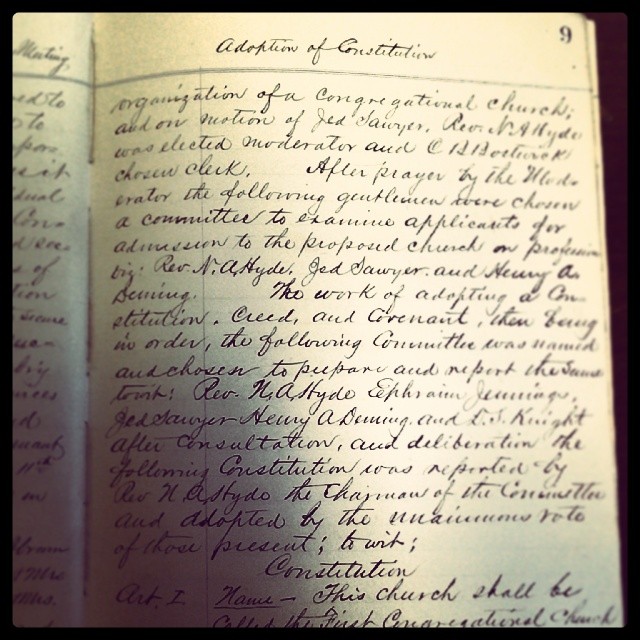
Original, handwritten copy of the church constitution circa 1869
History is a pretty cool thing. Last week at church we found this old log book in a cabinet. The earliest entry was from 1869. It had the membership rolls of people who were part of my church LONG before I was here. It really reminded me of the importance of remembering. The Bible is filled with passages about the importance of remembering. It is something God does:
Genesis 9:15 – I will remember my covenant between me and you and all living creatures of every kind. Never again will the waters become a flood to destroy all life.
Genesis 19:29 – So when God destroyed the cities of the plain, he remembered Abraham, and he brought Lot out of the catastrophe that overthrew the cities where Lot had lived.
Exodus 33:13 – If you are pleased with me, teach me your ways so I may know you and continue to find favor with you. Remember that this nation is your people.”
He remembers. He has not forgotten us. He knows who we are and where we come from. His memory keeps us close to him. Like God, we are supposed to remember.
Exodus 20:8 – “Remember the Sabbath day by keeping it holy.”
Matthew 16:9 – Do you still not understand? Don’t you remember the five loaves for the five thousand, and how many basketfuls you gathered?
To remember something is to keep in in mind. When something is part of your memory it affects what you know, and what you know affects what you do. God’s activity and behavior is supposed to be always on our mind – in our memory. It keeps us aligned with him. When we forget him is when we start to slip away. Remembering keeps us on a godly path.
One of my favorite “remember” passages is from Revelation 2:5 ~
Remember therefore from where you have fallen; repent, and do the works you did at first. If not, I will come to you and remove your lampstand from its place, unless you repent.
Knowing where we come from is important. It keeps us focused. It tells us why where here and where we’re going. Today I encourage you to remember. Remember your first experience and encounter with God – what did you feel? What did you think? What did that encounter compel you to do? Have you changed? Have you forgotten?
Remember, and let what you know affect what you do.
Image courtesy of stockimages at FreeDigitalPhotos.net
“If they knew this about me, they’d never talk to me again. I don’t know how I could handle seeing them again in church if they touched that part of my life.” Thoughts like that fill all of us. It’s part of the human condition. It’s something that we all have to deal with. There are parts of us that we think no one can help us with that no one can or will want to touch. We keep parts of ourselves on the outskirts of our faith. Have you ever thought, “I don’t think God likes this part of me” or wondered if he could work with you as the big mess that you are?
On the flip side of the same coin, there are some of us who don’t want to touch people in their messiness. “I don’t want to touch him. His uncleanness might rub off on me. Such was the attitude of Christians towards blacks in the 1800’s. This was the attitude of many conservative Christians when AIDS really came on the scene in the 1980’s. I say this is a human condition because it doesn’t affect only Christians.
In India the whole social structure, their caste system, is based on who is or isn’t touchable. People in the lowest caste are called untouchables. Refusing to touch something unclean and have it rub off on you even became part of the religious practice of God’s people. One of the laws in the old covenant simply said, “Or if any one touch any unclean thing, whether it be the carcass of an unclean beast, or the carcass of unclean cattle, or the carcass of unclean creeping things, and it be hidden from him, and he be unclean, then he shall become offensive.”
Many Christians feel the same way about the world in general. We are often concerned that, if we interact too much with the world, we will be defiled and made unclean. That leads many of us to limit our interaction with the world to “only as necessary” encounters. We do what we can to avoid contact with the world around us. But we cannot be clean without being touched by Jesus. And we cannot followers of Jesus and not touch the world around us.
Touch is an important aspect of communicating with someone. There is something intimate and close about touching other people. Maybe this is why touching is taboo in many settings – the intimacy is too much for some people to take. In terms of OT religion, the intimacy of touch made the uncleanness of one person rub off on another. In some cultures, touching is a way of showing solidarity-of being connected with someone else. I used to work in the public high school system and it was not uncommon to see two girls walking down the hall holding hands. Not the boys, of course, because American men don’t do that!
There is something intimate in touch, and our culture has said that it’s just not right to see men acting in that way. In the middle east and Asia you can see men walking down the street holding hands. They aren’t lovers – they are simply relative or close friends who are connected to each other. Everyone who sees them knows that to mess with one means taking them both on. Touch communicates intimacy and connection. So it’s a big deal when the spiritual leaders of God’s people said that unclean people had to remain outside of populated areas. It’s an even bigger deal when someone decides to break these taboos! One time, as Jesus was walking along:
A leper came to him, begged him and said, “If you wish, you can make me clean.” Moved with pity, he stretched out his hand, touched him, and said to him, “I do will it. Be clean.” And the leprosy left him immediately, and he was made clean. Then, warning him sternly, he dismissed him at once. Then he said to him, “See that you tell no one anything, but go, show yourself to the priest and offer for your cleansing what Moses prescribed; that will be proof for them.” The man went away and began to publicize the whole matter. He spread the report abroad so that it was impossible for Jesus to enter a town openly. He remained outside in deserted places, and people kept coming to him from everywhere. (Mark 1:40-45)
This is the attitude most people have with diseased people. No touchy! Stay away. I’d rather not come into contact with you. And here this man with some sort of skin disease approaches Jesus. You can just imagine the horror on the faces of the original audience 1900 years ago…. “So a leper came to Jesus….” “What!?!? Oh, no he didn’t!” It’s shocking. He should know better.
But still he comes to Jesus. And he’s got nerve. “If you wish, you can make me clean,” he says. Skin diseases can be serious things. They aren’t easily cured. Years ago I had a skin condition that I could not identify. I was red, splotchy, and itchy. It freaked some people out to look at me or be near me. They kind of kept their distance. Even one of the doctors I went to walked in the room and looked at me from afar. Then he took me to the dermatologist who diagnosed me in 10 seconds (don’t worry, I’m fine!). Not even my doctor wanted to get to close without knowing what was going on! Rabbinic opinion stated that it is as difficult to cleanse a leper as to raise the dead! Good thing this leper came to the right guy!
The amazing part of this story is not that the man with a skin disease came to Jesus. The amazing part is Jesus’ response. Jesus stretches out his hand and touches the diseased man. And immediately the man became clean. Here’s the neat thing – Jesus doesn’t become unclean by touching the leper; the leper becomes clean by Jesus’ touch. The filth that is in one person does not stick to others, nor does outward uncleanness defile people who are clean of heart. So [Jesus] touches him in his untouchability.
If Jesus doesn’t blink before touching a scabby, diseased man, how does Jesus look upon me? We’re all untouchable in some way. None of us is perfect. The apostle Paul admits that when he says, “It’s not that I have already reached this goal or have already become perfect. But I keep pursuing it, hoping somehow to embrace it just as I have been embraced by Christ Jesus.” So there is something in all of us that appears untouchable to others. We struggle with addiction. We struggle with past sexual abuse. We struggle with slander. We struggle with impurities of every kind that, if people could see the real us, would keep others far off at a distance. We would live away from others and cry out, “Unclean! Unclean!” And Jesus reaches out his hand and touches us in our untouchability.
In the Gospel of Mark this healed man is the very first missionary! Should we be quiet about Jesus? No. When Jesus touches us in our uncleanness the only appropriate response is to go out and tell others! When was the last time God touched you? When was the last time you told someone else about God touching you?
After the healed man went back into town and told about what happened, so many people swamped Jesus that Jesus wasn’t able to go into town any more. There’s an ironic reversal between Jesus and the diseased man. Initially, the man is forced on the outskirts and Jesus can travel in and through the towns. Then Jesus touches and cleans the man and the man can now go into town and Jesus is forced to stay on the outskirts because of the mobs of people and has to remain in the deserted places.
Similarly, Jesus has done a role reversal with us – he has taken our place on the cross. The disease of sin that would have been our undoing is now undone as he takes it on himself. This is the good news that we need to be sharing with others! “Hey, Jesus touched me! Let me take you to the foot of the cross so he can touch you too!”
There’s an old Gaither song that goes, “He touched me, oh, he touched me. And oh, the joy that floods my soul. Something happened and now I know, he touched me and made me whole.” Are you willing to let others know how God has touched your life?
Image courtesy of imagerymajestic at FreeDigitalPhotos.net
Yesterday in Part I we talked about giving people the benefit of the doubt and looking beyond our initial emotional response to anger and offense. But sometimes people go beyond the benefit of the doubt and actually do something that causes legitimate pain. Take Joseph, for example… (GENESIS 37-45)
– Joseph is one of the youngest with 10 older half-brothers
– They plan to kill him, but the oldest convinces the others simply to throw Joseph in a pit
– They end up selling him to a caravan of Ishmaelites on their way to Egypt
– Joseph becomes a slave to Potiphar but is a hard worker and trustworthy – soon Potiphar puts Joseph in charge of the entire estate
– Potiphar’s wife gets the hots for Joseph but he won’t betray his master’s trust or sin against God, so she has a temper tantrum and falsely accuses him of attempted rape
– Joseph goes to prison (no DNA evidence available to exonerate him) and while in prison
If there’s anyone who has reason to seek vengeance and hold on to resentment it would be Joseph. But forgiveness is the letting go of the need for vengeance and releasing negative thoughts of bitterness and resentment. It involves a willful decision to restructure thought life and cognitions regarding the offender and the offense.
Divine forgiveness and forgiveness between humans are central themes at the heart of biblical faith (Ps. 51:1-2; Matt. 6: 12-15).
GRACE-FILLED FORGIVENESS and the non-remembrance of offenses are scandalous, especially when extended to vile evildoers. We often feel a strong urge to reject forgiveness and non-remembrance towards bad people – those who really wound us deeply.
If I were Joseph I would probably have a serious grudge against the brothers who sold me away. Yet Joseph is the agent of God’s grace and kindness towards his brothers. They were to take a long time – and this is often the case even for us today – to appreciate and to fully receive the transforming loving-kindness of the Lord into the very depth of their beings. Joseph understood that beyond and above the foul schemings of his brothers, God was in control. It is the Lord himself that gives and reveals the ultimate and true meaning to history.
To forgive is to offer mercy to someone who has acted unjustly.
Grace in the Bible can also mean “favor” as in “find favor in his eyes” – the word occurs 101 times in Paul’s letters alone… In the Bible, forgiveness is primarily the act of God by which he graciously takes away the obstacles or barriers which separate man from His presence.
The New Testament word for forgiveness means “to send away.” Forgiveness does not excuse or minimize the hurtfulness of the other person’s act. Rather, it says, “Yes, you did a hurtful things to me. You did wrong.” But forgiveness is then acting mercifully and saying, “I choose not to hold that against you. I am sending away that grievance.”
We often have difficulties in forgiving others. Sometimes we think we have forgiven when we really haven’t. Sometimes we think that, to forgive, we must forget and act as if the hurt never happened. Offenses are not forgotten, but when forgiven they should not be brought up again. Other times we think we can forgive only after the person has suffered or made restitution. Revenge requires suffering and restitution, not forgiveness.
Letting go of the right for revenge has real benefits. It can lower blood pressure, reduce free-floating hostility associated with elevated cardiovascular problems, help you feel less stressed, fearful or depressed, and restore you spiritually to a better relationship with the Lord. When the Bible talks about forgiveness it’s not just about restoring relationships between people, it’s not just about modeling God’s behavior (the One who forgave us even when we didn’t deserve it) – it’s also about our OWN well-being.
Whatever you’ve been holding on to – it’s time to let it go. It’s time to let go of the need for vengeance and justice. It’s time to choose not to hold things against people, even if you’ve been wounded deeply.
So how can you start? First, ask God to remove the anger associated with the hurt. He can bring healing and forgiveness even when you don’t think it’s possible. Keep talking to God about it. Then there are three practical things you can do to start the process of letting go and forgiving people:
1) Write a hurting letter, listing how the person hurt you and how the hurts affected you – Read the letter to an empty chair where you cannot be overheard
2) Write a forgiveness letter – Read that letter to an empty chair
3) Destroy both letters as a symbol of releasing you pain and anger
Hate, anger, and unforgiveness will eat us up from the inside out if we don’t release it. It sucks the joy out of life.
It’s time to live a joy-filled life, and that means walking in forgiveness.
















 Chris Linzey