

This is number two in our “Bouncing Back” series, where we’re dealing with being spiritually anchored so that we can weather any storm. Last time we talked about refusing to see obstacles as unbeatable. Today we’re talking about maintaining hope.
Hope is a funny thing. We’re willing to pay good money for hope. We probably don’t think of it like that, but we do. That’s the power behind the infomercial. These infomercials blast us day in and day out (and in the wee hours of the morning when there’s no regular programming on t.v.). These “as seen on tv” products are trying to sell hope – hope that buying a particular product will be the miracle to cure whatever troubles us. Like the Snuggie.
C’mon, people!
It’s. A. Backwards. Robe.
But it calls out to us and gives us hope that life would be better if we just had…. This is the power of the infomercial – it plays off of hope. My wife and I used to be in the habit of having cable news playing in the background during the day. I realized that we needed to stop when my then-5 year old got to me after work one day and said, “Daddy, we need to get a sunsetter!”
No, baby girl, we don’t NEED one. Not at all.
But humanity believes that these little doses of hope will make life better. But the emotion of hope is something that comes and goes. These temporary things cannot be enough to sustain long-term hope. Lasting hope has to be rooted in something much deeper. Lasting hope must be rooted in something bigger than ourselves or the stuff we fill our lives with.
Lasting hope is spiritually anchored.
The Bible talks a lot about hope, and the people who need it.
For the oppressed will not always be forgotten;
the hope of the afflicted will not perish forever. (Psalm 9:18)
I say: The Lord is my portion, therefore I will put my hope in Him. The Lord is good to those who wait for Him, to the person who seeks Him. (Lamentations 3:24-25)
You see, when we talk about bouncing back from life’s troubles, it is hope that gives us the bounce! And while we sometimes think that troubles kill hope, hope and affliction can co-exist.
Do not lack diligence; be fervent in spirit; serve the Lord. Rejoice in hope; be patient in affliction; be persistent in prayer. (Romans 12:11-12)
The Apostle tells us to rejoice in hope WHILE TELLING US TO BE PATIENT IN AFFLICTION! They’re happening simultaneously. In a nutshell, then, hope is about holding on to that better tomorrow in spite of the difficulties of today. But how do we develop hope?
- Build a future focus.
We get so caught up in today’s troubles we lose sight of tomorrow. But we know that everything in this life is temporary. Life itself is temporary! We’re all headed towards that same destination – the grave. But the Christian has hope beyond the grave, for we know the day is coming when we stand in the presence and perfection of God. This hope has sustained Christians through the worst time and persecutions imaginable.
Don’t be so caught in the “here & now” that you lose hold of the “there & then.”
- Work on a path to tomorrow.
We know that life will get tough. Obstacles are going to hit. Instead of letting them stop us, we need to plan our path towards tomorrow. Asses your life like it’s a number line.

If the obstacle has your life stuck at 5, don’t try to jump to 30. Ask what it’s going to take to get to 6. Then, when you find your life is at 6, ask what you can do to move up to a 7. The point is you keep at it little by little.
I have a friend who was convinced that God had a certain destination for his life. The problem was that obstacle after obstacle kept being thrown at him. It was discouraging. A mutual mentor of ours told him, “If you believe this is where God wants you to be, you CANNOT stop trying. Do EVERYTHING to keep moving in that direction.” It took years but it finally happened!
- Finally, recognize God’s plan in your life regardless of personal circumstances.
Sorrow doesn’t have to diminish hope. God can work through your suffering. God and work in spite of your suffering. Hope remains, because it’s grounded in God’s activity, not our changing circumstances. I’m reminded of the Apostle Paul who prayed earnestly that God would remove a personal obstacle, his “thorn in his flesh.”
Concerning this, I pleaded with the Lord three times to take it away from me. But He said to me, “My grace is sufficient for you, for power is perfected in weakness.” Therefore, I will most gladly boast all the more about my weaknesses, so that Christ’s power may reside in me. (2 Corinthians 12:8-9)
Your obstacle may never be resolved the way you want it. It doesn’t stop God’s grace from being present in your life. Hope stays, no matter what happens today.
Let’s hold on to a better tomorrow.
I won’t quit.
I have impact.
Pain isn’t permanent.
I will not break.

 Think about a glass that’s slammed on the floor. It’s going to shatter. But replace the glass with a super-ball, one of those rubber balls that kids love to play with (no matter how many times you say, “DON’T BOUNCE THAT IN THE HOUSE!). No matter how hard you slam that ball down, it won’t break.
 But self-control is one aspect of our character development that we let fall to the wayside. In my words, it’s because pizza tastes better than self-control. In generic terms, our individual indulgences are more important to us than exercising discipline. The Bible compares self-control to a city’s walls:
 When it comes to our possessions, the idea is that stuff will make us happy. If I could only have that new iPhone. If I could only acquire that special __________ – you get the idea. The problem with linking our happiness to stuff is that they’re ALWAYS making new stuff! What good is getting a new phone when they’ll make a new one next year? Pursuing the latest stuff is only a temporary fix. But stuff will always leave us sad. The new thing breaks or becomes outdated.
 Humility is one of those things that I know is good for me but also one of those things that is so hard to put into practice. Our culture regularly drives us to “be number one!” Many of us have jobs that require an annual review in which we sum up all of the great things we did through the year.
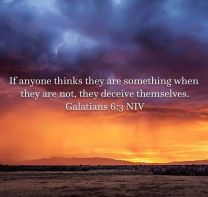 There’s a practical wisdom to Jesus’s words. It’s FAR better to choose humility than to have someone else thrust humility upon you! Don’t get so big-headed you think more highly of yourself than you ought. Instead, choose lowness and, if other people exalt you – score! If not, you’re no worse for the wear and can avoid the walk of shame when someone tells you you’re in a place for someone more important.
 In the end, I gave her a simple version of the Westminster Catechism, “Baby girl, God made everyone to glorify and worship Him.”
 Even people who have never seen Forrest Gump have heard the expression, “Stupid is as stupid does.” It’s the way Forrest’s momma teaches him that real stupidity is not in intellect or how others judge you. Stupid people are revealed through their stupid behavior. People who DO smart things ARE smart people. People who do stupid things…well, you get the idea. And that concept is not unique to stupidity. It’s a truism of many facets of life. If you want to know about the character of a person, look at his actions. His behavior will out the truth. Smart people are those who DO smart things. Careful people are those who practice safety and care. Friendly people are those who behave as friends. In his first letter, John says it’s no different with spirituality and righteousness.
 This is no different spiritually. Our spiritual family is supposed to change the way we look and sound. God’s family is supposed to do godly things. We turn our backs on ungodly behavior. To paraphrase Forrest Gump, righteous is as righteous does. We are called to turn our backs on ungodly behavior. We’re either part of God’s family or part of the devil’s family.
 While we all judge and are judged, it’s not SUPPOSED to be this way for those in God’s kingdom. We’re supposed to be above it. We’re supposed to let go of judging others. And most people know this. How often have you heard someone say, “Only God can judge me!”
 Judgment tears people down without building people up. Judgment is more concerned with the tiny fault in someone else than the massive fault in ourselves. This is why Jesus gives us this absurdly humorous illustration about a log sticking out of our face.
 Chris Linzey