A Church That Loves Politics More than It Loves Jesus

I enjoy following politics. I really enjoy political races for office. I believe that citizens in a democratic republic (like America, if you didn’t know what we are) have a duty to cast votes and play an active role in the political process. It is the primary means by which we hold our leaders accountable and shape the vision and future of our society.

I enjoy my faith. I really enjoy Jesus. I believe that citizens of God’s kingdom (all of those who claim to follow Jesus) have a duty to be loyal to Jesus and play an active role in the life of God’s kingdom. This necessitates we understand the breadth and scope of Jesus’s life, mission, and call to those of us who follow him.

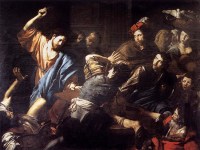
One of my favorite stories from Jesus’s life takes place during a visit to the temple. Jesus sees a bunch of merchants and vendors trying to make a profit selling sacrificial animals to worshipers traveling from out of town. The mark-up would have been considerable, and the vendors were there not so much to help those who needed to offer sacrifices, but to line their own wallets with cold, hard cash.

This was simply unacceptable to Jesus, and he goes ballistic. He starts flipping over tables and driving out the cattle and animals, jesus-clears-the-temple

and He would not permit anyone to carry merchandise through the temple. And He began to teach and say to them, “Is it not written, ‘My house shall be called a house of prayer for all the nations’? But you have made it a robbersden.” (Mark 11)

Then this week I saw a very interesting phenomenon.

During the Iowa Caucus, I saw many churches that had opened their doors and had become caucus voting locations. Pews were filled with voters carrying flags, buttons, and banners promoting their favorite candidate.

It got me thinking…

I’m pretty sure Jesus would visit these church caucus sites in Iowa and start flipping over pews and tables…

No, it’s not wrong for Christians to engage in politics. I think it’s a GOOD thing to do.

What I have a problem with is people turning our sacred spaces into political grounds. How can we worship Jesus and worship candidates at the same time? How can our sanctuaries be converted to multi-purpose rooms used for secular political activity? I’m not cool with it.

Our call as Christians is to influence and change culture, not let culture influence and change us. One of my favorite Ed Stetzer quotations goes something like this:

When you mix faith and politics you get politics.

This is what I see happening during this election cycle. Don’t let it.

Yes, vote. Yes, get election-978904_1920involved in the political process. Yes, make sure the right candidate takes office.

No, don’t mix the two. Jesus doesn’t ride beside our politics. He needs to be above our politics. Because he’s the Lord of Republicans AND Democrats…heck, even of the Socialists. Jesus supersedes politics.

Don’t get caught up in the political movement and sacrifice our sacred spaces and our very faith.

——————————————
What do you think? Are you okay with churches being voting locations? How do you respond to the blending of faith and politics?

Off With Her Head! A Biblical Response to the Death Penalty

Queen of Hearts

The Queen of Hearts is quite a memorable character in literature. She’s prone to rage and has one punishment for any offense: death.

The death penalty is again being hotly debated due to the pending execution of death row inmate Kelly Gissendaner. Gissendaner was found guilty of plotting her husband’s murder. While incarcerated, her supporters state Gissendaner has turned her life around and is a pastoral presence in the prison. They are seeking clemency.

Christians, meanwhile, are back to debating the merit and justification of the death penalty. Let’s note from the outset that there is no monolithic Christian perspective on this issue. Some adamantly believe the death penalty is wrong while others (just as adamantly) proclaim that the death penalty is biblically justified.

One’s position on the death penalty is not an indicator of piety or faithful Christian discipleship.

I looking at the issue from a biblical perspective we run into a big problem: the Bible is not a guide for running a democratic republic. Let’s break it down a bit.

The Old Testament

Death penalty proponents point to passages in the Old Testament that call for death as the penalty for certain offenses. It’s true – we can’t deny that the Law did indeed embrace for the death penalty. Just a couple quick examples:

He who strikes a man so that he dies shall surely be put to death. (Exodus 21:12)

If a man acts with premeditation against his neighbor, to kill him by treachery, you shall take him from my altar, that he may die. (Exodus 21:14)

But here’s the thing – the Old Testament was designed to govern the ancient theocracy that was Israel. It was not a political guide for all time. We cannot say, “The Old Testament endorses the death penalty so we should as well.” It’s not that simple. We don’t live in that society and are not governed by those rules. The Old Testament might demonstrate principles that certain crimes are worthy of death, but we cannot bring in ancient theocratic law to rule a modern democratic republic.

The New Testament

In the New Testament we see a strange reversal – Jesus seems to take the understanding of Old Testament retribution and turn it on its head. One of the most striking examples is John 8, where a woman who, by Old Testament law, deserved death, receives a pardon from Jesus. Grace and forgiveness take the place of judgment and condemnation.

But the New Testament makes no claim to represent political power – in fact, quite the opposite. The New Testament tells believers how to behave on a personal level no matter what the government might do. The New Testament does not address how to run a government. The whole penal system, while necessary to an ordered and civilized society, is never really addressed in the New Testament (although the NT does reference authorities being put in place by God to punish evil-doers).

So where does that leave us? We can see principles for righteous judgment and punishment. We can see principles for forgiveness and leniency. But we have to be honest and say that there is no direct guidance for how to run a penal system in a democratic republic.

That being said, we need to approach the topic with sensitivity to how God leads and directs us without belittling people who disagree. Good Christians might favor the death penalty. Equally good Christians might oppose it. And some Christians might vacillate between the two positions in the course of their lives.

Life is more complicated than simple black and white dichotomies.

_ _ _ _ _ _ _
How about you – do you or don’t you support the death penalty? What is your reasoning for your position?

I welcome all discussion, just keep it civil and polite. If this post resonates with you in any way, please share it on Facebook, Twitter, or email!

Newsweek Declares Jihad on the Bible

Newsweek Cover

I remember when I was a young student at Bible college. I remember hearing about the transmission of the Bible through the centuries. I remember learning about critical methodologies (the ways we examine a text). The first time I ever heard such outrageous thoughts I thought, “How can these professors claim to be Christians and treat the Bible like this?!?” I was 19 – young and dumb.

But I grew.

I grew in my knowledge. I grew spiritually.

I saw that my professors could talk honestly about the Bible yet were still incredible people of faith. I decided that I wanted to be like that, too. So I studied the Bible. I earned a Bachelor of Arts and Master of Arts in Biblical Studies because I wanted to really KNOW the Bible. I earned a Master of Divinity in Pastoral Preaching because I wanted to be able to communicate well everything I knew about the Bible – God’s revelation to humanity.

When I read the latest Bible article from Newsweek called “The Bible: So Misunderstood It’s a Sin“, I had a flashback to the 19 year old version of myself – before I matured.

Kurt Eichenwald wrote a very LOOOONG piece that brings up a lot of those questions with which Bible novices question. The problem with his article is that there is no evidence of growth. The problem with his article is that it is designed to attack the Bible rather than approach it in genuine study. The problem with his article is that it’s not about the Bible – not really.

Mr. Eichenwald’s article is about politics.

The opening paragraphs of the article reveal his true intent:

They wave their Bibles at passersby, screaming their condemnations of homosexuals. They fall on their knees, worshipping at the base of granite monuments to the Ten Commandments while demanding prayer in school. They appeal to God to save America from their political opponents, mostly Democrats. They gather in football stadiums by the thousands to pray for the country’s salvation.

They are God’s frauds, cafeteria Christians who pick and choose which Bible verses they heed with less care than they exercise in selecting side orders for lunch. They are joined by religious rationalizers—fundamentalists who, unable to find Scripture supporting their biases and beliefs, twist phrases and modify translations to prove they are honoring the Bible’s words.

This is no longer a matter of personal or private faith. With politicians, social leaders and even some clergy invoking a book they seem to have never read and whose phrases they don’t understand, America is being besieged by Biblical illiteracy.

I must compliment Mr. Eichenwald’s writing. His use of imagery, rhyme, and alliteration is worthy of some of the best preachers I’ve heard. But he’s not talking about the Bible for the sake of examining the Bible. His article is clearly pointed towards taking down certain people that use the Bible and faith in their politics. He’s using all the right buzzwords, isn’t he?

Homosexuals
Ten Commandments
Prayer in School
Political Opponents
Democrats
Politicians
Social Leaders
America

He’s not writing about the Bible. This is a political piece. And to an extent I agree with him. I think that too many American Christians confuse faith and politics. I even made up a word for them: Americhristians. An Americhristian is someone who confuses faith and politics, thus making them BOTH worse off. Ed Stetzer once wrote:

When you mix faith and politics you get politics.

No, Mr. Eichenwald is not writing about the Bible. This is a political piece.

And that totally makes sense – his undergraduate degree is in…you guessed it – political science.

Still, you can’t unring the bell, and Mr. Eichenwald’s piece has brought up a lot of issues that many Christians never thought about (or even knew about). So here are my issues with the article.

1. Mr. Eichenwald seems to lump all Evangelical Christians into the same camp. He writes against “the illiteracy of self-proclaimed Biblical literalists” as though all Evangelicals fall into this camp (we do not). The rest of his piece is a Bible hatchet job, trying to prove why literalists are wrong and should get their heads screwed on straight.

The truth is that there are many Evangelicals who are not literalists. There are many of us who recognize that the Bible contains parts that ARE meant to be read literally. But there are parts meant to be read figuratively. The Bible is filled with poetry, prose, fact, fiction, prophecy, history…get the idea?

In fact, I don’t know ANYONE who insists on reading the Bible 100% literally. Even the staunchest Fundamentalist will concede that the psalmist isn’t being literal when he talks about God sheltering him under his wings. God is not a giant, cosmic chicken. 😉

Giant Chicken

2. Mr. Eichenwald shows only a rudimentary grasp of the Bible’s transmission history and critical methodologies. He is actually correct when he is reporting facts. There ARE thousands of manuscripts and fragments of manuscripts. All of the manuscripts have slight (and sometimes major) differences. Punctuation was not part of the original Greek manuscripts and can change some meanings if you tweak periods and commas. Some Bible stories are in certain manuscripts that don’t appear in others.

What Mr. Eichenwald writes in an attempt to shock and startle Christians is not shocking or startling. He writes nothing that I wasn’t taught at a “conservative” Christian university (an Assemblies of God Bible College). But Eichenwald only brings up the problem and never talks about the solution – what we call critical methodology. We examine texts. We compare texts. We talk about the sources for texts.

Secular scholars utilize the same methods when working with Homer’s “The Odyssey” and other ancient texts. So we work our way back to the text closest to the original writing. When you look at the transmission of the Bible compared to works like The Odyssey, the Bible is actually much more reliable and better attested!

3. Mr. Eichenwald doesn’t understand translation issues. There is no such thing as a perfect translation. I’m not talking about the Bible. I’m talking about ALL of life. It’s the reason we have the expression “lost in translation.” Anytime you try to move thoughts and ideas from one language into another there is going to be some amount of change and interpretation taking place.

I studied Spanish in school. I learned that when I want to say, “My name is Chris” I say, “Me llamo Chris.”

Wait, what? I started with four words and went down to three.

There is no exact translation.

So yes, in translating from Hebrew and Greek into English, sometimes words and phrases are shifted so that we get to the best meaning and wording of the text. It’s not, Eichenwald puts it, “translational trickery.” And the New Testament DOES attest to the deity of Christ (an idea that Mr. Eichenwald seems very intent to disprove).

4. Mr. Eichenwald chooses to focus his “examination of the Bible” and slam some conservative talking points: homosexuality, feminism, government control, and prayer.

He highlights that homosexuality is included in sin lists with many other sins and thus should not be highlighted by conservatives. On this point I actually agree with him. The Bible talks about many sins. We tend to get bogged down in the ones that affect or bother us the most. We also like to focus on other people’s sins rather than our own. So many times we’d prefer to focus on your sexuality than our drunkenness or envy. He’s right.

But still – it’s a sin (the Bible is clear that God-designed sexuality is between a man and a woman who are married to each other). Mr. Eichenwald seems to think that, since homosexuality is included in sin lists with other sins, those of us who wrestle with other sins should not point out homosexuality. There was only one sinless man ever to walk the earth. The rest of the time, sinners are going to point out sin. We need to do it better. We need to do it with fairness and consistency. But still we do it.

As to the other biblical issues Mr. Eichenwald raises, I believe most of them are washed away when you examine the Bible in light of its historical context. The Bible was not written in a vacuum, and many times the authors address specific issues that are not intended to be binding for all humanity for all time.

5. Mr. Eichenwald is a liar. There – I said it. At the end of his piece he states:


This examination is not an attack on the Bible or Christianity.

Really? I don’t know how anyone could view it as anything BUT an attack. I see it as an attack, and I’m not even a Fundamentalist Evangelical (I like to think I’m an even-keeled kind of guy).

In the end, Mr. Eichenwald resorts to the typical liberal spiritual mantra:

Jesus said, Don’t judge. He condemned those who pointed out the faults of others while ignoring their own. And he proclaimed, “Thou shalt love thy neighbor as thyself. There is none other commandment greater than these.” That’s a good place to start.

That’s not actually what Jesus said. Jesus said, “Don’t judge the speck in your brother’s eye when you’ve got a log in your own. First, take the log out of your own eye. Then you will be able to see clearly to remove the speck from your brother’s.”

It’s never a prohibition on judging. Jesus tells us to make sure our own lives are in order and then help others get straightened out. But the left seems to prefer the lovey-dovey Christ who welcomes all without any judgment. They forget the Christ who loved peopled but said goodbye saying, “Go and stop sinning.”

Mr. Eichenwald’s article is really geared to stir the pot, not engage in honest dialogue about the Bible. I am saddened (but not surprised) that Newsweek published such a piece.


Hobby Lobby Hates Women

hobbylobby-birthcontrol

Well, it has certainly hit the fan.

No, I don’t think Hobby Lobby really hates women, but I have seen people on social media say that.

Within a day, the nation has drawn up lines and split in two (yet again) over the recent Hobby Lobby case before the Supreme Court.

One jokester even put it like this:

Conservative Xians: HOORAY, Hobby Lobby. HOORAY, Jesus!
Liberal Xians: #%!#@ Hobby Lobby. The world is doomed.

It certainly does seem to be how Christians are taking sides. Personally, I just don’t see the left’s side.

Some points to consider:

1. Hobby Lobby is not denying women access to contraceptives, they ask not to be forced to pay for particular contraceptives (and they do cover others).
2. If women want a particular product they are still allowed to go get it on their own.

A friend recently railed against employers dictating medical decisions to women.

Hobby Lobby

Some workplaces cover things like medical, dental, auto, etc. Other workplaces cover nothing. But we have the freedom to go find what we want if we’re willing to pay the price. No freedom is being restricted. No one is being told, “YOU CAN’T DO THAT!” There is not loss of liberty or freedom.

No religious belief is being imposed on anyone. People are still free to believe and act how they want. Being required to pay for your own decisions is not the same thing as having a religious belief imposed on you.

Coming from a biblical perspective, I’ve seen people say, “The Bible calls us to respect and submit to authority. Shouldn’t we just accept the healthcare law without saying anything about it?”

Biblically, no.

When the Apostle Paul wrote about submitting to authority he was writing to people who lived in a time and place who had only two options: submit or rebel. You couldn’t lawfully change the emperor’s mind. So Paul instructed Christians that rebellion is not the way of Jesus. But we don’t live in that kind of society. In a democratic republic we have the option of participating in forming laws and petitioning to change laws that shouldn’t exist.

Christians can work within the system to make (from our perspective) a positive change in society. There is nothing biblically wrong with that.

“But, Chris, isn’t that forcing our opinions on others?!”

All laws force opinions on others. The question is: who will have the winning opinion?

At the end of the day, I’d rather have laws that reflect a Christian worldview than laws that reflect an Atheist worldview.

The day will come (indeed, it is already fast approaching) when the Christian worldview is completely overturned. When that happens, and we no longer have legal recourse, then Paul’s admonitions once again apply: submit rather than rebel. Rebelliousness is not a quality of Christ.

Until then, there is nothing wrong with Christians using the legal system to protect our beliefs and values.

I know this is a hot topic for many people. I welcome all comments as long as you keep it civil and respectful. 🙂

Related Post:
Hobby Lobby and Taking a Stand for Faith

Shut up! Stop talking about me!!!

shut-up-fool

Sometimes a story really gets under my skin. In the last couple days I’ve come across three separate news stories about powerful men seeking to silence critics.

The first story that caught my eye was about Dave Ramsey.

The second story was about Mars Hill and Pastor Mark Driscoll.

The third story was about Peoria mayor Jim Ardis.

Powerful people have a way of silencing critics. It is tragic when people use power, influence, and wealth to mute those who raise valid concerns and criticisms. This is nothing new, but that doesn’t make it any less tragic…

Or wrong.

I can’t speak to Jim Ardis, I know very little about him, but I do know a bit about Mark Driscoll and Dave Ramsey. Both are Christian men, leaders of their community. Yet the way they are handling things goes against a biblical view of leadership.

But Jesus called them to him and said, “You know that the rulers of the Gentiles lord it over them, and their great ones exercise authority over them. It shall not be so among you. But whoever would be great among you must be your servant, and whoever would be first among you must be your slave, even as the Son of Man came not to be served but to serve, and to give his life as a ransom for many.” (Matthew 20:25-28)

The idea that a leader would try forcibly to silence critics and maintain an iron grip on all under him doesn’t seem to fit the general direction Jesus is trying to take his disciples.

I understand that there are always two sides to every story. I understand that a news article may not give the whole picture. I hope and pray that these situations are not as bad as they appear to be. My concern is that they are just as bad, if not worse.

Everyone who does anything is going to receive criticism. Shoot, I get criticized for things I haven’t even done! (ask me about the latest rumor sometime and we’ll laugh together – or cry?)… And, while we cannot control what others say, we can control how we respond.

These men have responded poorly.

As Christians we can do better. We NEED to do better.

You’re Breaking the Law But You Want the Church to Protect You?

Breaking the Law

Recently I read an article from MSN about a man who was ordered to be legally deported out of the U.S. back to Mexico. Instead of surrendering himself to the authorities, he took refuge in a church and sought sanctuary. As it stands now the government is not immediately taking action.

For some reason I can’t get Homer Simpson out of my head yelling out, “SANCTUARY! SANCTUARY!” and Reverend Lovejoy muttering to himself, “Why did I ever teach him that word?”

In all seriousness, though, I get that how we deal with illegal immigration is a hot topic for many.

The Bible calls us to treat well the foreigner in our midst. At the same time, I believe that Christians are called to be law abiding citizens (when the law doesn’t conflict with the Bible).

I understand the desire to help people, but I don’t think that the church should be getting involved in politically assisting people who break the law. I’m not cold-hearted, and I would see exceptions being granted for unjust, unethical, or immoral laws, but for all intents and purposes, we should not be assisting criminals – even in the name of grace and mercy.

Our primary purpose as the church is spiritual, not to protect people from the law. I’m reminded of the baptism scene from “O Brother Where Art Thou?”

Delmar thinks that his earthly crimes are no longer held against him because of his baptism. Later on his companion has to tell him that, though God may have forgiven him, the state will take a different view.

Ed Stetzer once wrote, “When you mix faith and politics you get politics.” We in the church ought to help the disenfranchised and show kindness to those who hurt and suffer. I don’t think the church should get involved in the political arena as much as it has been (especially in the U.S.). Where do we draw the line? For what crimes will we offer sanctuary? When will we turn people away?

It’s hard to balance demonstrating love and practically governing a nation. I don’t pretend to have all the answers on this issue, and I recognize that good Christian people will have different opinions. So I’m asking you:

What do you think? (keep it civil, keep it nice, and keep it from being racist…)

Related Post:
Christianity and Immigration Reform

Christian Faith Driven Out of New York Schools

School Welcome

It’s happening again. The world is coming against Christianity. This time you can see it in the fact that New York City can now block religious services in public schools.

Of course, the Conservative Right is jumping all over this and using that dreaded P-Word. That’s right – PERSECUTION!

Rally the troops!

Sound the alarm!

They’re attacking the faith again.

Okay, I’m being a little facetious. I get tired of people tossing around the “Christian persecution” line. It flows too easily off our lips. Any time someone does something to a Christian or church that prevents us from doing what we want we play that persecution card.

It may be legislation attempting to do damage to the Church. But it may not be. I would be curious to know who else rents school facilities in New York City and what the criteria are for accepting or denying requests from outside organizations that wish to utilize school facilities.

I will say that the organization which helped push this through, the New York Civil Liberties Union, is wrong in their assessment of the situation. The executive director of NYCLU stated:

“When a school is converted to a church in this way,” she added, “it sends a powerful message to students and the community at large that the government favors that particular church.”

When I was a pastor in California the church I was at rented the multi-purpose room of a local middle-school. There was no sense of favor from the government. The students and teachers got no message sent. In fact, since we were only there on Sundays (and cleaned up very well after ourselves), the students and faculty would really have NO knowledge we were even there. This seems to be a case of a biased liberal agenda crying wolf.

But even if this legislation stays and Christian organizations are removed from utilizing public school facilities, we need to understand that our conflict with the world is to be expected. We’ve enjoyed so much favor that we’ve forgotten that the faith was born under adversity. Throughout history, the Church has thrived under adversity. It’s when we get comfortable that we move away from God.

So hang in there, baby. We might get pushed around, but that’s okay. Jesus told us to expect trouble. We can deal with it. The Church has survived for thousands of years, even without the public school system giving us a place to meet.

We’ll be okay.

When World Vision Shrivels Up and Dies

world-vision

Man! What a topsy-turvy week this has been for Evangelical Christianity. First World Vision, a ministry organization dedicated to helping underprivileged kids and families around the world, announced that it would change its employee conduct policy and allow homosexual individuals in committed and legal marriages to work for the ministry.

Then, two days later (and after MUCH backlash from the Christian community), they reversed their decision affirming that they would NOT allow homosexuals in legal marriages to be part of the ministry.

It doesn’t take much intuition to see that the reversal was a direct response to the Christian outcry and pull of support. George O. Wood, the General Superintendent of the Assemblies of God, even called on members of the AG to withdraw support from World Vision and shift support to organizations that support a biblical view of sexual morality. In the span of a couple days, World Vision lost thousands of supporters and financial backers. Then came the letter recanting.

But all is not well in American Christianity.

There were some who applauded World Vision’s original shift allowing married homosexuals to participate in the ministry. They see the reversal as a slap in the face to the LGBT community and are outraged that World Vision has “caved” to conservative Christians. Zack Hunter calls it “biblical blackmail.”

When World Vision made their shift, Rachel Held Evans crusaded to get them new supporters. When World Vision recanted she publicly apologized (how many “so, so, sorry’s” can you have in an apology?) to everyone who supported the ministry because of her.

At the end of her apology she included a message from a man who told her he supported World Vision only after they made their first change to accept married homosexuals.

This simply boggles my mind.

People who sponsored a child BECAUSE of World Vision’s decision to hire married homosexuals are no better than Xians who decided to withdraw support because of the decision. It is using the almighty dollar to designate approval of an organization/ministry.

While liberal Christians are crying foul, reminding conservatives that children’s lives will be affected, those liberals weren’t saying anything to their liberal followers about the children before. Don’t let people fool you – it’s political. For liberals as well as conservatives, the children run the risk of taking a backseat to theological politics.

Meanwhile, thinkers like Zack Hunter create a false dilemma. The argument goes something like this: “How can you conservatives pull your support of World Vision? Think of the children!” The dilemma created is that, if we don’t support World Vision then there will be no one to take care of impoverished kids and families around the world.

This is a false dilemma because there are many organizations dedicated to bringing aid and relief to people around the world. If you look at the statement from George Wood, he did not simply ask Pentecostals to withdraw support from World Vision. He asked people to shift support to other organizations DOING THE SAME THING that still supported a Pentecostal understanding of biblical morality.

If we believe that an organization is falling away from biblical morality there is no obligation to support that ministry. If we TRULY believe the ministry to be going in the wrong direction we have an obligation to step up and tell them so. That’s what happened with World Vision. And they changed their position back to align with biblical morality.

If liberal Christianity wants to back aid/relief organizations that support their understanding of biblical morality they are more than welcome to do so. We should all support taking care of those less fortunate than ourselves!

But don’t get mad when a ministry doesn’t support your pet theological position. If it’s that big a deal, go find someone doing the same type of work who does support your position.

In the end, even though we disagree on the theology and biblical morality issue, the work of the kingdom is still done.

Eradicate: Blotting Out God in America – A Review

ERADICATE (Front Cover)

It’s a normal desire to want to live in a place where people share your values. It’s a normal part of humanity to see your culture and way of life as normative and everything outside the norm as a problem to be fixed. This is the basic premise of David Fiorazo’s Eradicate: Blotting Out God in America.

David Fiorazo
David Fiorazo

I received a free copy of the book from the publisher in exchange for a fair review of the book. Even though I was reading to write a review I was anticipating reading. As a moderate Evangelical Christian pastor and a Chaplain in the United States Army Reserve the idea of a society that is slowly taking God out of the picture disturbs me. My hope was that this book could provide a vision for the way ahead – showing Christians how to move forward in the culture in which we live and live as people of faith in a world that does not share that faith.

Alas, this was not what happened.

From the outset, Fiorazo confuses patriotism with faith. He is what I have termed an “Americhristian” – someone who believes that being a citizen of God’s kingdom and a citizen of the USA are one and the same. When that confusions takes place, we place nationalism on the same plane is faith. What the author desires is not necessarily Christian, but conservative American values that may or may not necessarily be Christian. Time and again he reveals his cultural bias. In the introduction he states:

“In spite of all its failures, America is still the greatest, most exceptional demonstration of faith, family, and freedom in the world.”

Such a statement is cultural bias, not fact. If God is the God of all nations then the emphasis of faith should be living, to appropriate the Bible, as strangers in a strange land. All Fiorazo does is call people back to conservative ideology. His talking points are the same you can hear daily from Rush Limbaugh or Mike Gallagher. His primary areas of concern:

1. Education
2. Planned Parenthood / Abortion
3. President Obama
4. The Media
5. Any form of Christian faith that isn’t old-school Christianity

Regarding education, Fiorazo is not an educator. He’s a media personality. He offers no curricular evidence when he talks about modern students learning “a much different history than you and I once learned in public schools.” He offers no data to verify what he says when he claims, “Parents studied the Bible and took its application seriously.” As a pastor I can tell you that I have not seen the overwhelming majority of ANY generation study the Bible and teach it to their kids. In the end, Fiorazo is merely upset that modern education pushes all of the things he is bothered by, including: environmentalism, illegal immigration, man-caused global warming, social justice, and the Democratic Party (pg. 31). He never stops to consider the possibility that one can be a faithful Christian and support environmentalism or be a Democrat. As I said, he’s confusing faith with politics.
Fiorazo’s chapter on Planned Parenthood and abortion is actually one of his better chapters. He takes an historical look at the development of the organization and its fight for abortion and the pro-choice position.

Then the author returns to his political attacks and writes on President Obama. His thoughts are nothing new and reflect what most in the conservative right already believe – that Mr. Obama is not a Christian and is working to undermine Christianity in America. One of the problems of this book is its dated material. Written before the election, Fiorazo talks about the upcoming election between Obama and Romney and urges people to vote for Romney. Ironically, while he rails against the “unchristian” Obama, he never really touches on the fact that Romney is not a Christian. Again we see politics coming into play above faith. It’s really not a faith issue for the conservative right. Has it ever been?

Fiorazo spends a good deal of time talking about corruption and bias in the media. “We must understand some news outlets are definitely biased, and we need to listen, read, and watch!” (pg. 131). He never addresses the fact that conservative outlets are just as biased as liberal outlets. HE throws around the same pejorative language as Limbaugh and Gallagher, referring to media “elites.” He brings up the media’s love for Mr. Obama, proving once again that his real concern is political, not spiritual.

At the end of the book, Fiorazo rails against any form of faith that does not conform to his understanding of traditional conservative values. He brings up the Emerging Church, New Age, Oprah, Yoga, multiculturalism, contemplative prayer, and every other issue that is seen as a hot-topic issue for the conservative right.

When all is said and done, Eradicate: Blotting Out God in America is more about political ideology than it is about faith and spirituality in culture. You will not find any content that is unique and cannot be heard every day from conservative talking heads.

It is merely the battle cry of conservative Republicans.

You can find the book on Amazon from author David Fiorazo.

Our Heathen President

seal

I am calling upon all Christians everywhere (well, at least in God’s special promised land of America) to fire up the Christian Outrage Machine.

Let’s be honest, we were a little concerned what we’d be outraged about once A&E brought Phil back to filming Duck Dynasty. But never fear, new outrage is here!

It goes back to the religious practices (or lack thereof) of the Commander in Chief, President Obama. You see, people who really care about such things have discovered that he’s only been to church 18 times since taking office!

Only 18 times!

That averages almost 4 times a year.

Can you believe that guy? How can he claim to be a Christian and “forsake the fellowship of believers”? You would think that a true Christian president would be in church every Sunday. You would think that a true Christian president wouldn’t act like the majority of Christians in America, who all attend church services fewer than 12 times a year (less than once a month).

No, a Christian president should be better than us. He should be in church more than we are. He should pray more frequently than we do. He should read his Bible daily and have a good chunk of it memorized.

It’s almost as though he has forgotten the righteousness received from the Holy Sanctuary and would rather live a Romans 3:21-26 kind of life ~

But now, apart from the law, God’s righteousness has been revealed—attested by the Law and the Prophets —that is, God’s righteousness through faith in Jesus Christ, to all who believe, since there is no distinction. For all have sinned and fall short of theglory of God. They are justified freely by His grace through the redemption that is in Christ Jesus. God presented Him as a propitiation through faith in His blood, to demonstrate His righteousness, because in His restraint God passed over the sins previously committed. God presented Him to demonstrate His righteousness at the present time, so that He would be righteous and declare righteous the one who has faith in Jesus.

Oh, well. I guess he’ll learn on Judgment Day when God checks his church attendance record. As a Christian Nation we need to rise up against this president’s mentality. We need to show him and teach him a lesson. So, in order to make our statement loud and clear, let’s be in church every Sunday in 2014.

That’ll teach our heathen president a lesson. So I’ll see you Sunday.

Right…?