
The Big 10: Swear to God

Welcome back to our journey through the 10 Commandments! We’ve already looked at the first two commandments. Now God continues with the 3rd commandment.

“You shall not misuse the name of the Lord your God, for the Lord will not hold anyone guiltless who misuses his name.

How many of you have ever been taught that the commandment means “Don’t have a potty mouth” swearingand don’t swear and curse. But it’s not about profanity. It’s about making oaths and promises.

At some point, most of us have been lied to by someone. Sometimes the liar declares with total conviction that he’s telling the truth. Have you been in a situation like that? You don’t believe the story and they tell you, “SWEAR TO GOD!” In the military, Sailor’s stories often start with, “I s*** you not.” Military member’s stories are less believable than any other stories – maybe only 20%!

Just because someone says, “Swear to God!” doesn’t mean that their words are going to be true. They can say that and still tell you lies. I asked some people about jobs that have reputations for being filled with liars: lawyers, contractors, politicians… It’s impossible to go through an election season without hearing both sides declaring the other guy is a liar! “He’s a lying lying-pants.”

I genuinely believe that most politicians are not trying to deceive the public. I think that they hear and believe spin and then repeat bad info without ever hearing the truth. Then they sully their name with “lies.”

Dale Carnegie talks about the power of the name. Our names are the most important word in our language. If you have an unusual name or a name that’s spelled or pronounced oddly, how do you respond when people say it incorrectly? Or when people are writing your name and misspell it? Like having the last name Linzey with no “d” and no “s.” Or when telemarketers call for my wife…

When I was in Chaplain School we had a Nigerian national whose name was 6 syllables long . Chaplains and Chaplain Assistants would approach him, look at his name, and resort to simply calling him “Chaplain O.” They would never learn how to say his name. In his culture it was an insult.Name He took it as an insult every time someone refused to learn his name, so I took it upon myself to learn his name and the proper pronunciation. When I said it his eyes got wide and his jaw dropped open.

The name of God is more important. God is saying, “Don’t take my name lightly. Don’t think you can throw my name around in your lying and in your declarations. My name is not cheap. My name is not dirt – don’t treat it as such. My name is holy. My name is sacred.”

He’s saying, “Don’t use my name to add weight to your words.” That’s what oaths are all about. It saying that our words alone are not trustworthy, so we give them added weight. “I swear….” If that’s not enough we’ll swear on the Holy Bible. As though throwing God into the mix will increase the truthfulness. Have you ever heard, “Swear on a stack of Bibles!” As though each Bible increases the truthfulness of your statements. If we have to swear on a stack of Bibles to convince people, what does that say about all of the other words that come out of our mouths?

It tells me that we’re untrustworthy people. It tells me that people think we’re full of it – that people think we’re habitual liars unless we swear on a stack of Bibles. Don’t use God’s name. It really comes down to our character and our honor. Deuteronomy 25:13-16 says:

Do not have two differing weights in your bag—one heavy, one light. Do not have two differing measures in your house—one large, one small. You must have accurate and honest weights and measures, so that you may live long in the land the Lord your God is giving you. For the Lord your God detests anyone who does these things, anyone who deals dishonestly.

The scales were used to buy things. Some shop owners would put bogus weights on the scales to make the cost seem greater than it should be. But God is calling us to live a life that is so sparkly that resonates with honesty in every fiber that nobody EVER requires us to swear any kind of oath.

Even kids learn early on: “Do you pinky-swear?” Why the pinky? pinky-swearWhy not the thumb? Who knows. What about “Scout’s honor”? Is if my credibility as a Scout gives my words MORE weight than normal. Why do we swear? To give our words weight. Even the Apostle Peter, when being accused of being a follower of Jesus, swore that he wasn’t part of Jesus’s crowd (Matthew 26:72; Mark 14:71).

We are people who will swear false oaths to protect ourselves from trouble. Sometimes we do it to manipulate others (used car salesmen, anyone?). We make all sorts of oaths, but it all comes down to adding credibility to our words because we feel that what we’re saying isn’t trustworthy enough. It’s a problem when we feel we have to call God in to lend weight to what we’re saying.

Integrity matters. Character matters. Why? 1) God is a person of integrity and character, so we need to be. 2) Relationships thrive on honesty and integrity but shrivel up and die without it. In marriage, it means that your spouse believes your behavior when you’re by yourself is the exact same as it would be if he/she were right beside you. That’s integrity. Honesty and integrity breeds trust.

People will never have to wonder or question our words when we live lives of integrity and honesty. How do we live swear-free lives (not profanity, but integrity)? It comes down to a yes/no lifestyle. Jesus says in Matthew 5:33-37:

Again, you have heard that it was said to the people long ago, ‘Do not break your oath, but fulfill to the Lord the vows you have made.’ But I tell you, do not swear an oath at all: either by heaven, for it is God’s throne; or by the earth, for it is his footstool; or by Jerusalem, for it is the city of the Great King. And do not swear by your head, for you cannot make even one hair white or black. All you need to say is simply ‘Yes’ or ‘No’; anything beyond this comes from the evil one.

Jesus says don’t try to back up your words with something stronger. You’re saying that you’re not normally trustworthy, so you’re bringing in your big guns. Jesus says it’s not supposed to be that way. We’re supposed to live lives of honesty and integrity that does not throw around God’s name lightly. No oaths necessary. You should know that my character backs up my words.

I want to be known as a person of honesty and integrity. This world trains us to gloss over the truth. We are okay with “partial truths” and “white lies.” We train ourselves to be dishonest. We must start living a yes/no lifestyle. Forget about oath-making, just live honestly. “Do what you say you’re going to do, when you say you’re going to it, to an agreed upon standard.”

Practice being honest in the little things. Practice being honest in the big things. No promises and oaths needed – we just live as people of our words in everything we say and do. When we become people of integrity, people will notice. They will take our words seriously. Don’t misuse the name of the Lord. Instead, live a life of honesty, regardless of the consequences. Let us be trustworthy people.

Questions for Reflection

  • Am I a person of integrity?
  • Can people trust my words or do I need to add weight to convince people?
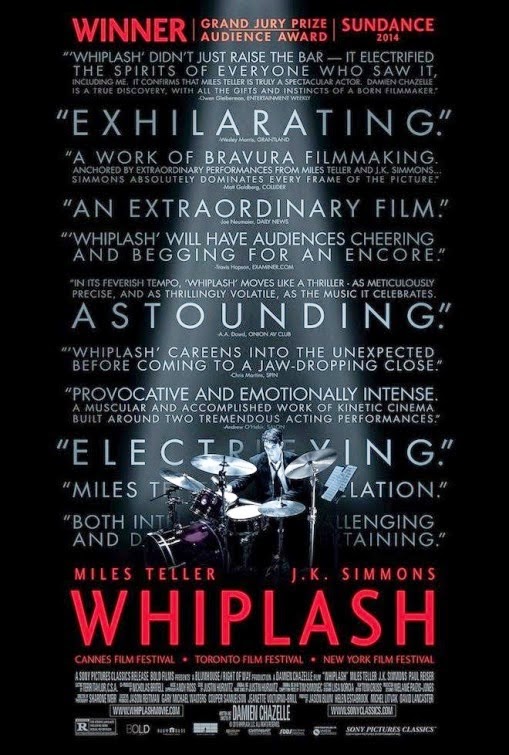
DVD Review: Whiplash – A Conversation With My Father

My wife and I recently watched the award winning Whiplash.Whiplash It is a phenomenal movie and stirred something in me. I found at times that I was holding my breath and my heart was racing. I watched a few scenes over again and had the same effect (you can watch one of my favorite scenes at the end of this review). If you’re going to watch it, though, know that the language is raw and graphic – clearly a reason the movie is rated-R. After making a comment about the movie on social media, my dad, Paul Linzey, mentioned that he and my mom had also recently watched it. Then I had a great idea: Why don’t I co-write a review with my dad, looking at some of the themes of the movie from a biblical perspective? So today’s review is actually from an ongoing email conversation he and I have been having over the past couple days. I’ve enjoyed it immensely and hope you find some value in it. 🙂

Chris: I’d like to kick off with the theme of relationships since I’m doing this with my you. There are three primary relationships I can identify in the movie:

– Andrew and his dad
– Andrew and his girlfriend
– Andrew and Fletcher

I think it’s pretty clear that Andrew’s relationship with Fletcher overrides the others. Here’s what I find interesting, though. While the girlfriend moves on and finds someone else, the dad is constant throughout Andrew’s ups and downs. They go to movies together. Dad stocks Andrew’s apartment with snacks. When the lawyer is trying to convince Andrew to testify against Fletcher, Andrew asks his dad, “Why are you here?” Dad’s response? “Don’t you know there’s nothing in the world I love more than you?” Even when Andrew returns to play with Fletcher for JVC after both had been kicked out of the conservatory, his dad was at the performance and ran backstage to hug the son in his most embarrassing moment. I’m very much reminded of the father in the Prodigal Son story. No matter what the son did, the dad is still there to throw his arms around his son and proclaim his love.

Paul: Yeah, the relationships are a powerful part of the story. And at times they’re pretty painful. Like in the scene at the family dinner table. It’s obvious the whole family is so proud of the football star and totally unimpressed with Andrew’s musical ambitions. You can feel his pain and anger when he points out that the football player is merely at a Division III college. In other words, it’s not worth bragging about. But nobody gets it, and Andrew is still considered the oddball whose goals and values are meaningless. But you’re right about the dad’s loyalty. Even though he didn’t understand his son, he was always there, like you pointed out. There’s a verse in the Bible that says

“Train a child in the way he should go, and when he grows up he will not stray from it.”

Some commentators point out that the terminology in the text is farm language, agricultural terms, specifically having to do with shaping and growing trees. If this is so, they believe the point of the verse is that good parents will find out their child’s interests, callings, and personality and adjust their parenting methods to bring out the best in the child – to help the child discover his or her direction in life. It’s not telling parents to make sure they raise the child the way they want the child to turn out. There’s more to parenting than that. It’s an art. It requires diligence, attention, getting to know the child intimately. It calls for relationship patterns that allow the child to explore and experiment. And the wise parent guides the child in the process of becoming. I didn’t see Andrew’s family fostering this kind of emotional-psychological freedom to be. We typically use that verse to tell parents how to raise their kids, and to tell our kids what we want them to do. Very controlling, very heavy-handed, very condescending. But maybe it was actually designed to liberate parents and liberate children, freeing all of us to discern what the Lord might want us to do, and to become. And then support each other in that process.

Chris: Let’s talk for a second about Andrew’s intense desire to be the best. In one scene, he tells his girlfriend, “I want to be great.” She responds, “You’re not great?” He comes back, “I want to be one of THE greats.”

Paul: Why are people who excel in almost any field edgy, quirky, OK — weird? Do we have to be so intensely focused and driven in order to be the best? Is it even possible to be “normal” and still be the best in the world at something? It’s true that in order to succeed, we have to make sacrifices. We have to prioritize. But is there a limit to how far we should go?

Chris: I was really pondering this one. I had a friend some years back who thought that all competition was contrary to Christ-like behavior. I’m not inclined to go that far, but I see his point. When you hear Jesus using expressions like “servant of all,” “the last shall be first,” and “the least of these,” it’s easy to see that Jesus has a heart for the underdog. The question is, “How far do Jesus’s teachings call us to care for the underdog vs. how far do Jesus’s teachings call us to BE the underdog?” I’m don’t think Jesus is calling us to eschew success, but there needs to be a healthy balance between success and humility, and my personal opinion is that such humility prevents us from ever achieving the status as “best in the world.”

Paul: It seems clear biblically that the Church will be the underdog societally, especially as we move towards the Eschaton. It’s also true, if I understand James 1:27 correctly, that we are called to care for the underdog. And it is true that we are called to be servants of all. However, that doesn’t necessarily mean we are called to be underdogs, impoverished, or less than the best in our chosen vocation. To follow that logic, each of us would need to be orphaned and widowed to truly be Christian. But that is clearly not the case. Jesus told at least one person that he would need to sell all his possessions and give to the poor, but there were quite a few other rich people he did not tell that to. In fact, there were some wealthy folks who supported him and his disciples so they could do the work of the Kingdom. Same with Paul and his ministry team. I don’t think humility per se is contrary to being the best. Many would agree that Moses would be considered one of the greatest leaders of all time. Yet Numbers 12:3 specifically says he was the most humble man in all the earth. I think you and I would agree that Jesus was the greatest person of all time. Yet, he was humble, according to Philippians chapter 2. And St. Paul was a pretty impressive apostle. Perhaps the best? Yet he displayed some impressive humility. Perhaps understanding of the word “meek” can be helpful here: “Power or greatness under control.” So I don’t believe that humility ought to prevent a Christian from being the best at what he or she hopes to achieve in life, whether as a musician, an athlete, a teacher, a pastor, a plumber, or anything else. In fact, the Bible says,

“Whatever your hand finds to do, do it with all your might.”

Don’t we usually understand that to mean “do your best”?

Chris: I don’t think humility NECESSARILY prevents us from greatness, only when pursuing greatness requires trampling on others.

Paul: Absolutely. I agree. And this is what we see happening in Whiplash. People trampling all over each other. Dog eat dog. Get mine. do what it takes to self-promote. I guess you could say Osteen’s teaching applied to the music industry. It’s all about you.

Chris: BWAHAHAHA! Joel Osteen applied to the music industry – now that.is.funny. Making sure that “I get mine” regardless of how it affects others flies right in the face of biblical principles:

Whatever you want men to do to you, do also to them (The Golden Rule) Matthew 7:12

and

Let nothing be done through selfish ambition or conceit, but in lowliness of mind let each esteem others better than himself. Let each of you look out not only for his own interests, but also for the interests of others. (Philippians 2:3-4)

Switching gears again, how did you guys respond to the language? It was incredibly harsh.

Paul: The profanity was indeed overwhelming. But we knew going in that the main reason for it’s R rating was raw language. More importantly, however, being in the world means we rub elbows with real people, real heathens, real scoundrels. We’re called to be in the world, though not “of” the world. Jesus didn’t avoid sinners. That included prostitutes, tax collectors, and cussers. Besides, there’s not a single word or phrase in the movie that I haven’t heard in the Army . . . . . . . or in the church! An aspect of human existence that I thought the movie showed pretty well was that every one of us has our own pain, our own problems, and our disillusionments. This was true of just about every character in the show. Would you comment on that?

Chris: You hit the nail on the head. The director has even said he approaches life from a dark place and I think the characters reflected that. But each gets so caught up in his own trouble he fails to find the relief that can be found in community. It’s the attitude that greatness only comes through suffering and, while there may be some truth to that, authentic relationships can help heal wounds.

Paul: And that’s where art and the gospel begin to intersect.

Chris: Thanks, Dad.

_ _ _ _ _ _ _
As always I welcome your thoughts and opinions. did you see the movie? What did you think?

Paul Linzey is a pastor, writer, and mentor. A retired Army chaplain, he and his wife live in Lakeland, Florida.
Chris Linzey is a husband, dad, pastor, and writer. Currently an Army Reserve Chaplain, he and his family Illinois.
Chris Linzey is a husband, dad, pastor, and writer. Currently an Army Reserve Chaplain, he and his family live in Illinois.