I know, I know. So many people all talking about Ferguson. I even made a joke that today 50 million bloggers would be posting, telling us all how to think about Ferguson (and I would, probably, be one of the 50 million).
I really wrestled with posting on the issue (obviously I caved). But part of me really dislikes being told I can’t do something, and there was an overwhelming feeling on social media today that white commentators should just be quiet and listen rather than speaking.
I understand the sentiment behind that feeling and I agree that we SHOULD be listening to the stories of other people. Still, asking me not to speak because of the color of my skin is ALSO racist. My skin color doesn’t affect my brain or my spirituality. If pastors were not allowed to speak on issues they had no direct involvement in then we could never preach on a lot of topics. Never having been married to more than one woman I could speak on polygamy. Having never been divorced I couldn’t speak to the biblical view on divorce. You get the point? We speak on the biblical perspective on things even when we don’t have direct experience because we don’t preach our experiences – we preach God’s revelation. That means we can speak to any issue when we come at it from a biblical perspective.
Ferguson and race-relations is no different. I won’t speak to the legal and justice issues, because I’m not a lawyer. I will speak to the idea of biblical behavior, since the Bible is what I know.
We’re all getting it wrong. There seems to be (I’m going to use the word overwhelming again for the second time in a single post) OVERWHELMING feeling that the riots are justified behavior. They are not – at least not from a biblical point of view.
The Bible calls us to exemplary behavior, even when we are mistreated by harsh and unfair people. There is no Christian justification for the Ferguson riots. Before you accuse me of being racist, please note that I also feel that white people were not biblically justified in violent revolution against England (a position I know MANY disagree with).
There is never biblical justification for violent and riotous behavior in order to bring social change. The supreme example of this is Jesus, who never participated in such behavior. When Peter was ready to riot and drew his sword, cutting off a man’s ear, Jesus told him to simmer down.
There is no biblical excuse for the riots in Ferguson.
But the rioters aren’t the only ones getting it wrong. Many of us watching and responding are also getting it wrong. Instead of reacting with compassion and trying to understand the anger and the hurt driving the riots, many get defensive and are content simply to point fingers at bad behavior.
But we need to do better. From a biblical point of view, we are called to care for the outsider, the alien, and the disenfranchised (this is actually an Old Testament AND New Testament concept). Pointing fingers at bad behavior without trying to understand what is motivating the behavior is not seeking to care for the disenfranchised. When the disenfranchised try to tell those in power, “This isn’t right!” the correct response is not, “Sit down and behave!” The correct response is, “Let me help you pursue justice and righteousness.”
This does NOT excuse the riotous behavior. It is simply to say we must do better at caring for those who are not feeling justice being done to them.
There is no easy road forward. There is a lot of anger on both sides that prevents the black and white communities from having real conversations with each other. But God calls us to pursue peace – to be peacemakers. A pastor friend of mine once told me, “The peace that Jesus brought was a costly peace. The peace that He calls US to bring is going to have to cost us, too.”
Until we’re willing to pay that cost and REALLY pursue peace and justice, the conflict will never go away.
So this week a friend send me this video to watch. I was laughing so hard I nearly died laughing.
Seriously, it was pretty bad. Fortunately my wife was able to revive me. Then I watched it again.
Have at it:
While it’s incredibly funny, the video highlights an all-too-true reality: We judge people based on external qualities and then form opinions based on those judgments. I know what you’re thinking:
“Oh boy – here we go again. Another post on race.”
Well…yes. While some deny it or try to trivialize it, the truth is that this is a common experience in the world. As husband to a mixed-race woman I’ve been there and have heard people ask:
“So…what are you?”
“Where are you from originally?”
Here’s a true story – Years ago we were interviewing for a church position. We had sent in a resume, photograph, sermon sample, etc. The search committee called me to conduct a phone interview. Over the phone one of the deacons asked, “What ethnicity is your wife?” My response? “Um, why does it matter?”
We did not end up going to that church.
Our problem is that, in these questions we pretend that we’re not racist. But we are. If we weren’t racist why would we even need to ask the question? I know, know. You’re just curious. You just want information.
Baloney.
That’s the kind of question you ask when you have a real relationship with and you end up having a conversation about family trees. It’s not something you ask someone superficially.
The Apostle Paul tried to address the way we view each other and the ways those views play out in behavior. He said that there is no class distinction in Christianity. There is not race distinction in Christianity. There is no gender distinction in Christianity. In Jesus the playing field is leveled. We are no longer this or that. We simply are. When you ask a person what he is and where he comes from you are taking away his ability simply to be.
That’s not Christian. Well, I suppose it too often IS Christian.
So there’s a minor kerfuffle going on with Megyn Kelly of Fox News. The other night she was talking about an author who wanted to do away with the idea of a white Santa. Ms. Kelly found the idea to be ludicrous and insisted that there are some people whose ethnicity you cannot touch. Jesus, for example, was a white guy – you can’t change what it is.
Here it is…
Now, here’s the thing. There have been a lot of people making fun of Ms. Kelly. I’ve even cracked a few jokes like:
Of COURSE Jesus was white. Who on earth would want to worship a middle eastern Jew?
Please understand that the previous sentence is a joke – I’m not serious. The simple fact of the matter is that Jesus was a middle eastern Jew. There’s a good chance he looked like a lot of cab drivers in New York.
In the midst of the discussion about Ms. Kelly’s goof there have been some accusations of racism. We need to be careful about the words we use, because I don’t think racism is at play here.
Racism is treating people as inferior because of their race.
What happened on Fox News the other night was not about inferiority. It wasn’t racism. It was racial bias but not racism. And racial bias is normal. It is a normal human trait to imagine stories from our own perspectives. When we read our imaginations usually make the characters look like us. Even when the author is clear about a character’s description we will often overlook that description in our heads.
There were many fans of The Hunger Games who were upset when the character Rue was cast as a little black girl. They failed to recognize the description the author provided and filled in their own gaps from their own perspectives….
The story of Jesus is no different. We don’t have any photos of the man, so we are left to use our imaginations to see him. Left to ourselves, we fill in the blank spots from our own experiences, culture, and background.
Megyn Kelly wasn’t being racist. Ignorant, sure, but not racist (and honestly, it’s hard not to see Jesus as white when the majority of sacred art we’re exposed to is European…).
One of my most prized possessions is a book called “The Life of Jesus” (1978, Buechner and Boltin). I don’t think it’s in print any more, but you can get it used on Amazon.
It’s the story of Jesus combined with sacred art from around the world. Let me show you some famous art of Jesus…
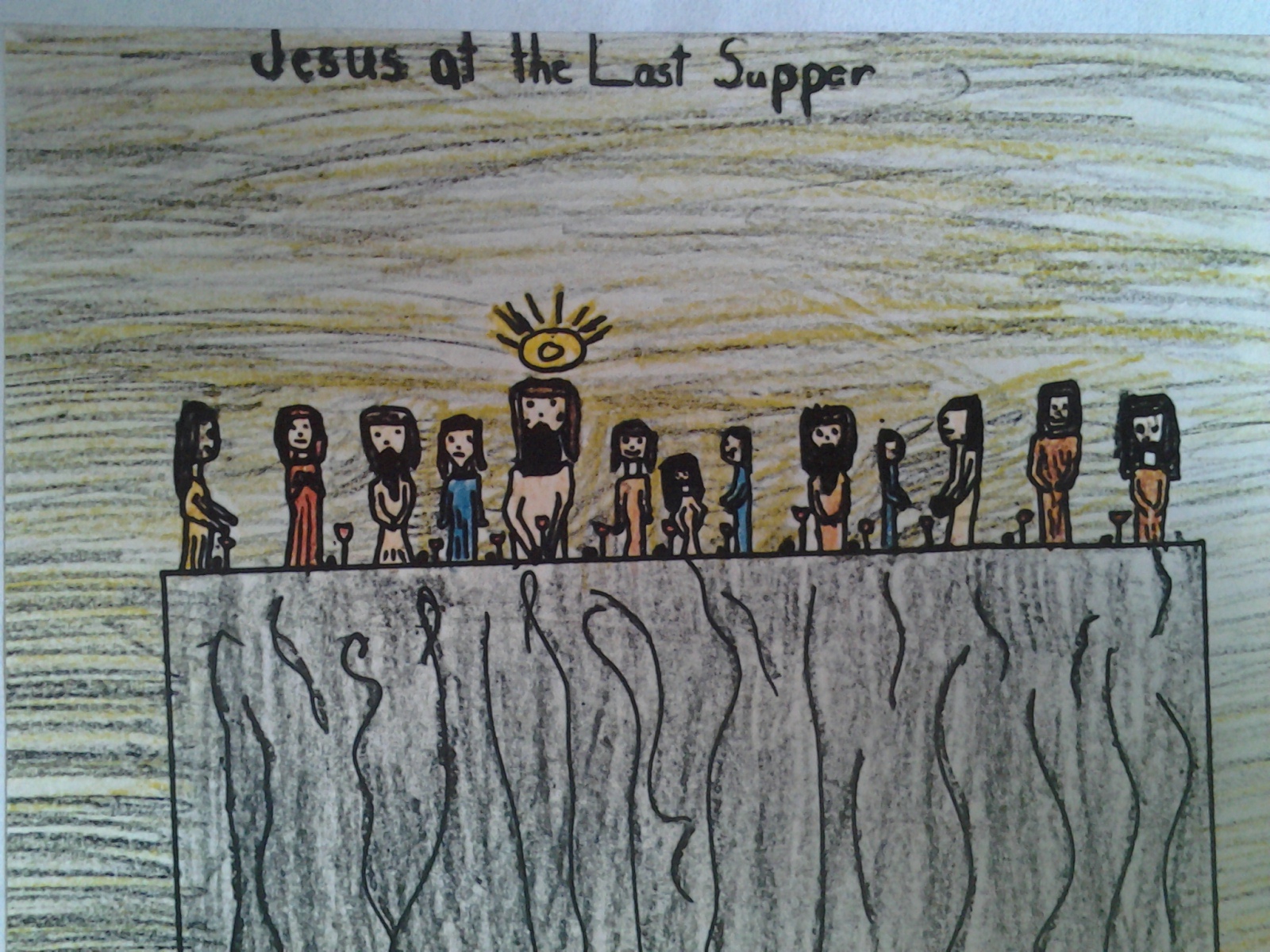
Christ Crowned with Thorns. Wood. Philippines, 20th CenturyVirgin and Child. Oil on Canvas. Uruguay, 20th Century.The Last Supper. Crayon on Paper. U.S.A., Contemporary.Mother of Divine Grace. Textile. Japan, Contemporary.Crucifixion. Bronze. Italy, 1933.Adoration of the Magi. Rome, circa 200.The Holy Family. Painting on Silk. Japan, 20th Century.
We all tend to fashion the Bible from our own background. Is it wrong to see Jesus as a white guy? As Japanese? As African? Historically, sure – he was a middle eastern Jew. But the whole point of the Incarnation is that Christ is WITH us. God is not far away and removed – He is one of us. So the God who left heaven to be like me might look like me. What other god ever bothered to become like us?
The mystery and magnificence of YAHWEH is the Incarnation. His name is Emmanuel, which means: God with us.
Ms. Kelly might want to apologize for her cultural bias and ignorance but I don’t fault her for seeing Jesus from her background and heritage. I don’t really expect my blog will ever cross her path, but if you do know her send her the link, okay? 😉
This Christmas season take some time to reflect on the idea that God cares enough for us to become like us. To feel like us. To suffer like us. To die like us.
Image courtesy of Victor Habbick at FreeDigitalPhotos.net
Hooray, I’m White! I wish all of you could be white, too. It’s pretty awesome. I don’t randomly get pulled over by the police when I’m driving. I have a fairly easy time making my way through airport security checkpoints. I get left alone by clerks when I’m shopping and perusing. Heck – I can even wander aimlessly and still not be eyeballed by nosy employees. I’m fairly certain that everyone would choose to be a white guy like me if they knew how many perks and benefits I get.
Yes, being a clean-cut white male is one of the best decisions I have ever made in my life…
I hope you are intelligent enough to know that I’m being facetious. As Boromir might say:
Boromir on Racism
Yet we cannot deny that there is unfair treatment towards people of different ethnic groups and different skin tones. Racism is a problem that we will be combating for a long time.
I recently came upon a picture on Facebook that talked about fairness to the gist of: If Black people have Black Pride, why is it wrong for us to have White Pride? The basic sentiment was that these people thought it was unfair for Blacks to have scholarship funds, Pride, and everything else yet it would be racist and politically incorrect to have any of these things for Whites.
The basic flaw with their position is that, as I mentioned earlier, it’s already pretty great being White. Most of American society is geared towards me. Movies, Television, College…and on and on. Heck, when this nation was founded people like me were considered 5/5 of a human. I’m whole! Yay, me!
Not so much for minorities. Most of American society has not been geared towards real equality. When only 3/5 of the Black population was counted for purposes of government representation our founding fathers (you know, those great Christian men who birthed this great Christian nation) created an inherent inequality.
In order to maintain any kind of community cohesion, there has been a necessity for Blacks to pursue avenues like the NAACP, UNCF, and the like. These organizations strive to see Black individuals validated. I have never had to fight for validity – I’m White.
In a perfect world it would not matter what anyone looked like. Jesus was commended for his authenticity and his ability to be real no matter who he was talking to. One time the Pharisees complimented him and said:
“We know you are true and that it doesn’t matter to you who anyone is, for you don’t look at men’s faces.” (Mark 12:14)
We do that – we see who we’re talking to before we act. Not Jesus – he was real no matter who was standing before him. That ought to be our goal. In the meantime, why do we have a problem with organizations that seek to give people a sense of validity?
We have a choice – we can perpetuate racist animosity or we can choose to join the cause to seek validation for ALL ethnic groups. So there are groups that exist to help minorities – the Church (and the Christians of the Church) should support such causes. Rather than begrudge people a stepstool, why not help people who are not as fortunate as I am to have picked a White family to be born into? 😛
Many kids in church grow up singing:
Red and Yellow, Black and White – they are precious in His sight. Jesus loves the little children of the world.
Image courtesy of Stuart Miles at FreeDigitalPhotos.net
I make no secret of the fact that I am a big fan of television and movies. Often times after a tv show has been running for a while it will save production costs and time and commit a whole episode to clips from previous episodes – it’s called a clip show.
Today is my day. I hit 100 posts on my blog and I wanted to take some time to look back over the last 4+ months of writing. In that time I’ve had nearly 8,000 views and over 200 likes (thank you all for reading and liking).
Rather than highlight the most popular posts, though, I wanted to share my person Top 10 – the posts that I liked the most even if they weren’t the most popular to readers (although many were). So without further ado, here is my list:
My Kids Don’t Know They’re Black ~ In this post I talk about race relations from the standpoint of my kids. I find that there are a lot of ignorant people out there who say and think stupid things, especially when it comes to race. This was the first post where I literally felt compelled to write. It kept me up thinking about it – I couldn’t sleep until I sat down and hammered it out.
Reflections on Racism from a Mixed-Race Couple ~ Here my wife and I look at racism from our own perspectives. As much as I know her I’m always reminded that her take on racism comes from a very different place than mine. I loved writing this post because I got to co-write it with my wife. I keep trying to get her to write more, but no success yet.
Christian Beer…I Mean Liberty ~ Christian freedom is one of the most misunderstood and hotly debated issues in the church. What are we allowed to do? What are we not allowed to do?
Patriotism vs. Faith ~ We often confuse the two. It’s a personal pet peeve that many Christians equate patriotism with Christianity. You can be one without the other.
THAT OFFENDS ME! ~ Another pet peeve – people who try to manipulate other’s behavior through mishandling the Bible. Just because something offends you doesn’t mean the other person must stop doing it.
Forced Gay: Punishment for Religious Dissent ~ Oooh, this one got me into some tense conversations. It seems that my own view of Gay Marriage was not clear. I had people question me as to why I was going against the Bible (I wasn’t, but people get hot-headed over sensitive issues).
Leave Your Bible on Your Shelf ~ A personal favorite of mine, this was a post where I was responding to another blogger. It doesn’t matter whether your Bible is leather-bound or on your smart phone – it’s still Scripture.
Shirt Sleeves ~ I love my son. Tremendously. I can’t even think about him without warming over on the inside. He’s my little dude. I love writing about him, too.
Jesus Loves Dinosaurs ~ This was just a fun post to write (and the idea of Jesus hugging a dinosaur always makes me smile).
September 11 is a strange time for Americans. It’s a day where we lump together a bunch of emotions and attitudes into one big kettle: loss, grief, sorrow, anger, self-righteousness, racism, vengeance, patriotism…and that just to name a few.
It was an event that shook America to its core. It’s one of those events where everyone remembers where he was and what he was doing when it happened. It was an event that forever altered reality.
On the anniversary of that day I want to reflect on some issues.
First: This is a time to remember those we lost. Nearly 3000 people died. The ripple effects of those lives is huge. It is appropriate to think of those people, to mourn our loss at their untimely passing. I was once asked if it was selfish to grieve over the loss of a loved one. I wouldn’t call it selfish – I would call it human. We build bonds and attachments with people. It is normal to feel pain at having people taken away. But yes, grief focuses on personal loss and not on the final destination of the other.
Second: This is a time to turn to God. In the midst of that tragedy God provided comfort that no one else could. The psalmist writes:
God is our shelter and our strength. When troubles seem near, God is nearer, and He’s ready to help. So why run and hide? No fear, no pacing, no biting fingernails.
When the earth spins out of control, we are sure and fearless. When mountains crumble and waters run wild, we are sure and fearless. Even in the heavy winds and huge waves, or as the mountains shake, we are sure and fearless.
Trouble is on the horizon for the outside nations, not long until kingdoms will fall; God’s voice thunders and the earth shakes. You know the Eternal, the Commander of heavenly armies, surrounds us and protects us; the True God of Jacob is our shelter, close to His heart.
(Psalm 46:1-3, 6-7)
The earth definitely changed on 9/11. And this song, written thousands of years ago, is still as appropriate today as it ever was. We who believe have a reason for peace – even in the middle of chaos. We who believe have a Power greater than any other power on which we can depend. When the world is falling down around us we turn to Him and find hope. We find comfort. We find peace.
Third: This is NOT a time to embrace hatred and racism. Over the last 15 years I’ve seen many Americans speak and behave as though 9/11 gives us freedom to hate, belittle, or discriminate against people of Middle Eastern descent. Let it not be so. It is wrong direct our anger towards Middle Eastern people. Over the years since 9/11 I’ve heard many derogatory comments about Arabs. Racism in any form is NEVER okay. It really doesn’t matter what you feel the other ethnic group has done – no group is so monolithic that you can fault all for the actions of a few. Would you lump Arab Christians into your hatred? It’s just stupid. Let’s fault the bad guys and not lump others in simply because of their ethnic group. It’s poor logic. It’s the logic that looks at the Charles Manson “family” and hypothesize that all white people are cult-following murderers. So let’s drop the racist element from 9/11, huh? No more “Kill ‘em all and let God sort it out” attitudes.
Fourth: As difficult as it might be, for our own sake we need to practice forgiveness. We forgive others because we are people who have been forgiven. Jesus himself taught us to pray:
“And forgive us our debts, as also have forgiven our debtors.” (Matthew 6:12)
Forgiveness does not seek vengeance. We do need to seek justice for wrongs. One of the roles of government is to hold people accountable for wrong doing. But as individuals we can let go of the idea of vengeance and move forward in forgiveness. Because let’s be honest…a lot of our mentality (not just from politicians and military leaders but from civilians as well) regarding the “war on terror” has been about vengeance, not simply justice. It’s not our place to avenge.
Image courtesy of nuttakit at FreeDigitalPhotos.net
Permit me to get out my soap box. I waited a couple days, debating whether or not I should even bring this up again. But the firestorm that I caused in my circles only solidifies in my head that we need to be talking about this…
If you had told me a year ago that I’d be arguing against Evangelical Christians in support of civil rights for same-sex couples I would’ve told you that you were nuts. Yet here we are.
A couple of days ago I wrote a post revolving around the wedding photographers in New Mexico that refused to provide services for a same-sex marriage. The Supreme Court of New Mexico ruled that the photographers had violated the couple’s civil rights – and Evangelical Christendom roared.
After a lot of thought about it and an eventual change in my own position, I publicly stated that I think the photographers were wrong to discriminate against the couple and that all Christians should think twice about refusing service to same-sex couples (I’ll post the link to my full post below).
I know that my position would clash with mainstream Evangelical thought, but I never expected the backlash I saw. And, not being one to back down from a verbal sparring, I’m going to write about it some more. I’m convinced more than ever that the Church has got to make some changes in how it approaches the LGBT community – for Christ’s sake. So…here we go.
I am a conservative Evangelical Christian (at least I thought so). I believe that God designed sexuality to be between one man and one woman who are married to each other. This means that adulterous relationships, fornication, and same-sex relationships are not part of God’s intended design. I believe that the Bible makes this case. I believe that nature and human physiology itself bears this out.
At the same time I believe that the Church should not be party to mistreating and discriminating against people – any people. I believe that the Church has been complicit in such discrimination. In my last post I compared the photographers’ behavior to establishments in the south that used to post “Whites Only” signs out front. I received criticism from Christians who told me that I cannot compare the racially charged civil rights movement with same-sex issues. I was told that the gay marriage issue is different from REAL civil rights.
To me it’s not an issue of gay marriage, racial equality, or any other issue. The topic at hand is about businesses refusing to serve certain elements of the public because of a personal disagreement with that element. Who gets to decide who is worthy of service or not? If conservative Christians can refuse to serve the LGBT community, who’s to say that racist business owners can’t refuse to serve other races?
I know, I know. “Racism is different.” That’s what I was told by other pastors. “You can’t compare racism with LGBT discrimination because racists distort the Bible for their own ends while we understand that the Bible is clearly against homosexuality.”
Excuse me?!?
Do you understand what was just said? “It’s wrong for racists to discriminate because they believe the wrong thing. It’s okay for us to discriminate because we believe correctly.” This infuriates me. The whole idea of freedom of religion is that we don’t hold another person’s private beliefs against him. You can believe anything you want and I can believe anything I want and we still come together as citizens in the same nation.
You can’t claim that your discrimination is okay because you read the Bible correctly and say another person’s discrimination is wrong because they misread it. So the civil rights laws step in and say, “We’re going to make sure that all people are treated the same no matter what their status or what your personal beliefs may be.”
If you have a business that serves the public you are not allowed to say, “Well…I won’t serve THOSE people.” I was told by other Christians that vendors ought to be allowed to refuse service to same-sex couples because a gay marriage might violate the vendor’s idea of marriage as a covenant between the couple and God. I agree that marriage is designed to be a covenant between the husband and wife and between the couple and God. Being a vendor does not endorse the views of the couple.
A baker can bake a wedding cake without endorsing the couple. The florist can arrange flowers without endorsing the couple. A Christian waiter can’t refuse to wait tables if it were an engagement party for a gay couple.
A Christian owner of a candle store doesn’t vet her customers to make sure that no Wiccans buy candles. “Excuse me, are you Wiccan? Because I won’t sell these candles to you if you’re going to go conjure up spirits with them.”
In all honesty, I sincerely doubt that Christian wedding vendors are performing background checks to make sure that every couple they serve fits the biblical model of marriage. Would the vendor refuse to provide services for a man who divorced his wife so that he could marry his mistress? They never even ask that question. At least I was never asked about my relationship background when my fiancée and I visited vendors. No one double-checked to make sure it wasn’t an adulterous relationship.
Rather than pretending that we care about God’s ideal for marriage, we should simply admit that we’re picking a particular segment of society to discriminate against. It’s the thing to do. Gay relationships offend our sensibilities more than an adulterous relationship. It’s become socially acceptable within the Church to single out the LGBT community for condemnation.
The natural follow-up question I received: “If you believe this way would you marry a same-sex couple?” And without hesitation I answer all who ask, “No, I would not.” As I said, I believe that God’s design for sexuality is for one man and one woman who are married to each other. It was at this point that I was called a hypocrite, putting myself and other pastors up on a pedestal while calling out non-clergy Christians.
I don’t see it as hypocritical. I genuinely see a difference between a wedding vendor and a pastor. I was told by one Christian that there is no difference between a pastor and any other vendor or justice of the peace. Am I not obligated being licensed by the state to perform same-sex marriages?
Let me clarify in case you did not know: pastors are not licensed by the state. I have never been nor will I ever be licensed by the state. I am ordained by the church. The state merely recognizes the church’s endorsement of the clergy. I am not a vendor – I am a pastor and spiritual care-giver. I do not claim to serve the public through my service. Pastors are not the same as vendors. We’re not the same as a justice of the peace. When I marry a couple it is more than a ceremony. I pastor them – talk to them about what marriage looks like from a biblical point of view. I talk to them about God’s ideal for healthy relationships. I read Scripture to them. I’m not a vendor, I’m a pastor. That might not make a difference to you – it makes a difference to me.
A friend commented to me that any issue combining civil issues and moral issues is messy. It is messy. There is no easy solution or answer to this stuff. But I do see too many Christians behaving poorly. We’re not acting like Jesus.
There were several times in Jesus’ public life that he encountered “sinners”. In these encounters we see him acting the same way. He talks to them. He touches them. He cares for them. He loves them. THEN he tells them to go and stop sinning. Not so much the Church today. Our attitude is often, “Go and stop sinning. Then come back so we can love you.”
I’m ready for the Church to lead the way in loving people. Too many Christians think that loving people means encouraging and allowing sin. I’m not for a soft-sell faith. I’m not for white-washing Jesus. I still believe in the Jesus of the Gospels who proclaims, “Repent, for the kingdom of heaven is at hand.” But we forget that he loved first, called for change second. And, honestly, I think most people in the LGBT community know my position as an Evangelical pastor. I don’t have to beat people over the head with my view of the Bible. I can love them in spite of our differences.
So…call me hypocrite. Quote Proverbs to me. Tell me you think I’m going against sound judgment. Tell me that you can’t believe I’ve fallen away.
Me? I can’t believe the Church has become so coldhearted. We don’t have to stop preaching righteousness. We don’t have to stop talking about Jesus, the cross, and forgiveness of sin. But we don’t have to discriminate, no matter what our differences may be.
We can still love people, no matter who they are or their type of sin. At least – I think that’s what Jesus would do.
So I’m off my soap box. Please feel free to send this to CNN. Or Oprah. It would be kind of cool to be on the air as the Evangelical pastor who is against gay marriage but for civil rights. But keep it away from Fox News – I don’t want to be crucified… 😉
I welcome all discussion, just keep it civil and polite. If this post resonates with you in any way, please share it on Facebook, Twitter, or email!
If you haven’t heard by now Nidal Hasan, the Soldier who murdered 13 people and injured dozens others in a mass shooting back in 2009, was finally convicted – found guilty of premeditated murder. You can read about it here. I wanted to take a few minutes to respond because I believe how Christians respond is important.
It will be very easy to let our response focus on the murderer’s religion. He is a Muslim. His shooting spree seemed (at least in part) to be motivated by a reaction to American involvement in Muslim nations overseas. Prosecutors claim Hasan believed he had a jihad duty to kill as many Soldiers as possible. He also yelled, “Allahu Akbar” (God is Great in Arabic) before opening fire on innocents. Yes, there seems to be a strong connection to his Islamic faith.
I know that there will be many individuals (and conservative talking heads) who will want to point out that Islam is not compatible with the West and will always be opposed to Democracy. I’ve heard the arguments that Islam will never truly be peaceful towards Christianity. It is easy to lump all Muslims into a single category. It’s almost a natural reaction because we’ve been at war in Muslim nations for so long. Americans been attacked at home and abroad by Muslims. And I will be totally honest here – I also believe that in the big picture Islam will never be at peace with Christianity.
I do not believe, however, that we can demonize all individuals because of the actions of others. I do not want to lumped together with “Christians” from Westboro Baptist Church. Hasan is Muslim, yes, but he acted alone. The tendency will be to look sideways at all Muslims (indeed, all brown-skinned foreigners) as if any of them, at any moment, might open fire. But let’s not jump to that extreme. Before you know it we’ll be creating internment camps for anyone who is “other than.”
Let’s remember that sick individuals do sick things all the time without greater ties to worldwide movements. When a white teenager opens fire on a movie theater we don’t go around acting suspiciously of all white teens (well, maybe some people do, but in general I think not!). Jump off the bandwagon and turn off Fair and Balanced news outlets and use common sense. Messed up people do messed up things. Don’t fly off the handle – Hasan admitted to the shooting and was found guilty. He will pay – possibly with his life.
From a biblical point of view we need to consider the words of the Apostle Paul:
Bless those who persecute you; bless and do not curse. Do not repay anyone evil for evil. (Romans 12:14,17a)
Nidal Hasan committed atrocious acts of evil against dozens of people. There is no excuse. There is no justification. But God calls the faithful to live a different way – without seeking to do damage to the offender, God calls us to bless and to avoid vengeance. We are to pursue forgiveness, in spite of what people do to us. It’s hard to even talk about, much less to live out. Like the Matthew West song says:
It’s the hardest thing to give away, it’s the last thing on your mind today – it always goes to those who don’t deserve – – -forgiveness
There will be hours of talk radio and news reports filled with stories, speculation, and judgments against Nidal Hasan. He will get what is coming to him. Even if you think his earthly punishment is not severe enough we can rest knowing that all of us will one day stand before the Creator of the Universe and give an account for our behavior here on earth. Hasan will. I will. You will, too.
So let’s not focus on hatred and fear and loathing of this sick and evil man. Let’s turn those emotions over to God. If you have to direct your focus anywhere, grieve and mourn with the families that are suffering loss because of this man’s actions. Love on the survivors.
Image courtesy of Victor Habbick at FreeDigitalPhotos.net
I’ve said it before and I’ll say it again: this country has lost its ever-lovin’ mind. It is clearer than ever before that we face sharp distinctions between categories of people. Distinctions in and of themselves are not bad things. Our lives fall into categories based on a variety of things: age group, ethnicity, gender, education level, income, homeowner or renter…and the list goes on and on. It’s impossible to live a “category-free” life.
The problem is when we discriminate based on categories. In simpler terms, discrimination is about playing favorites. Every grade-school child knows about playing favorites. The popular or athletic kids are always picked first for games. The kids in the negative categories (unpopular, overweight, uncoordinated, whatever) are discriminated against and picked last – if picked at all. Playing favorites. Discrimination. It’s the same thing. It’s about treating some people more or less favorably based upon some quality or characteristic.
This isn’t a new phenomenon; it’s been going on since the dawn of time. In his letter to the Diaspora James writes:
My brothers, show no partiality as you hold the faith in our Lord Jesus Christ, the Lord of glory. For if a man wearing a gold ring and fine clothing comes into your assembly, and a poor man in shabby clothing also comes in, and if you pay attention to the one who wears the fine clothing and say, “You sit here in a good place,” while you say to the poor man, “You stand over there,” or, “Sit down at my feet,” have you not then made distinctions among yourselves and become judges with evil thoughts?
Listen, my beloved brothers, has not God chosen those who are poor in the world to be rich in faith and heirs of the kingdom, which he has promised to those who love him? But you have dishonored the poor man. Are not the rich the ones who oppress you, and the ones who drag you into court? Are they not the ones who blaspheme the honorable name by which you were called? If you really fulfill the royal law according to the Scripture, “You shall love your neighbor as yourself,” you are doing well. But if you show partiality, you are committing sin and are convicted by the law as transgressors. (James 2:1-8)
James’ audience had a particular problem of treating wealthy people better than they treated the poor. The rich got the best seats and the most attention. The poor got the floor and the cold shoulder. The principle at work in his churches is the same principle that drives discrimination today: paying attention and responding to outward appearances is the primary way of showing partiality.
Not only is discrimination incompatible with authentic Christian behavior but it is actually sinful. It is contrary to the will and character of God to discriminate against and treat people as less-than because of a category to which they belong. If you show partiality you are committing sin. That’s not me saying that – it’s the Bible. The Bible repeatedly tries to move us away from a mindset of discriminating against people, showing favoritism, because of their categories.
One of the most popular stories from the Gospels is about Jesus calling out his disciples for discriminating:
Then children were brought to him that he might lay his hands on them and pray. The disciples rebuked the people, but Jesus said, “Let the little children come to me and do not hinder them, for to such belongs the kingdom of heaven.” (Matthew 19:13-14)
Even Jesus’ closest companions fell into discrimination. It happens whenever we start to think less of someone because of his status. He doesn’t count as much, he’s only a child. She doesn’t count as much, she’s just a woman. They don’t count as much, they’re not _________ (fill in the blank). There is no room for discrimination in God’s Kingdom. God doesn’t play favorites – why do we? It’s because we let our identity come from our categories rather than from God. We’re ethnic before we’re Christian. We’re political before we’re Christian. We’re employees before we’re Christian. We’ve got our priorities backwards. We need to shed the classifications of this world. Our sense of identity ought to come from God.
So what’s the answer? First, we have to change our allegiances, our priorities, our categories. We need to stop seeing others with the classifications of this world and start seeing people through God’s eyes. It comes down to loving people the same way you love yourself (a biblical concept). No one wants to be treated as less-than or other-than. So don’t treat others that way.
Second, we need to see OURSELVES without the categoriesof this world and see ourselves through God’s eyes. One of the early leaders in church history was a young guy named Timothy. It seems that some preferred to classify Tim by his age rather than by his calling as Pastor. Paul instructs Tim to shed the human classifications and to remember the calling that God has given you.
It’s time to make a change. It’s time for Christians to lead the charge. We should not put up with discrimination. We should recognize that identity is not determined by human categories but on our Creator. Imagine a world where physical distinctions disappear and we treat each other decently simply because we’re all made by the same creator. It’s tough – I know. But try. Drop all the other labels and put on this one: CHILD OF GOD.
How about you? How have you been discriminated against? In all honesty, how have you discriminated against others?
We may not live in the Wild West but sometimes we sure do act like it. We become gunslingers, looking to take down our enemy at high noon. Instead of six-shooters, though, we use words. Words have power.
With our words we can cut people down. With our words we can cripple another. With our words we can destroy a reputation or even cripple a business. Words have power. You may have found yourself on the wrong end of someone’s words – what they say to you or about you is terrible and difficult, like looking down the barrel of a .357 Magnum.
Perhaps you’ve already faced the destruction that comes from someone’s harsh and hurtful words and now you’re trying to recover as best you can. Words have power. Choose them wisely.
Too many fail to see how powerful their words are. The tongue can be an ugly thing. We throw around terms and phrases without thinking about the consequences of those power weapons. In the Army every warfighter has to qualify with their rifle. When we go to the range to shoot the instructors are clear to remind Soldiers that they have the responsibility to know where their targets are and what lies beyond. Every time a bullet comes out of the rifle the Soldier is responsible for what happens on the other end. What would happen if we started treating our words in a similar fashion? Stop speaking so quickly and think about your intended target and what happens beyond. Where do the words go? Who might the words hit? Human speech has an enormous capacity for harm or for good. Words have power. Choose them wisely.
The Bible has some practical advice on how we should behave when it comes to our mouths. Not merely some abstract thoughts here – concrete steps on what we can do to gain control of our mouths, to stop tearing people down, and to start building people up. It’s not difficult at all – just three things to remember:
~ Listen up, shut up, and calm down. I don’t know about you, but every time I’m told to “do something” there is a part of me that wants to rebel and do the exact opposite. I remember one time when my wife thought I was driving too fast and told me so. Rather than admit that I might be going a little too fast I punched the gas. Not smart, but that seems to be a human response. When God tells us to listen up, shut up, and calm down there’s part of us that wants to say, “WHAT?!? YOU CAN’T TELL ME WHAT TO DO!” Of course, the Bible doesn’t phrase it so coarsely. It says:
“Let every person be quick to hear, slow to speak, slow to anger; for the anger of man does not produce the righteousness of God.”
Yeah, that’s much nicer. But the point is the same. We too often fly off at the handle and speak without listening, embracing rage and anger. I don’t want to beat a dead horse but we’ve seen just this thing happen in response to the Zimmerman/Martin issue. God says, “Listen first, speak second, and hold back on the anger.” But we’re doing just the opposite! An entire nation is quick to speak, slow to listen, and fanning the flames of rage and anger. In all fairness, it’s both sides of the fence that are behaving this way – not merely one party.
We forget that words have power. Racist words. Sexist words. Slander & Gossip. Manipulation. There are many ways that we use language to cut each other down. And we let our rage fuel our pet issues. But the Bible is clear that human anger may bring about vengeance or payback but it does not bring about divine justice. It doesn’t reflect the character of God nor does it accomplish that which God would regard as true righteousness.
It’s hard even to imagine our world filled with people who are listen first, take their time to respond, and stay calm. But it will never happen if we don’t start to imagine it. Imagine a world where people actually lived out watching what they said and using words wisely. This means we need use our words to build up and not tear down. Like a little spider or a hand grenade – the tongue isn’t so big, but is capable of great damage.
Be careful, little mouth, what you say….
How about you? How have you been hurt by words? How have you hurt others with your words?












 We don’t have to stop preaching righteousness. We don’t have to stop talking about Jesus, the cross, and forgiveness of sin. But we don’t have to discriminate, no matter what our differences may be.

 Chris Linzey