Image courtesy of Stuart Miles / FreeDigitalPhotos.net
Have you ever wondered which Bible version was the best version? If so you’re in the same boat with most Christians. When it comes down to it, people usually base their choice on two factors: 1) what they’ve been taught by their pastors and 2) what they’ve grown up with in their own Christian life. There is sometimes a third factor: readability. Sometimes people will choose a version based on how easy it is to read and/or understand.
Let’s talk honestly about the different versions and what they mean. Hopefully you’ll be able to choose wisely and with discernment for your own needs.
The first real difference between versions has to do with the original manuscripts. The Bible was not written in English but in Hebrew, Aramaic, and Greek. So any English translation is a secondary work. Most mainstream Evangelicals believe that the original manuscripts are what are inspired, not the various translations. That means that, while translations are different, no single translation is more anointed than any other.
It is important to note that among all of the differences between translations and the original texts they use (KJV uses some different manuscripts than the NIV, etc.) there are no real significant theological differences between any of them. That means we can have confidence that the Bible translation we are reading today is accurate to the Bible the early church was reading.
So then it comes down to a choice of personal preference. Let me walk you through some of the options and why they are the way they are.
There are three mindsets for translators working on a Bible:
1) Translating word for word as much as possible. This is called a literal or wooden translation. These translations would include the KJV, NASB, RSV, and ESV.
2) Trying to blend the literal wording with the actual meaning. This is called dynamic equivalence. These translations would include the NIV, HCSB, and (to a lesser degree) the NLT.
3) Trying to put the Bible into an easy to read version regardless of the original wording. This is called a paraphrase. An example of a paraphrase would be The Message. It is not actually a translation but rather loose approximation of meaning based off of other translations.
Most serious Bible students stay away from paraphrases. While they create an easy to read story, they place fast and loose with the actual text. Since we believe that the original text was inspired, I would rather not give an approximation. On the other hand, being too wooden becomes very burdensome to read and makes for difficult comprehension.
For this reason I prefer a version that is a dynamic equivalent – one that cares about the original text and seriously attempts to bridge the original text with a contemporary vocabulary and comprehension (like the NIV or HCSB). The problem with dynamic equivalent translations, though, is that the translation involves much more interpretation than a wooden translation. What I mean is this:
A wooden translation focuses more on getting the words translated accurately than on meaning. In order to get to underlying meaning, translators of dynamic equivalent versions have to make some educated guesses as to meaning, context, etc. This means that the translators’ personal theology or ideology has a greater chance of coming through in a dynamic equivalent version than a wooden translation. You may not like the woodenness of the ESV or NASB, but they are less likely to include the personal biases of the translators.
In the end, I always tell people that the best version is the one that they will actually pick up and read! No matter what your decision, I have confidence that you’re reading God’s Word to humanity. So find one that works for you – one that you can dig into and spend time with.
Happy reading!
Let your voice be heard: Which version is your “go to” version? Why?
I am calling upon all Christians everywhere (well, at least in God’s special promised land of America) to fire up the Christian Outrage Machine.
Let’s be honest, we were a little concerned what we’d be outraged about once A&E brought Phil back to filming Duck Dynasty. But never fear, new outrage is here!
It goes back to the religious practices (or lack thereof) of the Commander in Chief, President Obama. You see, people who really care about such things have discovered that he’s only been to church 18 times since taking office!
Only 18 times!
That averages almost 4 times a year.
Can you believe that guy? How can he claim to be a Christian and “forsake the fellowship of believers”? You would think that a true Christian president would be in church every Sunday. You would think that a true Christian president wouldn’t act like the majority of Christians in America, who all attend church services fewer than 12 times a year (less than once a month).
No, a Christian president should be better than us. He should be in church more than we are. He should pray more frequently than we do. He should read his Bible daily and have a good chunk of it memorized.
It’s almost as though he has forgotten the righteousness received from the Holy Sanctuary and would rather live a Romans 3:21-26 kind of life ~
But now, apart from the law, God’s righteousness has been revealed—attested by the Law and the Prophets—that is, God’s righteousness through faith in Jesus Christ, to all who believe, since there is no distinction. For all have sinned and fall short of theglory of God. They are justified freely by His grace through the redemption that is in Christ Jesus. God presented Him as a propitiation through faith in His blood, to demonstrate His righteousness, because in His restraint God passed over the sins previously committed. God presented Him to demonstrate His righteousness at the present time, so that He would be righteous and declare righteous the one who has faith in Jesus.
Oh, well. I guess he’ll learn on Judgment Day when God checks his church attendance record. As a Christian Nation we need to rise up against this president’s mentality. We need to show him and teach him a lesson. So, in order to make our statement loud and clear, let’s be in church every Sunday in 2014.
That’ll teach our heathen president a lesson. So I’ll see you Sunday.
I’m disappointed that A&E caved and is lifting Phil’s suspension from Duck Dynasty.
There.
I said it.
I’m disappointed that A&E relented. Changed their minds. Caved.
I’m not disappointed for some moral high-ground reason. There will be enough on the Left who will lament that.
No, I’m disappointed because it will reinforce the bullying of the Christian Outrage Machine. It’s the machine that kicks in whenever the Religious Right feels threatened or attacked. The Right blusters, huffs, and puffs, and tries to blow away the Left-Leaning hippie-commie-scum that are trying to take ‘Merica away.
You see, A&E did not cave because they wanted to provide wholesome, family television for their viewers. They caved because of the financial smack to the face they were about to take. Rather than lose millions (or more?) in revenue, they decided to relent and allow Phil back in the fold.
Actually, the capitalistic system worked quite well. The producer said, “We’re not going to produce XYZ anymore.” The consumer said, “If you don’t we’re going to take our business elsewhere.” The producer responded, “Um…well, okay – you win.”
It’s capitalistic back-and-forth.
I am disappointed because the Religious Right will not see it this way. We (I tend to be conservative in my theology, so the Religious are pretty much my people) will interpret this move from A&E as a moral victory, not a consumer victory.
I am disappointed because we view everything through the wrong lens. Instead of looking at the world (and television shows) through a Christian lens, we see the world as Ameri-Christians. We blend our citizenship with our faith and come out with a junky hybrid that isn’t good for either the nation or the faith!
As consumers, we won.
Yay us.
But that’s it. A&E doesn’t agree with our theology or our biblical positions. We will misread and misinterpret these events. The whole thing will quickly be spun into a righteous moral victory. And that disappoints me.
I wish we could have rallied people to save some of my favorite shows in the past. There are some great shows that were killed before their time. But we couldn’t muster the consumer base to make a dent in the producer’s wallet. Duck Dynasty made that dent.
Not Christianity.
If you’re a fan of the show I’ve got nothing against you. I’m glad you get your favorite character back on the show. But don’t pretend it’s about Christianity winning the day.
In the end we show that Christians can bully with the best of them.
Today’s post comes from guest blogger and pastor Jeff Stephens.
The incredibly awesome Jeff Stephens!
Jeff is still a Christian even though he graduated from Fuller Seminary and Vanguard University. He’s also a children’s pastor at Oak Valley Church, loves his big family, and is engaged to Claire Browning. Take it away, Jeff!
I know, I know. I’m beating a dead duck.
I started this blog, a vague post about celebrity Christianity, last week. I wrote about how, in America, we’ve baptized the marks of celebrity culture (exorbitant riches, notoriety, ease, good or interesting looks), and turned them into markers of the “blessed” Christian life. I addressed how fame has become a noble pursuit, and how we plebes long to be “great” too. I wanted to say that we’ve bought into the tabloid culture of American celebrity, FREAKING OUT (!!!!!) about everything before bothering to check the facts.
Oh, there’s more.
I wanted to talk about how we even make local celebrities out of pastors, “platform” ministers, and other church leaders (like myself), and how damaging that can be to church leaders (like myself) and to the body of Christ. I wanted to prove that celebrity Christianity is an ineffective means for evangelism, that it hurts our witness in the world, and how it destroys our prophetic voice. Finally I wanted to discuss how we put our pet celebrity Christians on pedestals, to the point where our adoration becomes idolatry. I would use a certain reality TV family as an example.
Image courtesy of James Barker at FreeDigitalPhotos.net
Of course, I would exegete the scriptures in such a way that every reader would have a blown mind and a changed heart. I would show that our obsession with celebrity makes us covetous and ignorant of many of the things that Jesus cared most about. I would illuminate how Jesus didn’t try to keep up with Kardashians, but rejected celebrity and earthly riches at every turn. I would explain the type of Christ the world needs to see in use. I would steal information (indeed, I already have) from a much better Christian blog. The reader would therefore see that I was worthy of the pedestal upon which I’ve been placed. All in 1,200 words or less.
And then something magical happened. You might even say it was my own personal Christmas miracle. Or that I can see into the future.
One of the most visible, uncompromising Christian celebrities in America got temporarily suspended from his TV program. As expected, the so-called Christian Outrage Machine (as coined by a prestigious blogger) came out in full force.
This got my wheels spinning. I said to myself, “Self, what if I can manipulate that blog-in-progress and make it about this current event? Then my blog won’t seem like it was conjured out of thin air, but rather was written in response to something going on in the real world!”
This was a blogger’s dream: writer’s passion meets controversy everybody is talking about! Now I could make my mark in the world, perhaps even have ten minutes of fame.
Upon further investigation, however, I realized that my blog and this controversy had nothing to do with each other. Nobody was putting Phil on a pedestal. If that were the case, tons of people would be changing their Facebook profile pictures, offering their unwavering support for Phil.
Oh wait…
Of course, I’m being facetious. I don’t mean to judge anyone’s motives or heart. And while it’s obvious that this debate is very complex, it is my opinion that, for Christians, celebrity is at the core of the issue. More specifically, it’s about worship.
When we worship, we place someone or something on a pedestal, hopefully for all to see. We show complete adoration and support, even to the point that someone or something is beyond reproach.
The same can be said about celebrity. Celebrity is about celebrating.
Image courtesy of Salvatore Vuono at FreeDigitalPhotos.net
So this past week has screamed of worship to me. We’ve placed a man, a network, a cause, an organization, a country, a doctrine, or ourselves on a pedestal. We’ve worshipped them.
Most obviously, we’ve worshipped the Robertsons, putting them in the spotlight. Today they’re probably more celebrated by their fans than they’ve ever been. You may think this is a good thing, for they’ll have a larger platform. I, however, am of the opinion that God doesn’t need them to have a larger platform. I believe that you can’t increase God’s fame and a man’s at the same time. Instead, it would be better to have the attitude of John the Baptist: Christ must become greater. I must become less! (John 3:30)
We’ve also worshipped the Robertsons by acting as if Phil doesn’t make mistakes. We’ve been unwilling to even hint at the possibility that some of his comments could have been reminiscent of the language of oppressors, or maybe a bit insensitive, or even just naïve. In all of this, we’ve made little gods out of them. We’ve made them shining examples of what it means to be Christian. We’ve acted as if questioning Phil is akin to questioning the bible or even Christ himself. We’ve made them out to be greater than they are. We’ve acted as if a temporary suspension from a tiny reality show (that is watched by .001% of the world’s population) is directly tied to the fortunes of the Kingdom of God. We’ve acted as if the gospel message cannot survive in a world where Duck Dynasty products are not sold at Cracker Barrel.
Instead of pointing people to the righteousness of God, we’ve pointed them to the righteousness of Phil. We’re bent on insisting that Phil is righteous. Yet scripture says that our righteousness is like filthy rags (Isaiah 64:6), that no one is righteous (Romans 3:11). With this in mind, is it possible that, instead of emphasizing our opinion that Phil hadn’t sinned, we should have emphasized the fact that all have sinned (Romans 3:23)? Would it have been better to admit that he did screw up in some way, yet Christ died for him anyway?
I’m not saying we should vilify the man, but these simple acts of humility would have done much to spread the message of Christ.
We’ve also pedestaled those things the Robertsons represent, some of the greatest celebrities of our day: oldendays America, the American dream, shootin’ stuff, and (the granddaddies of them all) the founding fathers and the constitution. Once again, we’ve acted as if those American deities are infallible, and we’ve treated the constitution as if it were scripture.
Don’t get me wrong. I believe freedom of speech is a great thing, and it must be protected. But demanding our rights only calls attention to that most timeless (and American) idol of all: ourselves. Demanding our rights is a way of shouting to the world, “Look at ME!” But Christ calls us to lose our lives for his sake (Matthew 10:39, 16:25//Luke 9:24).
I also believe that we cannot advance God’s mission while demanding our rights. Instead, we must lay down our rights, becoming the servant of all. We must be like Christ, who refused to demand his rights as God. Instead, he took the form of a slave and humbled himself, even to death on a cross. That act of humility and love made him exalted above every other name (Read Philippians 2:1-11).
So what are we to do? Even if celebrity and this issue are unrelated, stories like this give us an opportunity for self-reflection. We can pause to check the planks in our own eyes (Matthew 7:23) instead of acting as if we have specks of sawdust and they have redwoods. We can be humble and admit our own sins, pointing people to the God who saves us in spite of ourselves.
That last point really has nothing to do with Christian celebrity, but I thought I’d throw it in there. I hope your minds are blown and your lives are changed. In 1,300 words or less.
For many years I always thought about the Christmas story from Mary’s perspective. She is, after all, the parent in the Holy Family that gets the most screen time…er –page time?
And then my son was born.
He wasn’t my first child, but he was my son. My little dude. Me: Part II. Please hold off on the feminist rage – this isn’t about gender equality. I’m simply saying that there was a change in my perception when my son was born. Especially when it came to the Christmas story.
All the love and emotion I felt about this little guy is perfectly normal. But how would I have felt if I knew the child wasn’t mine? This is the scandal of the Christmas story. Joseph is saddled with raising a boy that is not his son.
Who wants to be married to a tramp? A slut? A whore? Yes, it offends our sensibilities to think of HOLY VIRGIN MARY in these terms. How would you feel about your fiancée getting knocked up by someone else? Joseph only saw one way out:
After His mother Mary had been engaged to Joseph, it was discovered before they came together that she was pregnant by the Holy Spirit. So her husband Joseph, being a righteous man, and not wanting to disgrace her publicly, decided to divorce her secretly. (Matthew 1:18-19)
Dude was ready to cut and run. The Bible says that he was thinking about Mary’s disgrace, but Joseph was only human. Part of him HAD to be thinking about himself. He was probably hurt. Feeling wounded. Betrayed.
Fortunately the story doesn’t end there. God had to step in and have a “come to Jesus meeting” – literally 🙂
But after he had considered these things, an angel of the Lord suddenly appeared to him in a dream, saying, “Joseph, son of David, don’t be afraid to take Mary as your wife, because what has been conceived in her is by the Holy Spirit. She will give birth to a son, and you are to name Him Jesus, because He will save His people from their sins.” Now all this took place to fulfill what was spoken by the Lord through the prophet: See, the virgin will become pregnant and give birth to a son, and they will name Him Immanuel, which is translated “God is with us.” When Joseph got up from sleeping, he did as the Lord’s angel had commanded him. He married her but did not know her intimately until she gave birth to a son.And he named Him Jesus. (Matthew 1:20-25)
After the birth of Jesus Joseph sort of fades out of the story. We never see him as part of Jesus’ adult life the way we see Mary. This leads some people to conclude that Joseph might have died before Jesus began his adult ministry. It’s possible.
But for a brief moment in time, when most normal people would have thrown in the towel and said, “I am not going to be a part of this,” Joseph stepped up. He gave Jesus his name – the kid probably would have been called Yeshua Bar Yosef (Joshua Josephson). He gave the kid his genealogy – the house and line of Abraham, Isaac, Jacob, and King David.
Joseph, though minimal in how many words are written about him, is crucial to the Christmas story. Without him it’s just another pregnant teen scandal. But he steps up and loves Mary and Jesus in a very practical way that no one else could – he gives them himself, and thus his credibility.
This Christmas think about the scandals in our lives – the ways we bring shame or disgrace upon ourselves. God loves us with the kind of love that pushes our scandals to the side. He gives us His name. He calls us His own. He loves us in a practical way that no one else could – he gives us himself.
This is Christmas.
I think I’ve gotta wrap this up because I’m starting to get emotional and well up with tears thinking about the love a Father can have for his kids.
This is how God loves you.
Glory to God in the highest heaven, and peace on earth to people He favors!
Image courtesy of phanlop88 at FreeDigitalPhotos.net
And like that (imagine snapping fingers) Christian America went bananas. Over television. Okay, not exactly over television. Over a network censuring reality tv star Phil Robertson (patriarch of the Duck Dynasty family) for voicing his own religious perspective on sin – specifically homosexuality, bestiality, promiscuity, drunkenness, (and a few more thrown in in the form of a Bible quotation).
That’s when the Christian Outrage Machine kicked into overdrive.
The Christian Outrage Machine (let’s call it the COM) is the mechanism by which Christians respond militantly with outrage towards any slight (or perceived slight) towards the faith or towards Christian people. When Chick-Fil-A came under fire a while back the COM fired up to defend it. When people want to remove a 10 Commandments statue from a public venue the COM comes to life. It’s everywhere.
But the COM should take a step back, breathe, and calm down a little bit. This isn’t really a persecution issue. It’s not even a love and tolerance issue. It’s a finance and image issue. I’m fairly certain that the nation could guess what the Robertson family’s views on morality would be. It’s not a surprise. I don’t even think the network’s response is due to Phil’s less-than-tactful way of phrasing things. Part of the family’s “charm” that the network promotes is their gritty, down-to-earth quality. If you want fancy oration on the nature of sin and morality you’re never going to find it in Duck Dynasty. The network cashes in on that down-to-earth quality (I do think that Robertson could have voiced his beliefs in a way that was more winsome and less in-your-face-confrontational, but perhaps that’s more my style than his).
No, it’s not about persecution of stating beliefs. It’s really a financial and image issue. The network needs to be as appealing as possible to as wide an audience as possible. If their LGBT demographic is upset it could cost the network revenue. So the execs take steps to pacify the demographic to ensure that the money keeps coming in and that the network maintains an image of being gay-friendly.
It was a business decision, not a persecution-for-the-sake-of-oppressing-faith decision.
Secondly, no Christian should ever be surprised when non-Christians get upset with a Christian view of morality. In fact, we should expect it. Jesus kinda promised that we would have trouble and difficulty, and that following him would put us at odds with the world.
This should make us sad – not outraged. Outrage is the response we have when we become soft and take on feelings of entitlement. We have blended in to the world too much when we feel outrage for being treated poorly. Shouldn’t we be used to it?
On the other hand, to my left-leaning and/or non-Christian friends: please clean up your rhetoric a bit. You have accused Phil Robertson of speaking hateful things against the LGBT community. But disagreeing with someone’s choices is not hate. Phil even said outright:
We never, ever judge someone on who’s going to heaven, hell. That’s the almighty’s job. We just love ‘em, give ‘em the good news about Jesus.”
You weren’t hearing it, but what Phil was saying is that how we treat people is not based on their sin. The left has its own outrage machine, the Liberal Outrage Machine. It gets fired up whenever Christians publicly state that any behavior is wrong. Ironically, Phil comes across as more tolerant that the “tolerant” liberals. He’s saying, “We love everybody and don’t judge, even when we disagree.” The Liberal Outrage Machine is saying, “You can’t voice your opinions! Be quiet!” Dang….
In the end, I am saddened that A&E would try to silence Phil Robertson for speaking what everyone could already have guessed about him. I’m really bothered by A&E trying to hide their financial and image issues behind false notions of tolerance and “doing the right thing.”
I’m also saddened that Christians have forgotten that being at odds with the world is supposed to be part of our standard operating procedures. We’ve grown complacent. We’ve gotten used to dominating society and have forgotten the need to share about the kingdom of God with a broken world.
So where does that leave us? In terms of Duck Dynasty, people who love it will continue to love it. People who hate it will continue to hate it. These outrage issues never sway anyone – they only solidify the lines drawn in the sand. But lines aren’t as important to Jesus as people are.
So, Christian, we can get off the Outrage Machine. The Outrage Machine focuses on us.
It does not focus on Jesus.
And when we focus on Jesus we can love people in spite of being hurt or attacked by them.
Image courtesy of Grant Cochrane at FreeDigitalPhotos.net
Do you ever get sick of greedy, money grubbing churches always asking for your money? For some reason many people have the impression that churches are always asking people for money. Churches have reputation for being money hungry; for trying to squeeze every red cent out of the people who attend. Shoot – I would get tired of that kind of behavior!
In all honesty, though, churches probably ask for money a lot less than you think. I’m not talking about the weekly routine of collecting money. Different churches call it different things:
– Taking the collection
– Passing the plate
– Time for tithes and offerings
– What else have you heard?
Though this has become a standard feature in many evangelical churches it’s not quite the same thing as “asking for money.” It’s not like the Christian radio station that has a bi-annual fundraiser telethon. In the Christian worship service, giving becomes an extension of worship – something we do in recognition that what we have is a gift from God and through our giving we say, “I value God and his kingdom and want to express it through my finances.”
So giving becomes an act of worship (assigning worth to something) and a practical way of making sure the needs of the ministry are met.
I had a friend tell me the other day:
The church doesn’t need money. Jesus didn’t need money.
But the truth is that the church does need money. Ministry requires money. And yes, Jesus did need money. Jesus had a group of financial backers that helped make his ministry possible:
And the twelve were with him, and also some women who had been healed of evil spirits and infirmities: Mary, called Magdalene, from whom seven demons had gone out, and Joanna, the wife of Chuza, Herod’s household manager, and Susanna, and many others, who provided for them out of their means. (Luke 8:1-3)
Jesus and his staff were provided for out of the means (income) of these women.
Once the Apostle Paul was trying to raise money to do ministry to Christians in Jerusalem. He was collecting it from the Corinthian church:
On the first day of every week, each of you is to put something aside and store it up, as he may prosper, so that there will be no collecting when I come. And when I arrive, I will send those whom you accredit by letter to carry your gift to Jerusalem. (1 Corinthians 16:2-3)
There are many different financial needs for a church to do ministry. Some are related to physical location: rent/lease/mortgage, utilities, salaries, etc. Some are material needs for people: rent assistance, utilities assistance, food/clothing aid. Some are for spiritual ministries: materials for communion, children’s church, Bible studies, etc.
Ministry requires finances. And how will people in the church ever know about the need unless the church tells them? It’s plain logic, really. It’s not about being money-hungry, it’s about letting people in the church know that, in order to do what God has called the Church to do, it’s going to take some backing.
If you don’t want to give, no one is twisting your arm.
Paul says:
The point is this…each one must give as he has decided in his heart, not reluctantly or under compulsion, for God loves a cheerful giver. And God is able to make all grace abound to you, so that having sufficiency in all things at all times, you may abound in every good work. (2 Corinthians 9:6-9)
To honor God and to participate in what he wants to do through my church my wife and I give. But that’s between us and God. Your giving is between you and God.
Whatever you decide to do, do it with joy for God, not for anyone else.
BE HEARD! How have you seen churches handle money well? How have you seen them handle money poorly?
So there’s a minor kerfuffle going on with Megyn Kelly of Fox News. The other night she was talking about an author who wanted to do away with the idea of a white Santa. Ms. Kelly found the idea to be ludicrous and insisted that there are some people whose ethnicity you cannot touch. Jesus, for example, was a white guy – you can’t change what it is.
Here it is…
Now, here’s the thing. There have been a lot of people making fun of Ms. Kelly. I’ve even cracked a few jokes like:
Of COURSE Jesus was white. Who on earth would want to worship a middle eastern Jew?
Please understand that the previous sentence is a joke – I’m not serious. The simple fact of the matter is that Jesus was a middle eastern Jew. There’s a good chance he looked like a lot of cab drivers in New York.
In the midst of the discussion about Ms. Kelly’s goof there have been some accusations of racism. We need to be careful about the words we use, because I don’t think racism is at play here.
Racism is treating people as inferior because of their race.
What happened on Fox News the other night was not about inferiority. It wasn’t racism. It was racial bias but not racism. And racial bias is normal. It is a normal human trait to imagine stories from our own perspectives. When we read our imaginations usually make the characters look like us. Even when the author is clear about a character’s description we will often overlook that description in our heads.
There were many fans of The Hunger Games who were upset when the character Rue was cast as a little black girl. They failed to recognize the description the author provided and filled in their own gaps from their own perspectives….
The story of Jesus is no different. We don’t have any photos of the man, so we are left to use our imaginations to see him. Left to ourselves, we fill in the blank spots from our own experiences, culture, and background.
Megyn Kelly wasn’t being racist. Ignorant, sure, but not racist (and honestly, it’s hard not to see Jesus as white when the majority of sacred art we’re exposed to is European…).
One of my most prized possessions is a book called “The Life of Jesus” (1978, Buechner and Boltin). I don’t think it’s in print any more, but you can get it used on Amazon.
It’s the story of Jesus combined with sacred art from around the world. Let me show you some famous art of Jesus…
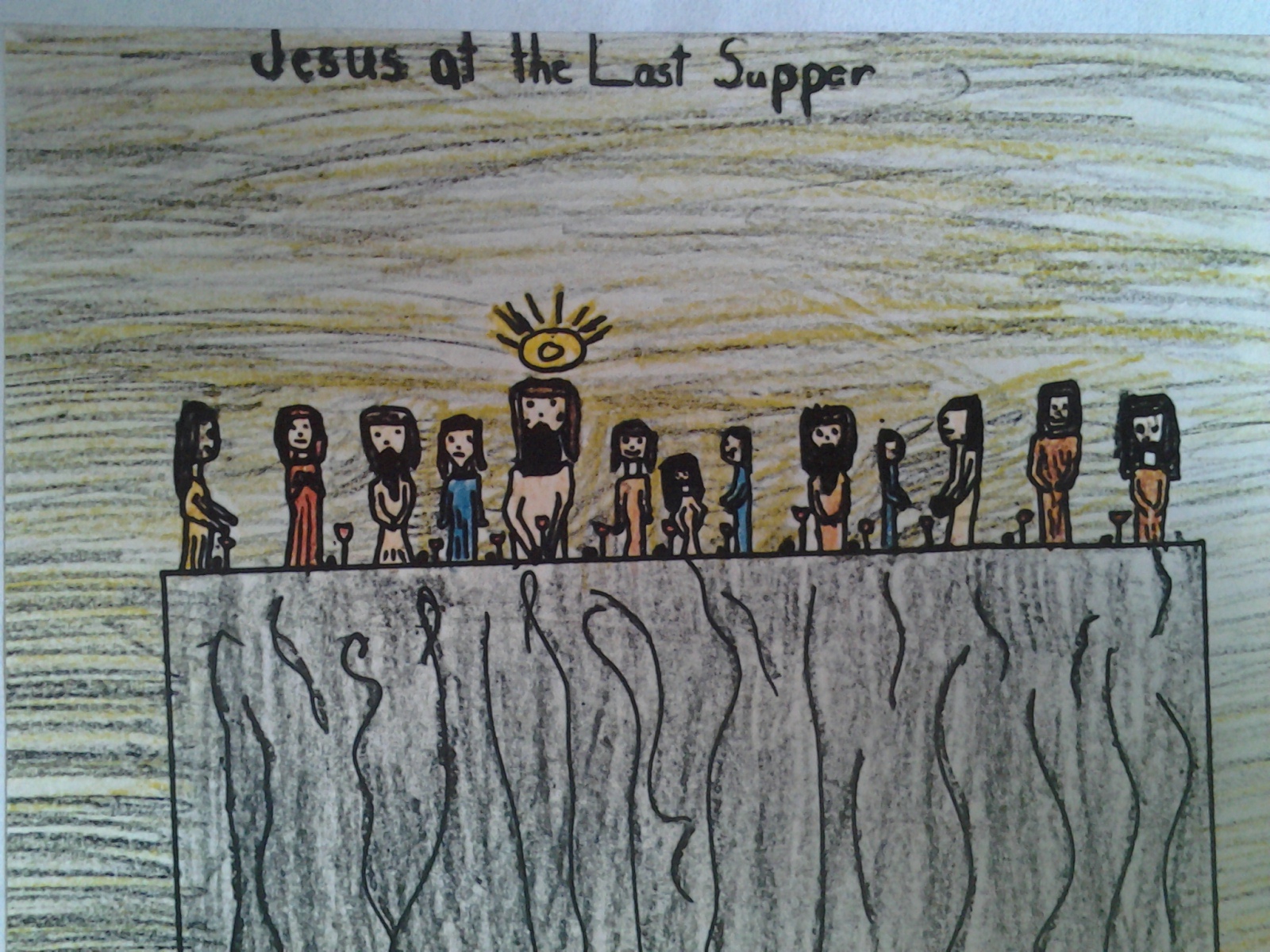
Christ Crowned with Thorns. Wood. Philippines, 20th CenturyVirgin and Child. Oil on Canvas. Uruguay, 20th Century.The Last Supper. Crayon on Paper. U.S.A., Contemporary.Mother of Divine Grace. Textile. Japan, Contemporary.Crucifixion. Bronze. Italy, 1933.Adoration of the Magi. Rome, circa 200.The Holy Family. Painting on Silk. Japan, 20th Century.
We all tend to fashion the Bible from our own background. Is it wrong to see Jesus as a white guy? As Japanese? As African? Historically, sure – he was a middle eastern Jew. But the whole point of the Incarnation is that Christ is WITH us. God is not far away and removed – He is one of us. So the God who left heaven to be like me might look like me. What other god ever bothered to become like us?
The mystery and magnificence of YAHWEH is the Incarnation. His name is Emmanuel, which means: God with us.
Ms. Kelly might want to apologize for her cultural bias and ignorance but I don’t fault her for seeing Jesus from her background and heritage. I don’t really expect my blog will ever cross her path, but if you do know her send her the link, okay? 😉
This Christmas season take some time to reflect on the idea that God cares enough for us to become like us. To feel like us. To suffer like us. To die like us.
Image courtesy of arztsamui at FreeDigitalPhotos.net
In Part I we looked at how a person isn’t saved by reciting magic words – it’s a matter of faith. While saying the Sinner’s Prayer is a great way to express one’s faith, it is faith that saves and not the prayer.
We also talked about what Christians mean when we use the word “saved.” It’s an understanding of the condition of your soul in relation to eternity. Life as we know it is merely one part of our journey. Death does not stop the journey but continues it.
Those who are “saved” (i.e. have faith in Jesus) will be spending eternity in the presence of God – this is heaven. To be totally honest the Bible doesn’t give explicit details about the nature of heaven. There is a lot of symbolism and imagery when people describe it (streets of gold, etc.), but no solid, “This is what heaven is like.” The most we can say about heaven is that it is the opposite of hell – it is the presence of God and a place that is wonderful, enjoyable, and the place where we are free from any problem, care, or worry.
Those who are “lost” (i.e. have no faith in Jesus) will be spending eternity outside the presence of God – this is hell. And, again, to be totally honest, the contemporary image of hell is not from the Bible as much as it is from the imaginations of writers, artists, etc. The most we can say about hell is that it is the opposite of heaven – the absence of the presence of God and a place that is generally unpleasant, uncomfortable, and not a place you want to be 😉
But the question I hear most frequently from non-Christians is:
Why would a loving God send people to hell?
People have a hard time hearing the message that God loves them when we simultaneously send the message that God will punish them if they don’t become part of the faith. While some Christians do send that message, the Bible does not. The Bible is clear:
God is patient with you, not wanting any to perish, but all to come to repentance. (2 Peter 3:9)
The verse speaks for itself – God doesn’t CHOOSE to send people out of his presence. He wants everyone to be in His presence (heaven). So then…who goes to hell?
Hell is for those who do not choose God. He doesn’t send – we decide. The Bible says:
The works of the flesh are obvious: sexual immorality, moral impurity, promiscuity, idolatry, sorcery, hatreds, strife, jealousy, outbursts of anger, selfish ambitions, dissensions, factions, envy, drunkenness, carousing, and anything similar, about which I tell you in advance-as I told you before-that those who practice such things will not inherit the kingdom of God. (Galatians 5:19-21)
For know and recognize this: no sexually immoral person or impure or greedy person, who is an idolater, has an inheritance in the kingdom of the Messiah and of God. (Ephesians 5:5).
Hear me out – I’m not God, and the Bible doesn’t get into the nitty-gritty of a lot of these. The point is, though, that certain behaviors and actions are not acceptable to be in the presence of a Holy God (holy means set apart or different).
It comes down to love and punishment. I think about it as a parent. I love my kids. But I have certain standards for their behavior. There are some things that are not acceptable. Because they are human individuals they are going to choose to do things with which I disagree.
Sometimes their behavior warrants being put in time-out. What is time-out? It’s removing the child from the family system – they cannot be part of the family system because of the choices they made to behave the way they did.
My children want to live by their own rules (or lack thereof). Then they’re always surprised when they go to time-out. Adults are no different. We want the freedom to live our own lives the way we want and then complain when we are told that there are eternal consequences for our behavior.
The Bible says:
All have sinned and fall short of the glory of God. (Romans 3:23)
Ultimately, we all deserve the BIG TIMEOUT (hell). But Jesus paid the price for our brokenness. Now we can once again be in the presence of God. But we can only approach him through faith and repentance.
When all is said and done, God is the one to judge our hearts and behavior. Not me. Not you. Not any human. I fully believe there will be people in heaven that will completely surprise us. Similarly, there will NOT be people in heaven that we always expected to be there.
In the meantime, we do our best in this life to live the life He has called us to live.
That means I may not do some things I want to do because it goes against what he wants me to do.
Because his way is supposed to come before my way.
Image courtesy of bandrat at FreeDigitalPhotos.net
The other day I had an interesting conversation with a young youth pastor. For the record, it was not the youth pastor at my church. He made the statement:
“The sinner’s prayer has sent more people to hell than any one thing in our time.”
If you’re not familiar with the Sinner’s Prayer you can read about it here.
In a nutshell, it’s a prayer that Christians (usually pastors or evangelists) walk non-Christians through on the path to following Christ. Billy Graham’s version went like this:
Dear Lord Jesus, I know that I am a sinner, and I ask for Your forgiveness. I believe You died for my sins and rose from the dead. I turn from my sins and invite You to come into my heart and life. I want to trust and follow You as my Lord and Savior. In Your Name, Amen.
What?!? How on earth could such a prayer send people to hell? The youth pastor is a young man, and young men tend to be very fiery in their speech. His point, though, was that repeating a few sentences after a pastor does not save you.
Time out.
What’s all this talk about saving? If you haven’t been in the church your whole life you may be wondering what on earth we’re talking about. Simply put, this life is not the end of existence – it is only temporary. Upon death we leave this life and begin the next. Depending on your spiritual condition you’ll be “saved” and in eternity with God or “lost” and in eternity apart from God.
Now, back to the prayer. The young minister was trying to express the fact that reciting words does not mean that one is saved. It’s not a magical incantation. Many people believe that if they simply say the words then they are guaranteed salvation and eternity in heaven.
But the Bible never says that you have to say magic words to get to heaven. The Bible does say:
– To all who received him, to those who believed in his name, he gave the right to become children of God. (John 1:12)
– Salvation is found in no one else, for there is no other name under heaven given to men by which we must be saved. (Acts 4:12)
– For it is by grace you have been saved, through faith – and this is not from yourselves, it is the gift of God – not by works, so that no one can boast. (Ephesians 2:8-9)
The Bible is clear that there is only one way to eternity with God, and that is through faith in Jesus. It’s not about Mohammad. It’s not about Buddha. It’s not about doing or saying the right things (works). It’s about our faith in Jesus. The youth pastor I was talking to was frustrated that too many people say the magic words, think they’re saved, and then stay exactly the same they always were.
Authentic, saving faith goes beyond reciting words – it’s about faith and the condition of our hearts, and that saving faith results in a changed life. Jesus once said:
“If you love me, you will obey what I command.” (John 14:15)
Pastors, evangelists, and churches do a good thing to share the truth about eternity and salvation with people. It is a good thing to bring people to an understanding and a saving faith. Then the Sinner’s Prayer becomes a useful tool for expressing that faith.
If you’ve ever said the “magic words” for fear of going to hell, saying the words won’t save you – you’ll still end up in hell if all you have is mere words.
The prayer itself doesn’t save. Our faith does.
Stay tuned…in Part II we’ll look at why a loving God will send sinners to hell.
















 Chris Linzey