When you title a post “The Greatest Thing You’ll Ever Learn” you get some people who are convinced you’ve lost your mind. Perhaps they think you’ve just succumbed to a massive ego trip.
But last week my wife and I were listening to Nat King Cole and one of his classics called “Nature Boy” came on. Nat sings of meeting an enchanted boy who tells him, “The greatest thing you’ll ever learn is just to love and be loved in return.”
And this isn’t a new concept. It’s actually biblical.
From the beginning of Creation to the coming end of the world (no predictions – Jesus says quite clearly that no one knows) – God is all about love. His love for humanity is the driving force behind everything He does. The whole story of redemption is about God’s incredible love for us.
And our response to a loving Creator is a response of love. In the Jewish community, the driving theme is the Shema – the central prayer of the Jewish prayer book. Many Jews recite it twice daily.
Hear, O Israel: The Lord our God, the Lord is one. You shall love the Lord your God with all your heart and with all your soul and with all your might. (Deuteronomy 6:4-5)
In the New Testament, Jesus reinforces this idea when someone asks him, “What is the greatest commandment?” Jesus answers, “The greatest is to love the Lord your God and the second is to love your neighbor as yourself.”
The greatest thing you’ll ever learn is love.
And love isn’t a schmaltzy feel-good kind of thing. It’s easy to love someone when there is a warm fuzzy feeling. But that’s not love. In the Bible love is not lip-service and fuzzies. Love is active behavior.
One verse of the Bible many non-believers have heard is John 3:16 ~
For God so loved the world, that he gave his only Son, that whoever believes in him should not perish but have eternal life.
And in our culture we hear that phrase “so loved the world” and interpret to mean the quantity of God’s love. We read it, “God loved the world SO much…”. but that’s a poor understanding of the word. It’s not about quantity – it’s about action. A better way of phrasing it would be:
This is how God loved the world – that he gave is only Son…
God’s love is something that is demonstrated in a very palpable way.
At one point Jesus tells his disciples:
By this all people will know that you are my disciples, if you have love for one another. (John 13:35)
But we miss the mark, don’t we? We often decided that we’ll just tolerate (at best) others. We don’t actually LOVE. We don’t sacrifice for others. We give out of our surplus, but not out of our scarcity.
When someone really LOVES something they’re willing to get stupid about it.
But when it comes to loving others we’re not willing to get stupid about it. We’re reserved. In John’s 1st letter he tells people, “How can you not help someone in need if you have the ability? Where’s the love?”
God’s love in us compels us to be people of love towards others.
In the end, Nat King Cole had it right. The greatest thing you’ll ever learn is just to love, and be loved in return. It’s the way of Jesus.
In the way we talk to people.
In the way we talk about people.
In the way we treat people.
I wrote about abortion once, when I was involved in a disagreement with someone who made a comment along the lines of, “A REAL Christian can’t support abortion.”
Christianity is about faith, and personal positions on ethics and morality are not a great litmus test for faith. There are people who believe in the deity of Jesus and that the only way to life in the presence of God is through faith in Jesus yet still have differing views on issues of politics and ethics. There is no monolithic voice that says, “IF CHRISTIANS DON’T BELIEVE XYZ THEY ARE NOT REAL CHRISTIANS!”
That being said, I do believe that life in the womb is a precious thing.
I do believe that life in the womb is a person.
I do believe that life in the womb ought to be protected and not disposed of.
First – an atheist talking about morality. That makes me laugh. Without a higher power as the foundation for all morality and ethics all we’re left with is, “I’ll do what seems right until it no longer seems right. Then I’ll do what suits me best.”
Second – in Dawkins skewed idea of morality he feels it is better to dispose of the fetus that tests positive for Down Syndrome rather than make the human suffer as he or she grows.
Dawkins said:
I think abortion is right if the woman wants an abortion. Down syndrome is one very good, and extremely common reason, to want it.
He is asserting his own opinion of what is “good” and, as a little slight of hand argumentation, mentions that it is an extremely common reason to abort. He claims that he is not trying to use the majority opinion as an argument. If he does not intend to use it as an argument then he has no need to say it. My kids commonly have reasons for all sorts of stuff. As responsible parents, we will often tell them, “You shouldn’t do that.” Even if many women choose to abort babies who have been identified as DS babies, it does not suddenly make it right.
The weight of opinion does not change the rightness of the action. This is true for any behavior that is contrary to God’s design.
I don’t expect a blog post like this to change opinions on abortion. Those who agree with me will continue to do so. Those who disagree will continue to do so. But I would be remiss if I didn’t point out some biblical reasons why I believe life in utero is precious life.
Samson was dedicated to God before he was even born:
So [Samson] told her everything. “No razor has ever been used on my head,” he said, “because I have been a Nazirite dedicated to God from my mother’s womb. If my head were shaved, my strength would leave me, and I would become as weak as any other man.” (Judges 16:7)
Job talks about God’s hand at work in creating life in the womb:
Did not he who made me in the womb make them? (Job 31:15)
The obvious pro-life favorite:
For you created my inmost being; you knit me together in my mother’s womb. (Psalm 139:13)
In the prophets:
This is what the Lord says— he who made you, who formed you in the womb, and who will help you: Do not be afraid, Jacob, my servant, Jeshurun, whom I have chosen. (Isaiah 44:2)
Listen to me, you islands; hear this, you distant nations: Before I was born the Lord called me; from my mother’s womb he has spoken my name. (Isaiah 49:1)
Before I formed you in the womb I knew you, before you were born I set you apart; I appointed you as a prophet to the nations. (Jeremiah 1:5)
I won’t beleaguer the point – but I think there is plenty of biblical cause to understand that life as we know it doesn’t begin and end with breath.
I am saddened that people like Dawkins think it is morally right to abort babies who test positive for problems. But when you’re an atheist, there’s really nothing stopping you from saying, “I’m going to choose whatever I want for my own ease and happiness – whatever the consequences might be for others.”
And that’s tragic.
** For the record, please recall that I acknowledge that this post won’t sway opinions. And if you differ, you won’t sway mine. For that reason I will not be entertaining comments from anyone who wants to argue. There’s another time and place for that. 🙂
Today we continue in the series on preventing extramarital affairs. Remember, this is not about picking on men. Infidelity is a problem that both men and women need to get a hold of. God wants us to thrive in healthy and happy marriages, and we do great damage to that His design when we let infidelity creep into the relationship. This topic can get a little blunt – obviously it’s not for kids… 🙂
So, tip #3 for preventing infidelity:
Set boundaries on sharing and hearing about intimate marriage issues with people of the opposite gender.
The intimate details of a relationship belong within the confines of the relationships. It would be highly inappropriate if I were to share with another woman any private information about my marriage. Not only is it not anyone’s business, but it would be a betrayal of my wife.
I have heard people justify their behavior with lines like, “But he’s such a good listener and I need to unload my relationship problems somewhere.” Ba-lo-ney. If you’re having problems with your partner the appropriate person to talk to is YOUR PARTNER!
This actually mirrors a biblical principle Jesus taught about resolving problems between people. Rather than blab about our problems to others we ought to be handling problems directly with the person/people involved.
Handling your relationship problems directly with your partner might not feel as good as venting to a friend. It can feel good when a friend of the opposite gender listens and comforts us. But such behavior leaves us vulnerable to inappropriate emotional connections and infidelities.
Rather than talking about your relationship woes, you should always seek to mention your partner positively. And, on a practical level, Dr. Rosenau mentions that “avoiding secret emails or phone calls, controlling sexual talk and joking, and preserving modesty” are important tools to preserving strong boundaries with members of the opposite gender and preventing infidelities.
Our mouths and minds lead us down the road to infidelities long before our bodies get there. The Bible cannot speak strongly enough about the power words have. We set the course for our lives by how we talk and to whom we talk. If you want to protect your relationship, make sure that you never speak negatively about it to others. Only speak positively. Deal with the negative elements in the appropriate time and place and with the appropriate people.
People get really passionate about some things, don’t they?
I’m talking about C.R.A.Z.Y. passionate.
Like these guys…
Or this guy…
And, just so you don’t think it’s only foreigners who are crazy, what about this guy?
When we are really and truly passionate about something we go to great lengths to embrace that passion. We don’t care what others say. We don’t care what others think. All we know is, “This is my passion and nothing will stand in my way.”
This is the kind of thing Jesus is talking about in Mark 9. When you’re passionate and dedicated to something, you will go to any length to support it.
Jesus said:
If your hand causes you to stumble, cut it off. It is better for you to enter life maimed than with two hands to go into hell, where the fire never goes out. And if your foot causes you to stumble, cut it off. It is better for you to enter life crippled than to have two feet and be thrown into hell. And if your eye causes you to stumble, pluck it out. It is better for you to enter the kingdom of God with one eye than to have two eyes and be thrown into hell, where “‘the worms that eat them do not die, and the fire is not quenched.’
How aggressively do you attack the obstacles that stand in your way? When a person is diagnosed with cancer, doctors sometimes have what they call “aggressive treatment.” They hit the cancer hard and fast and with everything they’ve got. This is the very attitude Jesus talks about here. How hard and fast will you hit the sin areas in your life? What will you chop off so that you can avoid the danger of eternal separation from God?
I’m not sure how many of us even think about our eternal destiny. We go through life and can get so bogged down in the daily grind that we take our eyes off of eternity. One of my favorite movies is the movie Gladiator. There’s a scene where the Roman general Maximus is inspiring his soldiers to fight well and he tells them, “What we do in life echoes in eternity.”
Do you hear what Jesus is saying? What we do in life echoes in eternity. So make sure that your behavior here is not creating echoes you never want to hear in the next life. Because separation from God is no joke. Many people have been caught up in the book and movie, “Heaven is for Real.” But God is clear that hell is for real, too. The image Jesus uses for hell is Gehenna.
Gehenna was a real place, a valley south of Jerusalem. In the ancient days of Israel, Gehenna was the location of a wicked cult that practiced passing children through fire. It came to be a metaphor, to represent the Jewish idea of hell. Jesus is not trying to give us a literal vision of hell but trying to help us understand how bad it is to be eternally separated from God. The worms that eat them do not die means that the flesh is forever rotting. Once the flesh is all gone from a corpse there is nothing left there for maggots. They die. But these maggots feed eternally, and the flames burn forever. Not a place you want to go. What’s it worth to you to be in the presence of God? Jesus says, it should be worth giving up your very limbs. Whatever in your life tempts you to drift away from God, discard it decisively – aggressively.
My hand is causing me to sin. Whack! My eye is causing me to sin. Spoink! My television is causing me to sin. Whoosh! My tongue is causing me to sin. Cu I ou! My mind is causing me to sin. Lobotomy!
Get the picture?
Jesus isn’t really telling us to mutilate ourselves. He’s using vivid imagery to make a point. Our eternal destiny is so important that we ought to be aggressive and intentional about making sure we stay away from the things that separate us from God. Take a moment and reflect. Let me ask you to think on this: What is something you did this week you know God wouldn’t want you to do? You can’t help it – almost all of us thought of something. There are no perfect people on earth. 🙂
Now – to what lengths will you go to get that out of your life?
The purpose of this post isn’t to argue the rightness or wrongness of the homosexual lifestyle. I’m squarely within the Christian camp that believes active homosexual behavior is contrary to God’s design and plan and, thus, wrong.
Rather, I want to focus on her statement itself. “God loves me just the way I am.”
This seems to be the cry of many people nowadays. While some people do believe it, too many people use this line as an excuse to remain spiritual stagnant.
People say, "God loves me the way that I am" but they really mean to say, "I'm a sinner who won't even think about changing so back off."
Rather than examine their lives to see where God would desire growth and change, they play the “God loves me just as I am” card to escape any kind of changed behavior.
But we misunderstand God if we cling to that expression. Instead, we should be telling people:
God loves YOU the way you are. God does not love the WAY you are. There is a difference.
Yes, God DOES love us. Just as we are He loves us. Messed up sinners but He loves us.
He loves US the way we are, but he doesn’t love the WAY we are.
A relationship with the living God ought to mean that we continue to grow and develop spiritually. It ought to mean that the way we are grows more and more dim in the review mirror as we move towards the new way we are as Christians. The Bible cannot be overstated when the Apostle Paul writes in Romans 12:2
Do not be conformed to this world, but be transformed by the renewal of your mind, that by testing you may discern what is the will of God, what is good and acceptable and perfect.
Not remaining like this world but being changed to be more like Jesus.
It’s too easy to make excuses for not making any changes in who we are. God loves me just as I am.
Yes, He does. He died for me just as I am. But He died for me just as I am so that I no longer have to be just as I am.
I can be something new. I can be something different. I can be something better.
As young as I am, I’ve been in church ministry for 17 years. I’ve been a worship leader, a youth pastor, an associate pastor, a preaching pastor, and a lead/senior pastor. In all that time I’ve said some dumb stuff. I’ve put my foot in my mouth plenty of times. If you were to tell me 17 years ago that one of the brouhahas I would start would be because I led my church in the Apostles’ Creed I would have thought you nuts.
Yet here we are. A couple weeks ago I led my church in saying the Apostles’ Creed. It was only the 2nd time in 2 years we had ever done it, but I was preaching on faith in Jesus and standing firm in one’s faith, so we closed the service by saying the Creed as one church.
I heard from several who were opposed to the Creed and thought it had no place in our church. So let’s talk about it.
The Creed first came on the scene in the 4th century. That’s about 1200 years before the Protestant/Catholic split. And about 600 years before the Eastern Orthodox/Catholic split. At the time there was only one Church – the Christian Church. It was referred to as catholic (little c) which meant “universal” – but we’ll talk about that more in a bit.
The Church put together the teaching of the Apostles in a simple, succinct form that could be learned by every Christian. In a time where literacy levels were low, a Creed that could be memorized was a big bonus in teaching people the core elements of faith.
Here are the elements and the Bible verses that spawned the Apostles’ teaching:
~ I believe in God, the Father almighty, creator of heaven and earth.
In the beginning, God created the heavens and the earth. (Genesis 1:1)
As a father shows compassion to his children, so the Lord shows compassion to those who fear him. (Psalm 103:13)
Throughout the Bible believers affirm that God is the source of everything, the magnificent creator of all things. Both Old and New Testaments refer to God as Father. God is neither male nor female, so Father isn’t a perfect metaphor for God, but in our limited language and human understanding it is how the Bible refers to God.
~ I believe in Jesus Christ, his only Son, our Lord,
The beginning of the gospel of Jesus Christ, the Son of God. (Mark 1:1)
For God so loved the world, that he gave his only Son, that whoever believes in him should not perish but have eternal life. (John 3:16)
Jesus was not merely a good man or a wise teacher – he was unique. He was one of a kind. He was God in the flesh.
~ who was conceived by the Holy Spirit and born of the virgin Mary.
In the sixth month the angel Gabriel was sent from God to a city of Galilee named Nazareth, to a virgin betrothed to a man whose name was Joseph, of the house of David. And the virgin’s name was Mary. And he came to her and said, “Greetings, O favored one, the Lord is with you!” But she was greatly troubled at the saying, and tried to discern what sort of greeting this might be. And the angel said to her, “Do not be afraid, Mary, for you have found favor with God. And behold, you will conceive in your womb and bear a son, and you shall call his name Jesus. He will be great and will be called the Son of the Most High. And the Lord God will give to him the throne of his father David, and he will reign over the house of Jacob forever, and of his kingdom there will be no end.” And Mary said to the angel, “How will this be, since I am a virgin?” And the angel answered her, “The Holy Spirit will come upon you, and the power of the Most High will overshadow you; therefore the child to be born will be called holy—the Son of God. And behold, your relative Elizabeth in her old age has also conceived a son, and this is the sixth month with her who was called barren. For nothing will be impossible with God.” (Luke 1:26-37)
We don’t even have to get into Protestant/Catholic debates on the immaculate conception or perpetual virginity of Mary or any of the other stuff we like to fight over. We agree on this basic element: Jesus was a supernaturally born child born of a young girl who didn’t get pregnant by any man.
~ He suffered under Pontius Pilate, was crucified, died, and was buried;
And they bound Jesus and led him away and delivered him over to Pilate. (Mark 15:1)
So Pilate, wishing to satisfy the crowd, released for them Barabbas, and having scourged Jesus, he delivered him to be crucified. (Mark 15:15)
And Jesus uttered a loud cry and breathed his last. (Mark 15:37)
And Joseph bought a linen shroud, and taking him down, wrapped him in the linen shroud and laid him in a tomb that had been cut from the rock. (Mark 15:46)
Jesus was an historical figure that actually lived, breathed, was betrayed, killed, and buried. Believe it or not, I’ve had conversations with atheists who genuinely believe that Jesus is a fictional character. They are blown away when I show them that Jesus was written about by secular Roman historians as well as the Bible and Christian historians.
~ he descended to hell.
Here it is. This is the kicker – the one that throws a lot of people for a loop. What?!? Jesus went to hell?
For Christ also suffered once for sins, the righteous for the unrighteous, that he might bring us to God, being put to death in the flesh but made alive in the spirit, in which he went and proclaimed to the spirits in prison, when God’s patience waited in the days of Noah…. (1 Peter 3:18-20)
There are several other passages used when talking about this element of the Creed.
…he foresaw and spoke about the resurrection of the Christ, that he was not abandoned to Hades, nor did his flesh see corruption. (Acts 2:31.)
The Greek use of Hades is not the same as our English understanding of Hell as place of torment. Originally it was a holding place between life and death. Even the Jews had a concept of Abraham’s Bosom, and Jesus used it in a parable (see Luke 16:19-31). The Bible isn’t saying that Jesus spent time in eternal judgment, but that he departed from this world and went to the afterlife, which could not contain him!
~ The third day he rose again from the dead.
But on the first day of the week, at early dawn, they went to the tomb, taking the spices they had prepared. And they found the stone rolled away from the tomb, but when they went in they did not find the body of the Lord Jesus. While they were perplexed about this, behold, two men stood by them in dazzling apparel. And as they were frightened and bowed their faces to the ground, the men said to them, “Why do you seek the living among the dead? He is not here, but has risen. Remember how he told you, while he was still in Galilee, that the Son of Man must be delivered into the hands of sinful men and be crucified and on the third day rise.” (Luke 24:1-7)
Unlike leaders/founders of other religions, we affirm that Jesus is NOT dead. He is alive after a physical and bodily resurrection.
~ He ascended to heaven and is seated at the right hand of God the Father almighty.
So when they had come together, they asked him, “Lord, will you at this time restore the kingdom to Israel?” He said to them, “It is not for you to know times or seasons that the Father has fixed by his own authority. But you will receive power when the Holy Spirit has come upon you, and you will be my witnesses in Jerusalem and in all Judea and Samaria, and to the end of the earth.” And when he had said these things, as they were looking on, he was lifted up, and a cloud took him out of their sight. And while they were gazing into heaven as he went, behold, two men stood by them in white robes, and said, “Men of Galilee, why do you stand looking into heaven? This Jesus, who was taken up from you into heaven, will come in the same way as you saw him go into heaven.” (Acts 1:6-11)
~ From there he will come to judge the living and the dead.
I charge you in the presence of God and of Christ Jesus, who is to judge the living and the dead, and by his appearing and his kingdom: preach the word…. (2 Timothy 4:1)
This world is not the end of existence. The afterlife awaits us all, and we will all be judged. The old-fashioned expression is “the quick and the dead.” When I was a kid I always wondered what that meant. What’s gonna happen to the slow people? But quick is an old way of saying “alive.” Those who are living and those who have already passed will face a final judgment before Jesus.
~ I believe in the Holy Spirit,
And while staying with them he ordered them not to depart from Jerusalem, but to wait for the promise of the Father, which, he said, “You heard from me; for John baptized with water, but you will be baptized with the Holy Spirit not many days from now.” (Acts 1:4-5)
The Spirit of God is active in the lives of believers. The Spirit leads us, guides us, convicts us.
~ the holy catholic church,
…the sake of [Jesus’] body, that is, the church, of which I became a minister…. (Colossians 1:24-25)
Christ loved the church and gave himself up for her… (Ephesians 5:25)
Here’s another one that bugs Protestants. Remember, catholic means “universal.” They weren’t trying to promote the Roman Catholic organization but saying that all Christians around the world are united in Christ. In the Bible, the word for church is ekklesia and literally means “called out.” We are different from the world. We are an assembly of people called together through our common faith in Jesus. It’s not the buildings but the believers who ARE the Church!
~ the communion of saints,
…that which we have seen and heard we proclaim also to you, so that you too may have fellowship with us… (1 John 1:3)
The Apostle Paul frequently refers to all Christians as holy ones or “saints.” Again, this isn’t about any Roman Catholic doctrine but about the bond and unity that all believers have in Christ Jesus.
~ the forgiveness of sins,
He has delivered us from the domain of darkness and transferred us to the kingdom of his beloved Son, in whom we have redemption, the forgiveness of sins. (Colossians 1:14)
In actuality, the Bible talks a lot about forgiveness of our sins because of the work of Jesus on the cross. It’s the whole point of the cross. So I think we can move on from this one.
~ the resurrection of the body, and the life everlasting.
Just as we have borne the image of the man of dust, we shall also bear the image of the man of heaven. (1 Corinthians 15:49)
The Apostle Paul says, if there is no resurrection of the dead then we’re all screwed. Why bother being faithful? We can live and let live. Eat, drink, and be merry, for tomorrow we die. But no – there is more to this life than the here and now. We live in temporary bodies but are eternal beings. Thank God one day we will shed these messes!
There, in a nutshell, is some of the biblical foundation for the Apostles’ Creed. While not appearing word for word in the Bible, the Creed has elements that do come from the Bible. It is not a Roman Catholic thing. It is a Christian thing that has been part of Christian worship services for 2000 years. Catholics use it, Anglicans, Orthodox Christians, Lutherans, Methodists, non-denominational churches, and on and on.
The purpose of reciting and using the Creed is to stand in solidarity with thousands of years of Christian faithful who declare, “We believe.” Every element of the Creed is biblical and represents the faith that has been passed down to us from the beginning of Christianity.
In a modern context, think about it like a contemporary church website. Every church website I’ve ever seen has a statement of faith/beliefs. The Apostles’ Creed is the statement of faith for the Worldwide Church website.
If you want to hear some version of the Creed put to music you should check out these:
I played little league baseball as a kid, a little football in high school, and ran cross-country one year in college. Additionally, I enjoy playing basketball, soccer, and a wide variety of other sports.
But I had never before played church league softball until I moved here. Now I’m in my second season and I enjoy it very much.
I wasn’t too sure they’d let me stick around after my first season, though! It was pretty rough. Don’t get me wrong, I’m not a bad at 1st base. But my hitting – goodness. I would get up to bat and hack away, trying to muscle out a hit. I don’t even want to think about what I looked like to everyone watching. 🙂
But this season something changed.
I received some good coaching regarding hitting form and style and made some changes.
I also came to a major realization that changed my whole approach to the game – I realized that I am not a power hitter. I will never be a Miguel Cabrera or a Mike Trout. So why was I trying to crush the ball?
So instead of trying to crush the ball at 100% power, I started trying to hit around 80% power and focus instead on hitting well. This season has been incredible for me. My hitting is dramatically better and my on-base percentage is higher than ever. I stopped trying to be something I wasn’t and embraced who I was as a ball-player. Now I can be more consistent and a better help to my teammates.
This is a lot like the Christian world.
I recently re-read a post from a famous Christian blogger lamenting the fact that the blogger’s church didn’t utilize her the way she wanted to be utilized. While I don’t know the specifics of her circumstances, I do know that it is common for people (myself included) to want to fill certain roles and to avoid others. But what we want isn’t necessarily the best place for us to be.
Sometimes we need to step back and say, “I’ve been trying to be this but God has really called me to be that.”
The Apostle Paul writes:
If the foot should say, “Because I am not a hand, I do not belong to the body,” that would not make it any less a part of the body. And if the ear should say, “Because I am not an eye, I do not belong to the body,” that would not make it any less a part of the body. If the whole body were an eye, where would be the sense of hearing? If the whole body were an ear, where would be the sense of smell? But as it is, God arranged the members in the body, each one of them, as he chose. If all were a single member, where would the body be? As it is, there are many parts, yet one body. (1 Corinthians 12:15-20)
There is a place for everyone in the church. God has given us all talent, skills, and abilities to do many things. Don’t think that you have nothing to offer. At the same time, don’t think that what you have to offer is what God actually wants you to be doing. Rather than forcing yourself into a role that’s not right for you, ask God and yourself where you actually fit best.
Then you can stop trying to be something you aren’t, embrace who I God has created you to be, and then can be more consistent and a better help to your church teammates.
You see, it all started when some of the good religious folk took issue that Jesus’ followers were not following the rules for ritual washing up – getting clean.
The Pharisees and the scribes asked him, “Why do your disciples not walk according to the tradition of the elders, but eat with defiled hands?”
They are calling out Jesus and his followers for being rule-breakers.
You would expect good, decent people to apologize when religious leaders chastise them. But not Jesus. He uses the Old Testament prophet Isaiah and tells them:
“‘This people honors me with their lips, but their heart is far from me; in vain do they worship me, teaching as doctrines the commandments of men.’ You leave the commandment of God and hold to the tradition of men”
Then he follows up by talking about being clean vs. unclean.
There is nothing outside a person that by going into him can defile him, but the things that come out of a person are what defile him.” And when he had entered the house and left the people, his disciples asked him about the parable. And he said to them, “Then are you also without understanding? Do you not see that whatever goes into a person from outside cannot defile him, since it enters not his heart but his stomach, and is expelled?” (Thus he declared all foods clean.) And he said, “What comes out of a person is what defiles him. For from within, out of the heart of man, come evil thoughts, sexual immorality, theft, murder, adultery, coveting, wickedness, deceit, sensuality, envy, slander, pride, foolishness. All these evil things come from within, and they defile a person.”
Pay close attention here. Jesus is actually telling a joke. When the English says, “into his stomach and is expelled” the translators are trying to put it nicely, but what Jesus is literally saying is that food goes “into the belly and then out into the toilet” – and THAT’S when it really gets “unclean”.
What a joker!
But the point of what Jesus is trying to say is this – we need to make sure that we’re not making up our own rules for people to follow. God cares less about human rules than he cares about human hearts.
In our own culture we develop rules about all sorts of things. We don’t make them up to be mean. Usually the rules are there because we believe they help us follow God better or be better Christians.
We come up with dress codes for what a “proper Christian” should or shouldn’t wear.
We come up with language codes for what a “proper Christian” should or shouldn’t say.
We come up with geographic codes for where a “proper Christian” should or shouldn’t go.
You get the idea?
The problem comes when we start insisting that people follow our rules if they want to be “real Christians” – and then we call into question the salvation of anyone who doesn’t abide by our rules.
Jesus would have a big problem with that.
He’d tell rule-makers today the same thing he told them thousands of years ago: “Take your rules and flush ’em down the crapper.”
God cares more about your heart than the rules you follow.
This is not license to behave poorly. God still desires us to act in ways that reflect his character. But sometimes good Christians will have different ideas about proper behavior. In those times when there is no clear-cut guidance from the Bible, we need to cut each other some slack and be gracious, allowing for differences.
And maybe, just maybe, we can start looking at the people’s hearts rather than the rules they break.
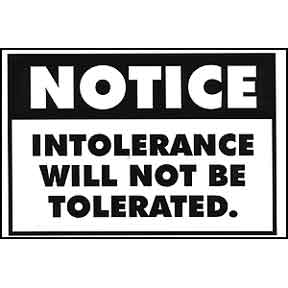
Over the last few days I’ve had several experiences with people regarding the idea of Christian intolerance and -phobia. In case you didn’t know, the in-thing is to take whatever Christians are against and add -phobe or -phobia to the word, thus creating a new word that labels the Christian as a hater.
Do you disapprove of homosexual behavior?
You’re a homophobe.
Do you disagree with Muslim faith?
You’re an Islamophobe.
Apparently anything you stand against is now something you’re afraid of. Except the definition of phobia is now being broadened to include “dislike of a specified thing or group.”
That makes me:
– a greenbeanophobe (never liked ’em – never will)
– a V8ophobe (c’mon, drinking tomato juice?!?)
– a wasabiphobe (I thought it was something else when I put a whole spoonful in my mouth…)
and a whole host of other things I dislike. It’s misleading to attach -phobe to designate dislike of something. It is attempt to attach a negative and derogatory label without understanding anything about anyone’s position.
In terms of faith it often comes down to Christians being labeled “intolerant” and/or “bigot.”
But I’m not intolerant.
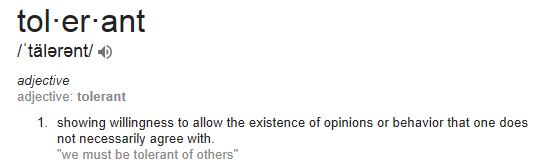
I have a willingness to allow the existence of other opinions and behavior I don’t agree with. I have never forced anyone to change to my way of thinking. So I guess I’m tolerant. Yay, me!
As for bigot, the all-knowing Wikipedia defines it as “someone who, as a result of their prejudices, treats or views other people with fear, distrust or hatred.”
But prejudice is “prejudgment, or forming an opinion before becoming aware of the relevant facts of a case.”
I have not pre-judged other faith groups or formed an opinion before becoming aware of relevant facts. As a Christian, I will go with Jesus when he says:
I am the way, the truth, and the life. No one comes to the Father except through me. (John 14:6)
Or Peter when he preached about Jesus:
There is salvation in no one else, for there is no other name under heaven given to people by which we must be saved. (Acts 4:12)
So I’m not prejudiced. My views about other faith groups are based on my understanding that Christianity is the only way to God. And if I’m not prejudiced then I’m not bigoted, for bigotry requires prejudice.
So here I am: a tolerant, unprejudiced, non-bigoted Christian.
But I’ll still tell you that Jesus is the only way and that, as much as we can, we need to conform our lives to the character of God and the kind of lives he calls us to lead as revealed in the Bible.
And that message won’t change, no matter what the Christianphobes say about it.
1. Hobby Lobby is not denying women access to contraceptives, they ask not to be forced to pay for particular contraceptives (and they do cover others).
2. If women want a particular product they are still allowed to go get it on their own.
A friend recently railed against employers dictating medical decisions to women.
Some workplaces cover things like medical, dental, auto, etc. Other workplaces cover nothing. But we have the freedom to go find what we want if we’re willing to pay the price. No freedom is being restricted. No one is being told, “YOU CAN’T DO THAT!” There is not loss of liberty or freedom.
No religious belief is being imposed on anyone. People are still free to believe and act how they want. Being required to pay for your own decisions is not the same thing as having a religious belief imposed on you.
Coming from a biblical perspective, I’ve seen people say, “The Bible calls us to respect and submit to authority. Shouldn’t we just accept the healthcare law without saying anything about it?”
Biblically, no.
When the Apostle Paul wrote about submitting to authority he was writing to people who lived in a time and place who had only two options: submit or rebel. You couldn’t lawfully change the emperor’s mind. So Paul instructed Christians that rebellion is not the way of Jesus. But we don’t live in that kind of society. In a democratic republic we have the option of participating in forming laws and petitioning to change laws that shouldn’t exist.
Christians can work within the system to make (from our perspective) a positive change in society. There is nothing biblically wrong with that.
“But, Chris, isn’t that forcing our opinions on others?!”
All laws force opinions on others. The question is: who will have the winning opinion?
At the end of the day, I’d rather have laws that reflect a Christian worldview than laws that reflect an Atheist worldview.
The day will come (indeed, it is already fast approaching) when the Christian worldview is completely overturned. When that happens, and we no longer have legal recourse, then Paul’s admonitions once again apply: submit rather than rebel. Rebelliousness is not a quality of Christ.
Until then, there is nothing wrong with Christians using the legal system to protect our beliefs and values.




 Today we continue in the series on preventing extramarital affairs. Remember, this is not about picking on men. Infidelity is a problem that both men and women need to get a hold of. God wants us to thrive in healthy and happy marriages, and we do great damage to that His design when we let infidelity creep into the relationship. This topic can get a little blunt – obviously it’s not for kids… 🙂









 Chris Linzey