Recently I had a conversation with a Christian friend who made the statement, “When it comes to the core elements of what makes a Christian, it’s a toss up for me between the Bible and Jesus Christ as Savior.” I stopped him fast and said, “Whoa, there! Jesus is far more important than the Bible.”
Before you stone me as a heretic, hear me out.
Between the Ascension and the writing of the first book of the New Testament there is a gap of roughly 20-some years. The New Testament wasn’t even finished for decades after that, then even more time for the book to be compiled into a single volume.
In fact, it wasn’t until the 16th century and the printing press that we had the ability to put the entire Bible in everyone’s hands.
So the question is, “What did the Apostles preach before the Bible was written, completed, and disseminated?”
Easy – they preached Jesus! Jesus is the common denominator among all those who would consider themselves Christians. Jesus is God incarnate. He physically died as a substitution for humanity. He rose again, defeating death once and for all.
Peter once preached that there is no other name than Jesus by which we must be saved. That’s it. If you don’t hold to Jesus, you don’t fall under the title Christian.
Yes, I believe that the Bible is inspired by God. It tells the story of God redeeming humanity. It is God’s Word to us. But people have been getting saved without having a Bible since the beginning of the faith. Let’s not turn the Bible into an idol.
It’s all about Jesus!
——————————————————————–
I welcome all discussion, just keep it civil and polite. If this post resonates with you in any way, please share it on Facebook, Twitter, or email!
Who is the wisest person you know? We’ve all got people in our lives we look to for insight into tough situations, to come up with that little nugget to find a way out of a difficult situation. Then there’s the other guy. You know him, too. The guy who thinks he’s always got the answers. He has the plan. He knows what to do. Just ask him. But he really doesn’t. His “wisdom” has him fooled.
Proverbs 11:2 says:
When pride comes, then comes disgrace, but with humility comes wisdom.
We have a real problem, though – a division between different kinds of wisdom. James’s readers had this kind of debate about wisdom. Wisdom was a really big deal, because we often look to wise people for guidance, direction, and leadership. The beauty of our political system today is that any dummy can get elected…and many do! James wants us to understand that there is a difference between worldly wisdom and heavenly wisdom; wisdom that comes from our own hearts and the wisdom that comes from God’s heart
James 3:13-18 says:
Who is wise and understanding among you? Let them show it by their good life, by deeds done in the humility that comes from wisdom. But if you harbor bitter envy and selfish ambition in your hearts, do not boast about it or deny the truth. Such “wisdom” does not come down from heaven but is earthly, unspiritual, demonic. For where you have envy and selfish ambition, there you find disorder and every evil practice. But the wisdom that comes from heaven is first of all pure; then peace-loving, considerate, submissive, full of mercy and good fruit, impartial and sincere. Peacemakers who sow in peace reap a harvest of righteousness.
Let’s unpack this a little bit:
Wisdom plays out in two ways:
Real wisdom that comes from God is exhibited through good conduct and work
Demonic wisdom is characterized by jealousy and selfish ambition
When James talks about demonic wisdom he’s not saying that some people are given wisdom by demons. He’s saying that worldly wisdom that focuses on jealousy and ambition is the same kind of wisdom that even demons have. We’ve all met people that use what they know only to pursue their own gain. They look out for number one. They don’t care about you or anyone else – they use their wisdom for their own benefit. Doesn’t sound like a real nice guy, does it? Human wisdom seeks self-advancement and is anything but humble. It is driven only for its own success.
Obviously real wisdom is what we’re after, then. James tells us what heavenly wisdom looks like. It hits us and changes us – forms us in three areas: our character, our actions, and our constancy.
As to character James tells us that Godly wisdom is pure. It is peace-loving. It is considerate. It is open to reason (submissive).
As to actions James tells us that Godly wisdom is merciful (compassionate) and full of good fruit (this is a biblical metaphor for behavior – an apple tree produces good apples).
As to constancy James tells us that Godly wisdom is impartial (unwavering) and sincere (no hypocrisy or anything false).
In a nutshell, what James is talking about is surrender, and these are our terms of surrender. We give over to God our character, our actions, and our constancy. That means who we are and what we do without any hypocrisy or waffling. We can’t be considerate today and inconsiderate tomorrow. We can’t be reasonable today and unreasonable tomorrow. We can be compassionate today and uncompassionate tomorrow. We need to be constant, allow God to change us more and more every day so that we are less and less like that old character.
God is calling his people to surrender our rebel hearts and to take on new character and new behavior without hypocrisy. On the job. In the home. With our families. With total strangers. It’s a call to a new way of living – his way of living.
Godly wisdom.
For Reflection: – Think about your “wisdom” – what does it lead you to do? – Does your wisdom lead you to Godly behavior and Godly character?
Over the last few days I’ve had several experiences with people regarding the idea of Christian intolerance and -phobia. In case you didn’t know, the in-thing is to take whatever Christians are against and add -phobe or -phobia to the word, thus creating a new word that labels the Christian as a hater.
Do you disapprove of homosexual behavior?
You’re a homophobe.
Do you disagree with Muslim faith?
You’re an Islamophobe.
Apparently anything you stand against is now something you’re afraid of. Except the definition of phobia is now being broadened to include “dislike of a specified thing or group.”
That makes me:
– a greenbeanophobe (never liked ’em – never will)
– a V8ophobe (c’mon, drinking tomato juice?!?)
– a wasabiphobe (I thought it was something else when I put a whole spoonful in my mouth…)
and a whole host of other things I dislike. It’s misleading to attach -phobe to designate dislike of something. It is attempt to attach a negative and derogatory label without understanding anything about anyone’s position.
In terms of faith it often comes down to Christians being labeled “intolerant” and/or “bigot.”
But I’m not intolerant.
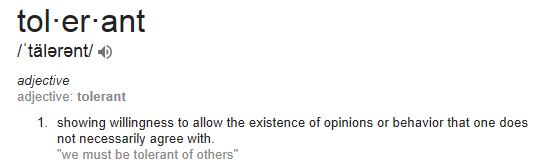
I have a willingness to allow the existence of other opinions and behavior I don’t agree with. I have never forced anyone to change to my way of thinking. So I guess I’m tolerant. Yay, me!
As for bigot, the all-knowing Wikipedia defines it as “someone who, as a result of their prejudices, treats or views other people with fear, distrust or hatred.”
But prejudice is “prejudgment, or forming an opinion before becoming aware of the relevant facts of a case.”
I have not pre-judged other faith groups or formed an opinion before becoming aware of relevant facts. As a Christian, I will go with Jesus when he says:
I am the way, the truth, and the life. No one comes to the Father except through me. (John 14:6)
Or Peter when he preached about Jesus:
There is salvation in no one else, for there is no other name under heaven given to people by which we must be saved. (Acts 4:12)
So I’m not prejudiced. My views about other faith groups are based on my understanding that Christianity is the only way to God. And if I’m not prejudiced then I’m not bigoted, for bigotry requires prejudice.
So here I am: a tolerant, unprejudiced, non-bigoted Christian.
But I’ll still tell you that Jesus is the only way and that, as much as we can, we need to conform our lives to the character of God and the kind of lives he calls us to lead as revealed in the Bible.
And that message won’t change, no matter what the Christianphobes say about it.
1611 is the year the King James Version of the Bible was produced. This nifty mathematical formula has randomly taken the year, split it up and multiplied it together to create a fictitious link to Psalm 119.
While not stated, the implication is that the 1611 King James Version is the true Word of God and all other Bibles are frauds.
This kind of math seriously aggravates me. There is nothing logical about it. I might as well say something like:
1611 KJV. 1+6+1+1=9. Genesis 9 is all about God making a covenant never protect and never destroy all humanity again.
It’s bogus. It’s assigning meaning to random numbers. There is nothing biblical about it. I’ve seen quite a few people talk about Bible codes and secret messages and meanings in the Bible. If you count every seventh letter (in the original Hebrew, of course) in the Book of ______ you’ll see a secret message from God…
Barf.
Here’s the thing – the Bible is special enough without secret codes and hidden meanings. The Bible is difficult enough without secret codes and meanings. Rather than making up bogus connections based on wonky math, let’s work on reading, interpreting, and applying the Bible to our daily lives.
How about that, huh? Let’s start there.
So next time you see someone posting about numbers in the Bible and making random connections, politely point out that such “interpretation” is full of…garbage.
Here we are with Episode 3 in my series called “The Bible Does NOT Mean That!” The goal is not to tell you definitively what the Bible does or does not say. The goal is to talk about how we can look at the Bible with intentionality and understanding. Since it is God’s revelation to humanity it’s not supposed to be filled with secrets locked away to all but the elite. It’s designed to guide us ALL!
The problem is that many of us are simply never taught how to read it.
So today we’re talking about hermeneutics (her-men-oo-tics): the branch of knowledge that deals with interpretation. It can be used with interpreting anything, really, but is often used when we talk about interpreting the Bible.
The other day I published a post about Feminist Theology and how it damages the text of Scripture. While there is a spectrum of thought within Feminist Theology, most of the thinkers within the movement tend to move away from affirming the authority of the Bible.
Long story short, I upset some people who thought I was marginalizing feminists. One went so far as to tell me:
There isn’t a singular interpretation of any religious text. It’s a 2000 year old comic book in my eyes. To say one reading is holy and another reading is “destroying the bible” is the most ridiculous, selfish, onerous thing [you] can say.
But here’s the thing. There is only one meaning to a text. Fee and Stuart say, “The Bible can not mean now what it never meant then.” That means that the author’s original intent is the foundational guideline for understanding any given text.
“What does this mean to me?” is not a valid method of interpreting a text. How I respond as a reader is not as important as what the author was trying to say. The author’s meaning is what we need to be looking for. In that sense, then, there is only one meaning to any text.
There are, however, multiple applications to a text. Era, culture, technology, and other elements all play a role in how a text is applied to our lives today, but the original meaning never changes.
In that regard, theologies that attempt to skew the original meaning of the text, whether they be feminist, liberation, systematic, whatever…all damage the text when they set aside the original intent in order to pursue their own agendas.
So the next time you read the Bible, the first question need to ask is, “What was God trying to say when this was first written?” Only then can you follow it up with, “How can I work to apply this to my life?”
In fact, there could be a movie with the worst production value EVER on tv but I will ultimately be drawn to watch.
If the tv is on there is a weird pull. I think it’s genetic. It must be, because my children suffer from the same affliction. If the tv is on and I need to talk to them I have to turn it off (putting it on mute doesn’t work).
And there are some movies/shows that I will sit and watch no matter how many times I’ve seen them. So, as I often do, I turned to Twitter:
Name a movie you could watch every time it comes on tv: The Rocketeer
It made me think about our attitude towards the Bible.
There are certain verses, stories, and passages to which we always turn. Preachers often find themselves preaching from the same handful of texts over and over again during a career in ministry. But even the church member in the pew (or chair, if that’s how you super hip churches roll) has a few key verses.
Usually it’s the passage that really resonates with us, or helped us get through a rough time.
They have a special place in our hearts. Cherish them.
But there’s a lot of other good stuff in the book, too. So change the channel.
Read part of the Bible you’ve never taken the time to read before. And when you come across something that makes you scratch your head, write your questions down and go talk to your pastor. Most of us LOVE when people approach us with questions about the Bible.
How about you? What’s story or passage from the Bible speaks to your heart? Where can you turn no matter how many times you may have seen it before and still find enjoyment?
Have you ever had a disagreement with someone over what a particular part of the Bible meant? Maybe you were talking about the meaning of an Old Testament story. Perhaps it was one of the Apostle Paul’s passages in his letters. The funny thing is that good Christians who take the Bible seriously as God’s revelation to humanity can arrive at different understandings.
The different understandings of what the Bible means does not mean that one person is a “bad” Christian and one is “good.” In fact, there are some instances where both understandings are valid – they simply represent different perspectives; different lenses through which we see things.
Over the next few weeks I’ll be writing a blog series called “The Bible Does NOT Mean That!” The goal is not to tell you definitively what the Bible does or does not say. The goal is to talk about how we can look at the Bible with intentionality and understanding. Since it is God’s revelation to humanity it’s not supposed to be filled with secrets locked away to all but the elite. It’s designed to guide us ALL!
The problem is that many of us are simply never taught how to read it.
So here we are – Episode 1. The buzzwords for today are prescriptive and descriptive. These words cause a lot of fights between faithful Christians.
Simply put, a prescriptive interpretive lens looks at a passage and says, “This is the way things are SUPPOSED to be.” The story prescribes the behavior or life we’re supposed to live.
A descriptive interpretive lens looks at a passage and says, “This passage simply describes how things are then.” The story is not saying how things are always supposed to be.
Let’s take an example from the Bible, shall we? Look at Gideon.
In one of the most famous stories from Gideon’s life is that blasted fleece. You’ve heard it. God told Gideon to go defend Israel and Gideon says:
“Look, if you’re gonna do what you promised, I’ll put a wool fleece out overnight. If the fleece is wet with dew tomorrow morning but the ground is dry, I’ll know that you’ll keep your promise.”
SO GOD DOES IT! But Gideon says again:
“Look, this time I’ll put out the fleece and you make the fleece dry but the ground wet with dew tomorrow morning.”
SO GOD DOES IT!
A prescriptive reading of this passage might say:
When you’re going through troubled and puzzling times and you’re not sure what God is telling you to do, throw out a fleece and seek God’s direction.
A descriptive reading might say:
Gideon’s kind of a blockhead. God has made promises, spoken to Gideon through an angel, and Gideon still is fearful and doesn’t trust God to keep his promises. Gideon should have had faith to trust what God already told him. This passage doesn’t tell us to throw out fleeces before God.
See the difference?
One of the difficulties in understanding the Bible is that it takes discernment. We need to ask: is this story/passage simply describing something to me or is it trying to tell me how I need to do things?
When we can ask that question every time we approach the Bible we come a long way in getting down to a proper understanding of the meaning of the text.
Even still, there will be times when we disagree on which lens through which we ought to read a passage. In those cases, as always, I advocate love and grace. We can disagree and still love each other. After all, we serve the same Lord.
Image courtesy of Stuart Miles / FreeDigitalPhotos.net
Have you ever wondered which Bible version was the best version? If so you’re in the same boat with most Christians. When it comes down to it, people usually base their choice on two factors: 1) what they’ve been taught by their pastors and 2) what they’ve grown up with in their own Christian life. There is sometimes a third factor: readability. Sometimes people will choose a version based on how easy it is to read and/or understand.
Let’s talk honestly about the different versions and what they mean. Hopefully you’ll be able to choose wisely and with discernment for your own needs.
The first real difference between versions has to do with the original manuscripts. The Bible was not written in English but in Hebrew, Aramaic, and Greek. So any English translation is a secondary work. Most mainstream Evangelicals believe that the original manuscripts are what are inspired, not the various translations. That means that, while translations are different, no single translation is more anointed than any other.
It is important to note that among all of the differences between translations and the original texts they use (KJV uses some different manuscripts than the NIV, etc.) there are no real significant theological differences between any of them. That means we can have confidence that the Bible translation we are reading today is accurate to the Bible the early church was reading.
So then it comes down to a choice of personal preference. Let me walk you through some of the options and why they are the way they are.
There are three mindsets for translators working on a Bible:
1) Translating word for word as much as possible. This is called a literal or wooden translation. These translations would include the KJV, NASB, RSV, and ESV.
2) Trying to blend the literal wording with the actual meaning. This is called dynamic equivalence. These translations would include the NIV, HCSB, and (to a lesser degree) the NLT.
3) Trying to put the Bible into an easy to read version regardless of the original wording. This is called a paraphrase. An example of a paraphrase would be The Message. It is not actually a translation but rather loose approximation of meaning based off of other translations.
Most serious Bible students stay away from paraphrases. While they create an easy to read story, they place fast and loose with the actual text. Since we believe that the original text was inspired, I would rather not give an approximation. On the other hand, being too wooden becomes very burdensome to read and makes for difficult comprehension.
For this reason I prefer a version that is a dynamic equivalent – one that cares about the original text and seriously attempts to bridge the original text with a contemporary vocabulary and comprehension (like the NIV or HCSB). The problem with dynamic equivalent translations, though, is that the translation involves much more interpretation than a wooden translation. What I mean is this:
A wooden translation focuses more on getting the words translated accurately than on meaning. In order to get to underlying meaning, translators of dynamic equivalent versions have to make some educated guesses as to meaning, context, etc. This means that the translators’ personal theology or ideology has a greater chance of coming through in a dynamic equivalent version than a wooden translation. You may not like the woodenness of the ESV or NASB, but they are less likely to include the personal biases of the translators.
In the end, I always tell people that the best version is the one that they will actually pick up and read! No matter what your decision, I have confidence that you’re reading God’s Word to humanity. So find one that works for you – one that you can dig into and spend time with.
Happy reading!
Let your voice be heard: Which version is your “go to” version? Why?
Image courtesy of Grant Cochrane at FreeDigitalPhotos.net
Do you ever get sick of greedy, money grubbing churches always asking for your money? For some reason many people have the impression that churches are always asking people for money. Churches have reputation for being money hungry; for trying to squeeze every red cent out of the people who attend. Shoot – I would get tired of that kind of behavior!
In all honesty, though, churches probably ask for money a lot less than you think. I’m not talking about the weekly routine of collecting money. Different churches call it different things:
– Taking the collection
– Passing the plate
– Time for tithes and offerings
– What else have you heard?
Though this has become a standard feature in many evangelical churches it’s not quite the same thing as “asking for money.” It’s not like the Christian radio station that has a bi-annual fundraiser telethon. In the Christian worship service, giving becomes an extension of worship – something we do in recognition that what we have is a gift from God and through our giving we say, “I value God and his kingdom and want to express it through my finances.”
So giving becomes an act of worship (assigning worth to something) and a practical way of making sure the needs of the ministry are met.
I had a friend tell me the other day:
The church doesn’t need money. Jesus didn’t need money.
But the truth is that the church does need money. Ministry requires money. And yes, Jesus did need money. Jesus had a group of financial backers that helped make his ministry possible:
And the twelve were with him, and also some women who had been healed of evil spirits and infirmities: Mary, called Magdalene, from whom seven demons had gone out, and Joanna, the wife of Chuza, Herod’s household manager, and Susanna, and many others, who provided for them out of their means. (Luke 8:1-3)
Jesus and his staff were provided for out of the means (income) of these women.
Once the Apostle Paul was trying to raise money to do ministry to Christians in Jerusalem. He was collecting it from the Corinthian church:
On the first day of every week, each of you is to put something aside and store it up, as he may prosper, so that there will be no collecting when I come. And when I arrive, I will send those whom you accredit by letter to carry your gift to Jerusalem. (1 Corinthians 16:2-3)
There are many different financial needs for a church to do ministry. Some are related to physical location: rent/lease/mortgage, utilities, salaries, etc. Some are material needs for people: rent assistance, utilities assistance, food/clothing aid. Some are for spiritual ministries: materials for communion, children’s church, Bible studies, etc.
Ministry requires finances. And how will people in the church ever know about the need unless the church tells them? It’s plain logic, really. It’s not about being money-hungry, it’s about letting people in the church know that, in order to do what God has called the Church to do, it’s going to take some backing.
If you don’t want to give, no one is twisting your arm.
Paul says:
The point is this…each one must give as he has decided in his heart, not reluctantly or under compulsion, for God loves a cheerful giver. And God is able to make all grace abound to you, so that having sufficiency in all things at all times, you may abound in every good work. (2 Corinthians 9:6-9)
To honor God and to participate in what he wants to do through my church my wife and I give. But that’s between us and God. Your giving is between you and God.
Whatever you decide to do, do it with joy for God, not for anyone else.
BE HEARD! How have you seen churches handle money well? How have you seen them handle money poorly?
Image courtesy of arztsamui at FreeDigitalPhotos.net
In Part I we looked at how a person isn’t saved by reciting magic words – it’s a matter of faith. While saying the Sinner’s Prayer is a great way to express one’s faith, it is faith that saves and not the prayer.
We also talked about what Christians mean when we use the word “saved.” It’s an understanding of the condition of your soul in relation to eternity. Life as we know it is merely one part of our journey. Death does not stop the journey but continues it.
Those who are “saved” (i.e. have faith in Jesus) will be spending eternity in the presence of God – this is heaven. To be totally honest the Bible doesn’t give explicit details about the nature of heaven. There is a lot of symbolism and imagery when people describe it (streets of gold, etc.), but no solid, “This is what heaven is like.” The most we can say about heaven is that it is the opposite of hell – it is the presence of God and a place that is wonderful, enjoyable, and the place where we are free from any problem, care, or worry.
Those who are “lost” (i.e. have no faith in Jesus) will be spending eternity outside the presence of God – this is hell. And, again, to be totally honest, the contemporary image of hell is not from the Bible as much as it is from the imaginations of writers, artists, etc. The most we can say about hell is that it is the opposite of heaven – the absence of the presence of God and a place that is generally unpleasant, uncomfortable, and not a place you want to be 😉
But the question I hear most frequently from non-Christians is:
Why would a loving God send people to hell?
People have a hard time hearing the message that God loves them when we simultaneously send the message that God will punish them if they don’t become part of the faith. While some Christians do send that message, the Bible does not. The Bible is clear:
God is patient with you, not wanting any to perish, but all to come to repentance. (2 Peter 3:9)
The verse speaks for itself – God doesn’t CHOOSE to send people out of his presence. He wants everyone to be in His presence (heaven). So then…who goes to hell?
Hell is for those who do not choose God. He doesn’t send – we decide. The Bible says:
The works of the flesh are obvious: sexual immorality, moral impurity, promiscuity, idolatry, sorcery, hatreds, strife, jealousy, outbursts of anger, selfish ambitions, dissensions, factions, envy, drunkenness, carousing, and anything similar, about which I tell you in advance-as I told you before-that those who practice such things will not inherit the kingdom of God. (Galatians 5:19-21)
For know and recognize this: no sexually immoral person or impure or greedy person, who is an idolater, has an inheritance in the kingdom of the Messiah and of God. (Ephesians 5:5).
Hear me out – I’m not God, and the Bible doesn’t get into the nitty-gritty of a lot of these. The point is, though, that certain behaviors and actions are not acceptable to be in the presence of a Holy God (holy means set apart or different).
It comes down to love and punishment. I think about it as a parent. I love my kids. But I have certain standards for their behavior. There are some things that are not acceptable. Because they are human individuals they are going to choose to do things with which I disagree.
Sometimes their behavior warrants being put in time-out. What is time-out? It’s removing the child from the family system – they cannot be part of the family system because of the choices they made to behave the way they did.
My children want to live by their own rules (or lack thereof). Then they’re always surprised when they go to time-out. Adults are no different. We want the freedom to live our own lives the way we want and then complain when we are told that there are eternal consequences for our behavior.
The Bible says:
All have sinned and fall short of the glory of God. (Romans 3:23)
Ultimately, we all deserve the BIG TIMEOUT (hell). But Jesus paid the price for our brokenness. Now we can once again be in the presence of God. But we can only approach him through faith and repentance.
When all is said and done, God is the one to judge our hearts and behavior. Not me. Not you. Not any human. I fully believe there will be people in heaven that will completely surprise us. Similarly, there will NOT be people in heaven that we always expected to be there.
In the meantime, we do our best in this life to live the life He has called us to live.
That means I may not do some things I want to do because it goes against what he wants me to do.
Because his way is supposed to come before my way.


 I stopped him fast and said, “Whoa, there! Jesus is far more important than the Bible.”










 Chris Linzey