Jesus says, “Flush your rules down the crapper.”

toilet_flushing

Well, he didn’t QUITE say it like that.

But it was close.

You see, it all started when some of the good religious folk took issue that Jesus’ followers were not following the rules for ritual washing up – getting clean.

The Pharisees and the scribes asked him, “Why do your disciples not walk according to the tradition of the elders, but eat with defiled hands?”

They are calling out Jesus and his followers for being rule-breakers.

dunce_cap

You would expect good, decent people to apologize when religious leaders chastise them. But not Jesus. He uses the Old Testament prophet Isaiah and tells them:

“‘This people honors me with their lips, but their heart is far from me; in vain do they worship me, teaching as doctrines the commandments of men.’ You leave the commandment of God and hold to the tradition of men”

Then he follows up by talking about being clean vs. unclean.

There is nothing outside a person that by going into him can defile him, but the things that come out of a person are what defile him.” And when he had entered the house and left the people, his disciples asked him about the parable. And he said to them, “Then are you also without understanding? Do you not see that whatever goes into a person from outside cannot defile him, since it enters not his heart but his stomach, and is expelled?” (Thus he declared all foods clean.) And he said, “What comes out of a person is what defiles him. For from within, out of the heart of man, come evil thoughts, sexual immorality, theft, murder, adultery, coveting, wickedness, deceit, sensuality, envy, slander, pride, foolishness. All these evil things come from within, and they defile a person.”

Pay close attention here. Jesus is actually telling a joke. When the English says, “into his stomach and is expelled” the translators are trying to put it nicely, but what Jesus is literally saying is that food goes “into the belly and then out into the toilet” – and THAT’S when it really gets “unclean”.

What a joker!

But the point of what Jesus is trying to say is this – we need to make sure that we’re not making up our own rules for people to follow. God cares less about human rules than he cares about human hearts.

In our own culture we develop rules about all sorts of things. We don’t make them up to be mean. Usually the rules are there because we believe they help us follow God better or be better Christians.

  • We come up with dress codes for what a “proper Christian” should or shouldn’t wear.
  • We come up with language codes for what a “proper Christian” should or shouldn’t say.
  • We come up with geographic codes for where a “proper Christian” should or shouldn’t go.

You get the idea?

The problem comes when we start insisting that people follow our rules if they want to be “real Christians” – and then we call into question the salvation of anyone who doesn’t abide by our rules.

Jesus would have a big problem with that.

He’d tell rule-makers today the same thing he told them thousands of years ago: “Take your rules and flush ’em down the crapper.”

God cares more about your heart than the rules you follow.

This is not license to behave poorly. God still desires us to act in ways that reflect his character. But sometimes good Christians will have different ideas about proper behavior. In those times when there is no clear-cut guidance from the Bible, we need to cut each other some slack and be gracious, allowing for differences.

And maybe, just maybe, we can start looking at the people’s hearts rather than the rules they break.

I’m Not Intolerant, I’m a Christian

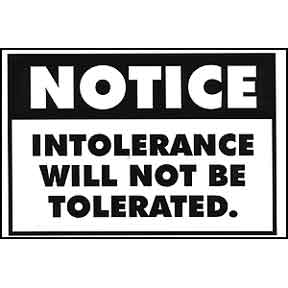
intolerance

Over the last few days I’ve had several experiences with people regarding the idea of Christian intolerance and -phobia. In case you didn’t know, the in-thing is to take whatever Christians are against and add -phobe or -phobia to the word, thus creating a new word that labels the Christian as a hater.

Do you disapprove of homosexual behavior?

You’re a homophobe.

Do you disagree with Muslim faith?

You’re an Islamophobe.

Apparently anything you stand against is now something you’re afraid of. Except the definition of phobia is now being broadened to include “dislike of a specified thing or group.”

That makes me:

– a greenbeanophobe (never liked ’em – never will)
– a V8ophobe (c’mon, drinking tomato juice?!?)
– a wasabiphobe (I thought it was something else when I put a whole spoonful in my mouth…)

and a whole host of other things I dislike. It’s misleading to attach -phobe to designate dislike of something. It is attempt to attach a negative and derogatory label without understanding anything about anyone’s position.

In terms of faith it often comes down to Christians being labeled “intolerant” and/or “bigot.”

But I’m not intolerant.

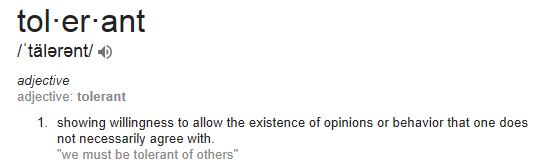
Tolerant

I have a willingness to allow the existence of other opinions and behavior I don’t agree with. I have never forced anyone to change to my way of thinking. So I guess I’m tolerant. Yay, me!

As for bigot, the all-knowing Wikipedia defines it as “someone who, as a result of their prejudices, treats or views other people with fear, distrust or hatred.”

But prejudice is “prejudgment, or forming an opinion before becoming aware of the relevant facts of a case.”

I have not pre-judged other faith groups or formed an opinion before becoming aware of relevant facts. As a Christian, I will go with Jesus when he says:

I am the way, the truth, and the life. No one comes to the Father except through me. (John 14:6)

Or Peter when he preached about Jesus:

There is salvation in no one else, for there is no other name under heaven given to people by which we must be saved. (Acts 4:12)

So I’m not prejudiced. My views about other faith groups are based on my understanding that Christianity is the only way to God. And if I’m not prejudiced then I’m not bigoted, for bigotry requires prejudice.

So here I am: a tolerant, unprejudiced, non-bigoted Christian.

But I’ll still tell you that Jesus is the only way and that, as much as we can, we need to conform our lives to the character of God and the kind of lives he calls us to lead as revealed in the Bible.

And that message won’t change, no matter what the Christianphobes say about it.

Hobby Lobby Hates Women

hobbylobby-birthcontrol

Well, it has certainly hit the fan.

No, I don’t think Hobby Lobby really hates women, but I have seen people on social media say that.

Within a day, the nation has drawn up lines and split in two (yet again) over the recent Hobby Lobby case before the Supreme Court.

One jokester even put it like this:

Conservative Xians: HOORAY, Hobby Lobby. HOORAY, Jesus!
Liberal Xians: #%!#@ Hobby Lobby. The world is doomed.

It certainly does seem to be how Christians are taking sides. Personally, I just don’t see the left’s side.

Some points to consider:

1. Hobby Lobby is not denying women access to contraceptives, they ask not to be forced to pay for particular contraceptives (and they do cover others).
2. If women want a particular product they are still allowed to go get it on their own.

A friend recently railed against employers dictating medical decisions to women.

Hobby Lobby

Some workplaces cover things like medical, dental, auto, etc. Other workplaces cover nothing. But we have the freedom to go find what we want if we’re willing to pay the price. No freedom is being restricted. No one is being told, “YOU CAN’T DO THAT!” There is not loss of liberty or freedom.

No religious belief is being imposed on anyone. People are still free to believe and act how they want. Being required to pay for your own decisions is not the same thing as having a religious belief imposed on you.

Coming from a biblical perspective, I’ve seen people say, “The Bible calls us to respect and submit to authority. Shouldn’t we just accept the healthcare law without saying anything about it?”

Biblically, no.

When the Apostle Paul wrote about submitting to authority he was writing to people who lived in a time and place who had only two options: submit or rebel. You couldn’t lawfully change the emperor’s mind. So Paul instructed Christians that rebellion is not the way of Jesus. But we don’t live in that kind of society. In a democratic republic we have the option of participating in forming laws and petitioning to change laws that shouldn’t exist.

Christians can work within the system to make (from our perspective) a positive change in society. There is nothing biblically wrong with that.

“But, Chris, isn’t that forcing our opinions on others?!”

All laws force opinions on others. The question is: who will have the winning opinion?

At the end of the day, I’d rather have laws that reflect a Christian worldview than laws that reflect an Atheist worldview.

The day will come (indeed, it is already fast approaching) when the Christian worldview is completely overturned. When that happens, and we no longer have legal recourse, then Paul’s admonitions once again apply: submit rather than rebel. Rebelliousness is not a quality of Christ.

Until then, there is nothing wrong with Christians using the legal system to protect our beliefs and values.

I know this is a hot topic for many people. I welcome all comments as long as you keep it civil and respectful. 🙂

Related Post:
Hobby Lobby and Taking a Stand for Faith

The Bible Stinks at Math

math-image

Well, not exactly stinks. It’s more the human side of the equation that bothers me.

The other day I saw some people debating this:

1611 is the year the King James Version of the Bible was produced. This nifty mathematical formula has randomly taken the year, split it up and multiplied it together to create a fictitious link to Psalm 119.

While not stated, the implication is that the 1611 King James Version is the true Word of God and all other Bibles are frauds.

This kind of math seriously aggravates me. There is nothing logical about it. I might as well say something like:

1611 KJV. 1+6+1+1=9. Genesis 9 is all about God making a covenant never protect and never destroy all humanity again.

It’s bogus. It’s assigning meaning to random numbers. There is nothing biblical about it. I’ve seen quite a few people talk about Bible codes and secret messages and meanings in the Bible. If you count every seventh letter (in the original Hebrew, of course) in the Book of ______ you’ll see a secret message from God…

Barf.

Here’s the thing – the Bible is special enough without secret codes and hidden meanings. The Bible is difficult enough without secret codes and meanings. Rather than making up bogus connections based on wonky math, let’s work on reading, interpreting, and applying the Bible to our daily lives.

How about that, huh? Let’s start there.

So next time you see someone posting about numbers in the Bible and making random connections, politely point out that such “interpretation” is full of…garbage.

This is me getting off my soapbox…

Related Posts:
The Bible Does Not Mean That! – Episode 1
The Bible Does Not Mean That! – Episode 2
The Bible Does Not Mean That! – Episode 3

The Bible Does NOT Mean That! – Episode 3

horrified-face

Here we are with Episode 3 in my series called “The Bible Does NOT Mean That!” The goal is not to tell you definitively what the Bible does or does not say. The goal is to talk about how we can look at the Bible with intentionality and understanding. Since it is God’s revelation to humanity it’s not supposed to be filled with secrets locked away to all but the elite. It’s designed to guide us ALL!

The problem is that many of us are simply never taught how to read it.

So today we’re talking about hermeneutics (her-men-oo-tics): the branch of knowledge that deals with interpretation. It can be used with interpreting anything, really, but is often used when we talk about interpreting the Bible.

The other day I published a post about Feminist Theology and how it damages the text of Scripture. While there is a spectrum of thought within Feminist Theology, most of the thinkers within the movement tend to move away from affirming the authority of the Bible.

Long story short, I upset some people who thought I was marginalizing feminists. One went so far as to tell me:

There isn’t a singular interpretation of any religious text. It’s a 2000 year old comic book in my eyes. To say one reading is holy and another reading is “destroying the bible” is the most ridiculous, selfish, onerous thing [you] can say.

But here’s the thing. There is only one meaning to a text. Fee and Stuart say, “The Bible can not mean now what it never meant then.” That means that the author’s original intent is the foundational guideline for understanding any given text.

“What does this mean to me?” is not a valid method of interpreting a text. How I respond as a reader is not as important as what the author was trying to say. The author’s meaning is what we need to be looking for. In that sense, then, there is only one meaning to any text.

There are, however, multiple applications to a text. Era, culture, technology, and other elements all play a role in how a text is applied to our lives today, but the original meaning never changes.

In that regard, theologies that attempt to skew the original meaning of the text, whether they be feminist, liberation, systematic, whatever…all damage the text when they set aside the original intent in order to pursue their own agendas.

So the next time you read the Bible, the first question need to ask is, “What was God trying to say when this was first written?” Only then can you follow it up with, “How can I work to apply this to my life?”

Related Posts:
The Bible Does Not Mean That! – Episode 1
The Bible Does Not Mean That! – Episode 2

How to Destroy the Bible: Reading Through Feminist Eyes

feminism

One of the enduring fights among the faithful is the “proper” role of women within Christianity. People really get heated when they talk about it. I have made no secret how I feel about women in ministry. You can get a pretty good understanding of my view in my post, “Skirts in the Pulpit.”

But even though I support women in ministry, I cannot get behind feminist theology that views every single biblical story as a story of oppression and abuse.

Case in point: a Twitter account popped up not too long ago that seeks to tell the story of every woman in the Bible through a feminist lens. I like the concept of telling the stories of people whose voices are not always heard. The problem is that the feminist lens falsely colors the stories and the new interpretation does damage to the text of Scripture which, in all honesty, is actually a sacred text that contains a high regard for women.

I have never written a blog post about a specific Twitterer before but I guess there’s a first time for everything, so let’s look at a few of these feminist renderings of biblical women with a few comments. Then let me know what YOU think.

This one interests me. Hannah, Samuel’s mother, was praying desperately for a child. When the priest, Eli, saw her lips moving but couldn’t hear her voice, he thought she was intoxicated (see 1 Samuel 1:9-18). So the feminist lens judges Eli as being misogynistic.

I take issue with this for two reasons:

1) Eli isn’t concerned about her gender, only about her appearing intoxicated before God. Once Hannah explains the situation Eli replies, “Go in peace, and may the God of Israel grant the petition you’ve requested from Him.” Yup – he’s a real woman-hater. 😐
2) When Jesus’ disciples were filled with the Holy Spirit in Acts 2, some who overheard sneered and accused them of being drunk. Peter has to stand up and say, “We’re not drunk. It’s only 9 a.m.!” In both stories gender isn’t the issue. The issue is the appearance of drunkenness.

The feminist re-interpretation damages the text.

How about:

This tweet assumes that there is something wrong with these women being remembered as the mother/grandmother of Timothy, as if they are being slighted for not having a more fully-developed story.

The problem is that there are many names in the Bible – men and women – who are only given a brief mention. How about Simon the Cyrene? How many Christians actually know who he is without looking him up? He’s the man who carried the cross of Jesus but he only gets one sentence. Just because the Bible doesn’t give pages and pages to a biblical character does not mean that the character is ignored or slighted. The feminist reading is creating a false dilemma.

The feminist re-interpretation damages the text.

Okay, just one more, because the tweets are starting to get my blood boiling…

In the ancient world, carrying on the family line was of extreme importance. When Sarai couldn’t give Abram children, Hagar (an Egyptian slave) was taken to be a surrogate mother in order to provide offspring. Later on, Hagar and her child were removed from the family and sent into the wilderness. It is a tragic story, to be sure.

The problem is that it’s not misogynistic violence against women. From beginning to end, Sarai is the one who mistreated Hagar. It was Sarai’s idea to use Hagar as a surrogate. It was Sarai who asked to remove Hagar and Ishmael. The feminist reading doesn’t admit that it is a WOMAN who is mistreating Hagar. It plays fast and loose with the text, ignoring certain elements in order to make the case for the Bible promoting female oppression.

The feminist re-interpretation damages the text.

The Bible illustrates many women who are terrific people of faith: Deborah, Jael, Huldah, Anna, Mary, Junia, Philip’s daughters…and on and on. So why go to the trouble to make up these problems? It’s about promoting a non-biblical agenda rather than reading Scripture honestly.

Don’t make up stuff in the Bible just because you have an axe to grind.

Um…You Want Me to Drink That?!?

surprise

So recently I stumbled across this video. The basic premise is this: some dude took soda and boiled out all of the water.

What you have left is some nasty looking black tar that is supposed to be sugar and whatever chemicals don’t boil out.

Wow… o_O

It reminded me of part of Jesus’ Sermon on the Mount where he’s talking about the difference between authentic believers and hypocrites:

Be careful not to practice your righteousness in front of people, to be seen by them. Otherwise, you will have no reward from your Father in heaven. So whenever you give to the poor, don’t sound a trumpet before you, as the hypocrites do in the synagogues and on the streets, to be applauded by people. I assure you: They’ve got their reward! But when you give to the poor, don’t let your left hand know what your right hand is doing, so that your giving may be in secret. And your Father who sees in secret will reward you.

And then…

Whenever you pray, you must not be like the hypocrites, because they love to pray standing in the synagogues and on the street corners to be seen by people. I assure you: They’ve got their reward! But when you pray, go into your private room, shut your door, and pray to your Father who is in secret. And your Father who sees in secret will reward you. When you pray, don’t babble like the idolaters, since they imagine they’ll be heard for their many words. Don’t be like them, because your Father knows the things you need before you ask Him.

And then…

Whenever you fast, don’t be sad-faced like the hypocrites. For they make their faces unattractive so their fasting is obvious to people. I assure you: They’ve got their reward! But when you fast, put oil on your head, and wash your face, 18 so that you don’t show your fasting to people but to your Father who is in secret. And your Father who sees in secret will reward you.

And again…

Don’t collect for yourselves treasures] on earth, where moth and rust destroy and where thieves break in and steal. 20 But collect for yourselves treasures in heaven, where neither moth nor rust destroys, and where thieves don’t break in and steal.

Do you get the sense of what Jesus is saying? He’s saying don’t appear sweet and tasty on the surface but be nasty black tar when you’re boiled down. The follower of Jesus is supposed to be genuine – what you see on the outside is supposed to mirror what’s on the inside.

We’re good at covering up the nasty stuff – aren’t we? Boil us down and you’ll find many of us are covered in the black tar.

But we don’t have to be. We can strive to be genuine and authentic people. It’s not about putting on a show for others to see. It’s about REALLY being God’s woman; God’s man.

So get rid of the sugary sweet fake exterior that covers the gross. Let Jesus really work on getting rid of the nasty, and then be that person all the time.

How Christians Should Respond to the Pending Alien Invasion

Alien

On the MSN homepage today the scrolling headline banner had a piece called, “Is there any proof that aliens exist?”

Now, if you didn’t know, I’m a Sci-Fi nut.

I have seen all of the Star Wars and Star Trek movies. At one time in my life I even had a replica of the NCC-1701D. If you don’t know immediately what that is, shame on you…but it looked like this:

NCC 1701D

I also owned the Star Trek trivia board games (TOS & TNG).

I have on DVD the every season of The X-Files.

I’m a nerd. I can embrace it. There are many like me. Needless to say, I was intrigued by the headline I saw on MSN. So I clicked the link and was taken to this video:

I was disappointed. Shame on you, MSN, for your cheap stunt. There was no real news there!

But it got me thinking about aliens and humanity and faith. Could there be alien life “out there”? Sure, why not?

I don’t see it as an issue that conflicts with faith.

The Bible talks about God creating humanity. It never rules out that God could have created other forms of life. The point of the biblical story is for us to know that we have purpose – we are not randomly occurring life forms. The highest being designed and created us to be in relationship with Him and to be in relationship with each other. That’s a pretty cool reason for existing.

One of my favorite Ray Bradbury short stories is called “The Man.” It’s from a collection of stories called “The Illustrated Man.” Seriously, download it now (and read it later).

Anyway, this rocketship lands on an alien world and the Captain expects people to come rushing out. He’s angered when the people just don’t care. You see, the ship landed at an inopportune time. The alien town has been visited by a nameless man who heals the sick, comforts the poor, and fights hypocrisy and corruption.

Personally, I don’t think that there is any intelligent life “out there” (go ahead and insert your jokes about intelligent life on earth)…. But IF there were, God would still be God – the creator of all things, the designer of worlds. Our purpose for existing would not change.

So relax. Have some fun. Enjoy Sci-Fi.

He’s got the whole world in His hands – even the aliens. 🙂

My son, beware of anything beyond these. Of making many books there is no end, and much study is a weariness of the flesh. The end of the matter; all has been heard. Fear God and keep his commandments, for this is the whole duty of man. (Ecclesiastes 12:12-13)

I Won’t Do That – That’s the Pastor’s Job

pastor

The other day I noticed some folks I know playing a game they called Pastor’s Job. In a nutshell, they were coming up with things people expect of the pastor that they themselves wouldn’t do.

While these people were trying to be funny and witty, there is truth in what they were saying. Many times we seem to place the major responsibility of ministry on the pastor. The truth is that we’re all called to be ministers. Peter writes:

You are a chosen race, a royal priesthood, a holy nation, a people for His possession, so that you may proclaim the praises of the One who called you out of darkness into His marvelous light. (1 Peter 2:9)

We have a calling to be a part of the priesthood of believers, that we may proclaim the praises of God!

While the pastor may be the lead shepherd of a local church, each and every member has a part to play in ministry.

Sometimes we stop and say, “Well…I can’t do anything.” You’d be surprised. It takes a lot for ministry to function. There is always something for you to do. And if you have a gift, a talent, or a calling that is not yet part of your church’s ministry, maybe God is telling you that it’s time to start one. Yes, you!

There should be no benchwarmers in the Church. We are all called to play a part.

14 For the body does not consist of one member but of many. 15 If the foot should say, “Because I am not a hand, I do not belong to the body,” that would not make it any less a part of the body. 16 And if the ear should say, “Because I am not an eye, I do not belong to the body,” that would not make it any less a part of the body. 17 If the whole body were an eye, where would be the sense of hearing? If the whole body were an ear, where would be the sense of smell? 18 But as it is, God arranged the members in the body, each one of them, as he chose. 19 If all were a single member, where would the body be? 20 As it is, there are many parts, yet one body.

21 The eye cannot say to the hand, “I have no need of you,” nor again the head to the feet, “I have no need of you.” 22 On the contrary, the parts of the body that seem to be weaker are indispensable, 23 and on those parts of the body that we think less honorable we bestow the greater honor, and our unpresentable parts are treated with greater modesty, 24 which our more presentable parts do not require. But God has so composed the body, giving greater honor to the part that lacked it, 25 that there may be no division in the body, but that the members may have the same care for one another. 26 If one member suffers, all suffer together; if one member is honored, all rejoice together. 27 Now you are the body of Christ and individually members of it. (1 Corinthians 12)

Time to get in the game!

Shut up! Stop talking about me!!!

shut-up-fool

Sometimes a story really gets under my skin. In the last couple days I’ve come across three separate news stories about powerful men seeking to silence critics.

The first story that caught my eye was about Dave Ramsey.

The second story was about Mars Hill and Pastor Mark Driscoll.

The third story was about Peoria mayor Jim Ardis.

Powerful people have a way of silencing critics. It is tragic when people use power, influence, and wealth to mute those who raise valid concerns and criticisms. This is nothing new, but that doesn’t make it any less tragic…

Or wrong.

I can’t speak to Jim Ardis, I know very little about him, but I do know a bit about Mark Driscoll and Dave Ramsey. Both are Christian men, leaders of their community. Yet the way they are handling things goes against a biblical view of leadership.

But Jesus called them to him and said, “You know that the rulers of the Gentiles lord it over them, and their great ones exercise authority over them. It shall not be so among you. But whoever would be great among you must be your servant, and whoever would be first among you must be your slave, even as the Son of Man came not to be served but to serve, and to give his life as a ransom for many.” (Matthew 20:25-28)

The idea that a leader would try forcibly to silence critics and maintain an iron grip on all under him doesn’t seem to fit the general direction Jesus is trying to take his disciples.

I understand that there are always two sides to every story. I understand that a news article may not give the whole picture. I hope and pray that these situations are not as bad as they appear to be. My concern is that they are just as bad, if not worse.

Everyone who does anything is going to receive criticism. Shoot, I get criticized for things I haven’t even done! (ask me about the latest rumor sometime and we’ll laugh together – or cry?)… And, while we cannot control what others say, we can control how we respond.

These men have responded poorly.

As Christians we can do better. We NEED to do better.